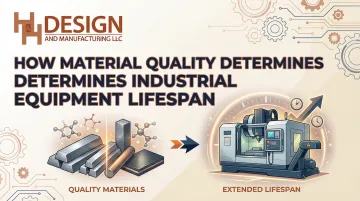
Introduction: Why the Material Your Equipment Is Made Of Matters More Than You Think
Plant managers know the frustration: equipment fails ahead of schedule despite following every maintenance protocol. The culprit often isn't the maintenance program—it's the materials the equipment was built with from day one.
Material quality sets the ceiling on equipment lifespan. No amount of downstream maintenance can fully compensate for substandard material choices. A machine built with inferior steel grades or inappropriate alloys will degrade faster, fail more frequently, and cost far more over its operational life — regardless of how diligently it's maintained.
This guide covers what procurement teams and plant managers need to know:
- How material properties directly limit equipment lifespan
- Which specific characteristics matter most in industrial environments
- How substandard materials drive premature failure
- The true lifecycle cost of cutting corners on material quality
- What to evaluate before making a purchase decision
Key Takeaways
- Material quality determines how equipment handles stress, corrosion, heat, and abrasion throughout its operational life
- Poor materials accelerate wear, increase breakdowns, and shorten lifespan regardless of maintenance quality
- Critical properties: tensile strength, corrosion resistance, hardness, temperature tolerance, and regulatory compliance
- Premium materials cost more upfront but consistently deliver lower total lifecycle costs through fewer failures and longer service intervals
- Always request material certifications, grade documentation, and specifications matched to your operating environment
Why Material Quality Is the Foundation of Industrial Equipment Lifespan
Equipment lifespan is largely determined before the machine ever enters service—when the manufacturer selects construction materials. Maintenance extends lifespan within material-defined bounds but cannot exceed them.
Materials define how machines respond to operational stress. Under continuous load, thermal cycling, vibration, and exposure to moisture, chemicals, or abrasive particles, materials either maintain structural integrity or begin degrading. Degradation rate directly correlates to material grade and application suitability.
High-grade vs. low-grade material behavior:
- High-grade steel maintains dimensional tolerances and surface hardness over time
- Substandard alloys deform, pit, or develop micro-fractures that propagate under load
- Premium materials resist environmental attack (oxidation, chemical corrosion)
- Inferior materials show accelerated surface degradation and structural weakening
Early-stage material degradation compounds over time. Microscopic surface wear or initial corrosion in year one can trigger exponential failure acceleration by year three, making total lifespan far shorter than design specifications intended.
Industry-Specific Material Demands
Not all operating environments stress materials equally. Sectors like dairy, food, chemicals, mining, and agriculture push equipment harder than most — combining multiple degradation forces simultaneously:
- Moisture and humidity accelerate oxidation and corrosion of exposed surfaces
- Abrasive bulk materials cause continuous wear on contact points and internal surfaces
- Temperature variation induces thermal fatigue in welds, fasteners, and structural components
- Hygiene requirements (particularly in food and dairy) demand specific material grades and surface finishes to prevent contamination
For H&H Design Manufacturing, which has built dry bulk weighing and packaging equipment for these sectors since 2008, material selection directly affects regulatory compliance and product safety — not just how long a machine runs.
Key Material Properties That Determine Equipment Durability
Tensile Strength and Structural Integrity
Tensile strength measures a material's ability to resist being pulled apart under load. In equipment handling heavy dry bulk materials—conveyors, filling machines, hoppers—structural materials must maintain load-bearing capacity over years of cyclic stress.
Common structural steel grades:
- ASTM A36: Standard for general construction with tensile strength of 400-550 MPa (58,000-79,800 psi) and minimum yield strength of 250 MPa (36,000 psi)
- ASTM A572: High-strength low-alloy (HSLA) steel available in grades 42-65, with tensile strength ranging from 415-550 MPa depending on grade
- ASTM A514: Extreme-strength quenched and tempered alloy steel with tensile strength of 760-895 MPa for critical structural applications
Corrosion Resistance
Oxidation and chemical corrosion attack metal surfaces, reducing wall thickness, weakening welds, and eventually causing component failure. Material selection directly affects corrosion resistance.
Material comparison for corrosive environments:
| Material | Corrosion Resistance | Best Applications |
|---|---|---|
| Mild/Carbon Steel | Poor in wet conditions | Dry, non-corrosive environments only |
| 304 Stainless Steel | Good general resistance | Food processing, light chemical exposure |
| 316 Stainless Steel | Excellent chloride resistance | Dairy, brine, harsh sanitizers, chemical handling |
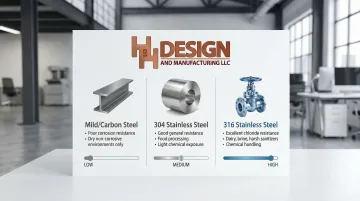
The difference between 304 and 316 stainless is critical. 316 stainless contains 2-3% molybdenum, which improves resistance to pitting and crevice corrosion in chloride environments. For food, dairy, and chemical applications, 316 is typically the minimum acceptable specification.
Corrosion costs the U.S. food processing sector approximately $2.1 billion annually—a cost largely driven by under-specified materials in wet and chemical environments.
Hardness and Abrasion Resistance
In dry bulk handling—especially mining and agriculture where abrasive particles flow continuously over surfaces—surface hardness directly determines wear rate.
Hardox 450 serves as an industry benchmark for wear-resistant plate in abrasive applications. With nominal hardness of 450 HBW (Brinell Hardness), it provides superior dent and abrasion resistance compared to standard structural steels. Typical yield strength reaches 1,250 MPa while maintaining good bendability and weldability.
Wear liners in high-abrasion zones should be selected based on material handled:
- AR plate (300-500 HB) for general abrasion
- Alumina ceramic tiles (9.0 Mohs hardness) for extreme abrasion
- UHMWPE for sliding abrasion applications
Temperature Tolerance
Thermal cycling causes expansion and contraction that weakens joints, fatigues metals, and degrades seals—making thermal ratings a critical spec for any environment with temperature swings.
Critical considerations:
- Dissimilar metals with different Coefficients of Thermal Expansion (CTE) create stress concentrations at weld joints
- Elastomer seals must be rated for maximum process temperatures and cleaning cycles
- CIP and SIP operations in food processing drive aggressive thermal cycling—seal and gasket material ratings must account for both process heat and sanitizer chemistry
Regulatory Compliance and Material Certification
The material properties above—corrosion resistance, hardness, thermal tolerance—align closely with regulatory requirements in food, dairy, and pharmaceutical applications. Here, material selection is both a compliance obligation and a durability one.
Key standards:
- FDA 21 CFR 110.40: Mandates food-contact surfaces be corrosion-resistant, nontoxic, and designed to withstand cleaning compounds
- 3-A Sanitary Standards: Requires surface roughness average (Ra) less than 32 µin (0.8 µm) and specific stainless steel grades
Equipment built to these standards is more durable—compliant materials are held to higher grade specifications by definition. H&H Design Manufacturing offers equipment with 3-A Dairy construction certification, ensuring both regulatory compliance and superior material durability.
How Poor Material Choices Lead to Premature Equipment Failure
Accelerated Wear and Micro-Fatigue
Substandard materials reach wear thresholds far faster than specification-grade materials. Lower hardness ratings and inferior alloy composition allow surface micro-cracks, abrasive material loss, and tolerance drift.
In precision equipment like weigh fillers and packaging machines, even small dimensional changes from wear cause measurement inaccuracies and sealing failures. Equipment that should maintain ±0.1 pound accuracy begins drifting to ±0.5 pounds or worse.
Corrosion-Induced Structural Failure
Corrosion progression follows a predictable path:
- Surface oxidation - Initial rust formation
- Pitting corrosion - Localized holes penetrate protective oxide layer
- Crevice corrosion - Accelerated attack in joints and welds
- Through-wall perforation - Complete structural failure
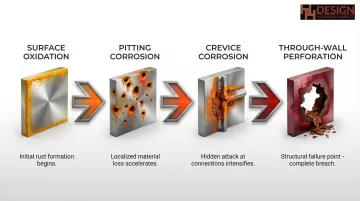
Corrosion damage often hides inside joints or beneath surfaces, making it difficult to detect until failure is imminent. Pitting is considered more dangerous than uniform corrosion because it leads to catastrophic failure with little visible warning.
Weld and Joint Failure from Incompatible Materials
Using mismatched material grades in fabrication creates failure points. Welding dissimilar metals or using filler materials incompatible with base metal grade creates:
- Galvanic corrosion hot spots where electrochemically dissimilar metals contact in the presence of moisture
- Brittle heat-affected zones (HAZ) that crack under stress
- CTE mismatch stress at dissimilar metal joints
These weak points are typically the first to fail under operational stress — and seals and gaskets are rarely far behind.
Seal and Gasket Degradation
In equipment handling chemicals, food products, or high-moisture environments, seals and gaskets made from wrong elastomer or polymer compounds degrade rapidly. This leads to leaks, contamination risk, and component damage.
Premature seal failure means unplanned downtime, emergency repairs, and in food and chemical applications, potential regulatory violations and product recalls. Those costs consistently outweigh whatever was saved on lower-grade materials.
The True Cost of Low-Quality Materials Over an Equipment's Lifetime
Purchase price represents a fraction of total cost of ownership (TCO). Maintenance and operational costs can exceed initial purchase price by 2 to 5 times over a 10-year horizon.
Hidden Cost Multipliers
Poor material quality creates compounding expenses:
- More frequent maintenance intervals
- Higher parts consumption
- Shorter mean time between failures (MTBF)
- Unplanned production stoppages
- Earlier-than-expected full equipment replacement
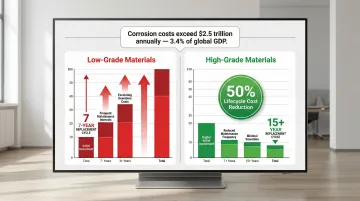
A machine requiring replacement in 7 years instead of 15 effectively doubles capital expense.
The Material Quality Premium
The upfront cost difference between standard and high-grade materials is modest as a percentage of total equipment cost. However, lifecycle savings from lower maintenance costs, less downtime, and extended replacement cycles are disproportionately large.
A lifecycle cost comparison for walkways in corrosive environments demonstrated that 3CR12 stainless steel showed a 50% reduction in lifecycle costs over 30 years compared to painted mild steel, despite higher upfront costs. Eliminating repetitive repainting cycles drove most of that savings.
That pattern holds at scale. Global corrosion costs exceed US$2.5 trillion annually — 3.4% of global GDP — meaning material degradation is a financial liability that shows up in every industry's maintenance budget, not just outlier cases.
What to Look for When Evaluating Equipment Material Quality
Ask for Material Specifications Upfront
Request documentation of specific steel grades, alloy specifications, and surface finishes—not just brand names. Any manufacturer worth considering should provide:
- Mill Test Reports (MTRs) verifying heat numbers, chemical composition, and mechanical properties
- ASTM/AISI grade documentation for structural components
- Surface finish certifications (Ra measurements for food-grade equipment)
- Compliance documentation (FDA, NSF, 3-A standards)
Match Materials to Your Operating Environment
General-purpose equipment built to standard specifications may not suit your specific conditions. Facilities with demanding conditions need materials rated for them, including:
- Abrasive processing environments requiring hardened wear surfaces
- High-humidity or washdown areas needing corrosion-resistant alloys
- Food and chemical handling where FDA, NSF, or 3-A compliance governs material selection
This is where custom-built equipment has a real advantage. Manufacturers like H&H Design Manufacturing, who oversee quality through every stage of design, manufacturing, and commissioning, can specify materials matched to your exact environment rather than fitting your operation to a fixed material configuration.
Evaluate Weld Quality and Fabrication Standards
Material grade alone is insufficient if fabrication quality is poor. Look for evidence of:
- Proper weld procedures (WPS documentation)
- Qualified welders (welder certification records)
- Appropriate filler metal selection
- Heat treatment practices where required
- Quality control checkpoints throughout manufacturing
Certifications like UL certification for control panels indicate a manufacturer's broader commitment to build quality and standards compliance. H&H Design Manufacturing holds a Certified UL Industrial Control Panel Shop designation for both the US and Canada — a certification that requires documented processes, qualified personnel, and third-party verification across the manufacturing operation.
Frequently Asked Questions
What material is most commonly used in industrial equipment manufacturing?
Carbon steel and stainless steel (grades 304 and 316) are most common. Material selection depends on application—stainless is preferred for food, dairy, and chemical environments due to corrosion resistance, while structural carbon steel is used in non-corrosive, high-load applications.
How does corrosion affect industrial equipment lifespan?
Corrosion progressively reduces wall thickness and structural integrity, weakens welds and joints, and can cause sudden failure in critical components. Damage is often hidden from visual inspection until it becomes severe, making proper material grade selection the most effective prevention strategy.
Does material quality matter more than maintenance for equipment lifespan?
Material quality defines the ceiling for lifespan—maintenance optimizes performance within that range but cannot compensate for substandard materials. Both matter, but material selection at the build stage has the more fundamental long-term impact on durability.
What material properties should I prioritize for dry bulk handling equipment?
Prioritize abrasion resistance (hardness ratings), corrosion resistance (appropriate stainless grade for moisture/chemical exposure), and structural tensile strength. For equipment handling consumable products, food-grade compliance is mandatory regardless of other properties.
How can I verify that an equipment manufacturer uses quality materials?
Request material certifications (mill certs) and specific ASTM/AISI grade documentation. Look for manufacturers with third-party certifications or documented quality control processes governing fabrication—not just final inspection—and who provide this documentation without hesitation.
What is the lifecycle cost impact of choosing lower-quality materials in industrial equipment?
Lower-quality materials increase total cost of ownership through higher maintenance frequency, shorter equipment lifespan, unplanned downtime, and earlier replacement cycles. These costs consistently outweigh initial savings on lower-grade materials—often by a substantial margin over the equipment's working life.