Key Takeaways
- Bulk bag unloader systems transfer dry ingredients from 500–2,000 kg bulk bags into food processing lines, cutting manual handling injuries and reducing dosing errors
- Food applications demand 304/316 stainless steel construction, dust containment, and compliance with FDA, FSMA, and cGMP standards
- Key selection factors include sanitary design quality, material flow behavior, loading configuration, and integration with downstream equipment
- Top manufacturers include H&H Design and Manufacturing, Spiroflow (Akona), AZO Inc., Flexicon Corporation, and Erie Technical Systems
- For tight spaces or strict hygiene requirements, custom-engineered systems consistently outperform off-the-shelf options
Introduction
Food manufacturers handling thousands of tons of dry ingredients annually—flour, sugar, dairy powders, starches, spices—depend on bulk bag unloader systems to keep production lines moving without contamination, spillage, or regulatory risk. Also called FIBC (Flexible Intermediate Bulk Container) dischargers, these systems have largely replaced labor-intensive manual bag dumping, which accounts for over half a million musculoskeletal disorders reported annually in the US.
Choosing the wrong unloader for a food environment creates real consequences: food safety exposure, compliance gaps, and costly downtime. Under the Food Safety Modernization Act (FSMA), specifically 21 CFR Part 117, equipment must be adequately cleanable and designed to prevent allergen cross-contact.
The right system has to meet several requirements at once:
- Handles material behavior (flow, bridging, aeration) without manual intervention
- Meets 3-A sanitary standards and supports clean-in-place procedures
- Manages combustible dust risks with proper grounding and containment
- Integrates cleanly with downstream conveyors, feeders, and processing equipment
This guide breaks down the key system types, their tradeoffs, and what actually matters when specifying a bulk bag unloader for food production.
Overview of Bulk Bag Unloader Systems in the Food Industry
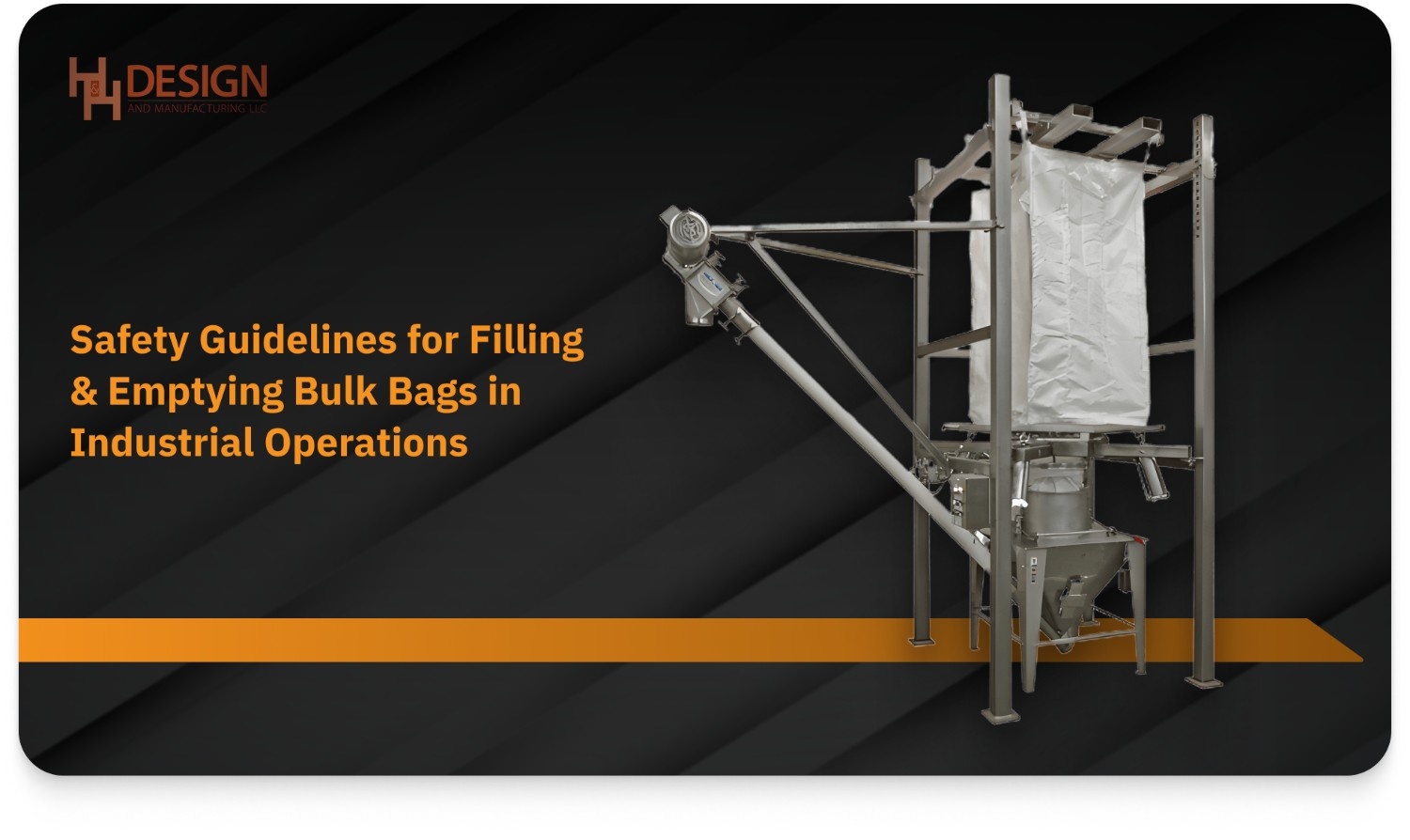
Bulk bag unloaders (FIBC dischargers) are specialized equipment designed to support, open, and discharge 500–2,000 kg bulk bags of dry ingredients into downstream processes. These systems replace labor-intensive manual bag handling in food plants, where workers previously cut open 25–50 lb bags and dumped contents manually—a practice that contributed to significant injury rates and batch inconsistencies of ±1-2 pounds per batch.
Food Industry's Unique Requirements
Unlike general industrial use, food-grade unloaders carry strict construction and sanitation demands. Core construction requirements include:
- Material: 304 or 316 stainless steel on all product-contact surfaces
- Surface finish: Smooth weld profiles with a 32 µin (0.8 µm) Ra finish
- Sanitation: Clean-in-place (CIP) systems or manual washdown capability
- Compliance: 3-A compliant designs for dairy; general food-grade for other applications
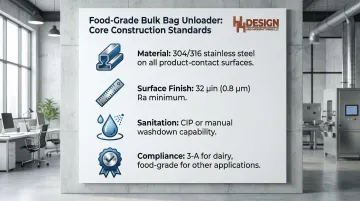
The gap between dairy-standard (3-A compliant) and general food-grade builds is especially important for facilities handling allergens or switching between ingredients. FSMA regulations mandate equipment that prevents allergen cross-contact and protects ingredients from contamination throughout handling.
Those same contamination concerns extend to airborne hazards. Fine food powders like flour, confectioners' sugar, and dairy powder create both worker safety hazards and product contamination risks. The new NFPA 660 standard (effective December 2024) consolidates previous combustible dust standards and governs these hazards, while NIOSH identifies flour dust exposure as a cause of baker's asthma with exposure limits frequently exceeded in manual operations.
Market Growth Signals Industry Shift
The bulk bag unloader market is projected to expand from $1.7 billion in 2025 to $2.7 billion by 2035 at a CAGR of 4.9%. Food manufacturers are investing in automation to cut manual handling injuries, tighten batch accuracy, and keep pace with tightening food safety regulations. Automated bulk handling systems cut peak compressive spinal load by 39% compared to manual lifting—while also reducing ingredient waste and improving batch consistency.
Top Bulk Bag Unloader Systems for Food Applications
Selection criteria for this comparison are evaluated through the lens of food manufacturing requirements:
- Sanitary design quality and material compatibility
- Loading flexibility for different facility layouts
- Dust containment and allergen management capability
- Depth of customization for non-standard applications
H&H Design and Manufacturing
Founded in 2008 and based in Parsons, Kansas, H&H Design and Manufacturing is a family-owned manufacturer with deep roots in dry bulk material handling for food, dairy, agriculture, and chemical industries. The company designs and manufactures custom bulk bag unloaders with in-house engineering and holds UL Industrial Control Panel Shop certification for both US and Canadian installations.
H&H engineers fully custom unloader configurations tailored to a food plant's exact layout, ceiling height, and material characteristics—including sticky dairy powders or hygroscopic ingredients. Where larger manufacturers require standard footprints, H&H can accommodate non-standard geometries while meeting tight project timelines.
Their 3-A Dairy construction certifications and end-to-end design control—from engineering through commissioning—make them a strong fit for food facilities with unique space or compliance constraints.
| Feature Category | H&H Design Capabilities |
|---|---|
| Sanitary/Food-Grade Design | Custom stainless steel construction; 3-A Dairy certified configurations; in-house design control from engineering through commissioning |
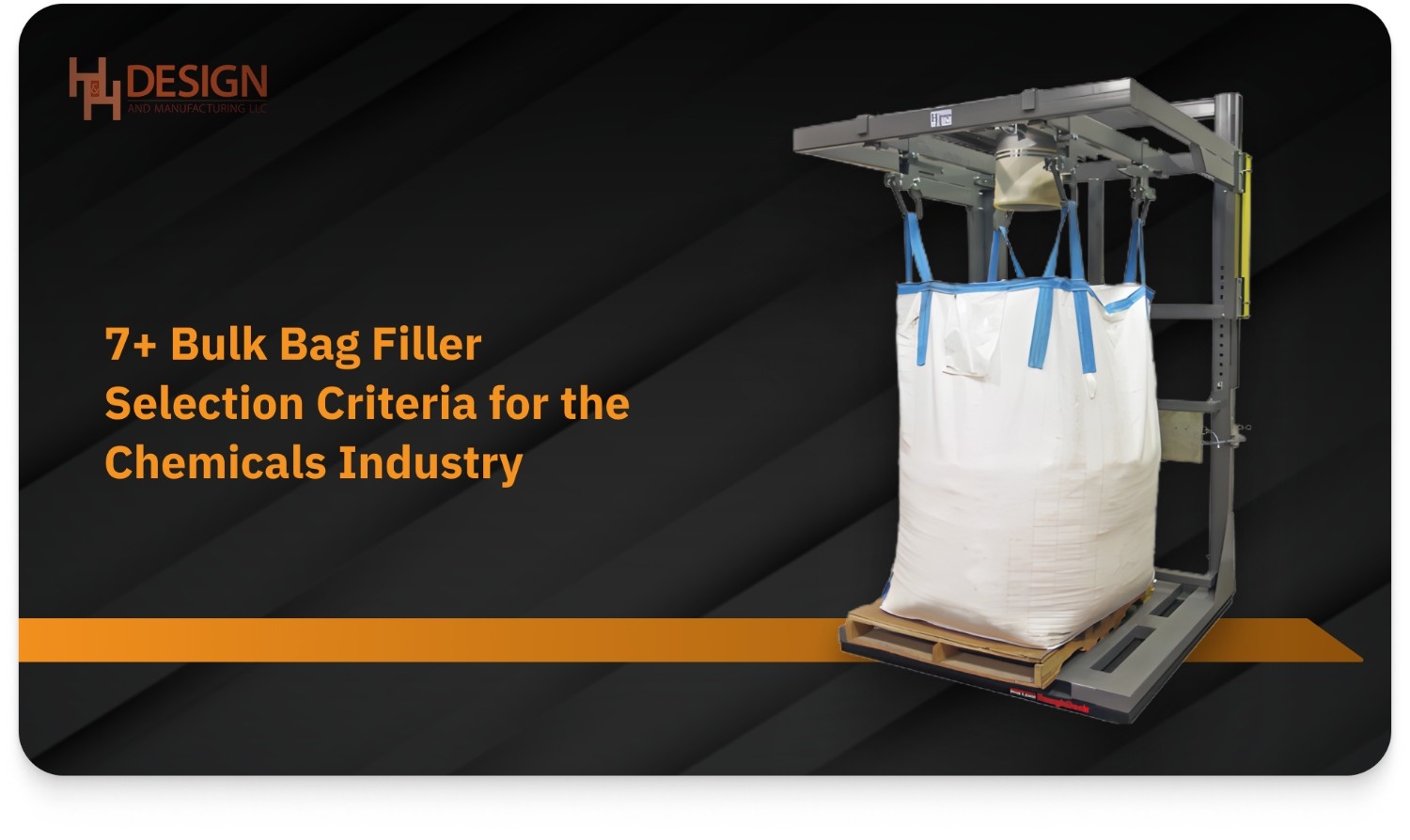
| Loading Configuration | Forklift-loaded and hoist/trolley configurations; custom frame geometry for low-headroom or space-constrained facilities |
| Certifications/Compliance | UL Industrial Control Panel Shop (US & Canada); 3-A Dairy construction; serves food, dairy, and agriculture sectors |
Spiroflow (Akona Process Solutions)
Now operating under the Akona Process Solutions brand, Spiroflow brings over 45 years of bulk material handling experience from their North Carolina (US) and Darwen (UK) facilities. The company offers one of the broadest product lines in the industry, including food-specific unloader variants like the T3 loss-in-weight model and T9-CV total containment unloader.
Spiroflow is particularly strong for food manufacturers needing precision dosing or allergen management. Loss-in-weight models enable accurate batch dispensing, while total containment units address cross-contamination in multi-allergen facilities. Test lab facilities in the US, UK, and Germany allow material trials before purchase.
| Feature Category | Spiroflow/Akona Capabilities |
|---|---|
| Sanitary/Food-Grade Design | Stainless steel contact surfaces; enclosed discharge chambers; T9-CV total containment model for allergen-sensitive environments |
| Loading Configuration | Simple frame (T1), hoist-equipped (T6), low-headroom (T5), and multi-container (T7) variants |
| Certifications/Compliance | Serves food, chemical, and pharmaceutical industries; material testing guarantees; global service network |
AZO Inc.
AZO Inc., based in Memphis, Tennessee, is the US arm of German manufacturer AZO GmbH. The company specializes in complete automated bulk material handling systems for food, snack, bakery, dairy, confectionery, and chemical industries, applying German-engineered precision with modular stock programs enabling fast delivery.
AZO's systems-integration approach designs bulk bag unloaders as part of end-to-end ingredient handling systems—including automated refilling, batching, and loss-in-weight feeding. This suits high-volume food plants managing multiple ingredients simultaneously across a single automated line. Product and worker safety are core design priorities, with dust-tight enclosures and ATEX compliance for combustible dust environments.
| Feature Category | AZO Capabilities |
|---|---|
| Sanitary/Food-Grade Design | German-engineered food-grade construction; designed around product integrity and worker safety; dust-tight enclosures |
| Loading Configuration | Modular stock units with rapid delivery; custom system configurations for high-volume ingredient handling |
| Certifications/Compliance | Serves food, snack, bakery, dairy, and pharmaceutical sectors; German engineering standards; ATEX compliance available |
Flexicon Corporation
Based in Bethlehem, Pennsylvania, Flexicon offers a broad catalog of sanitary bulk bag discharger models specifically engineered for food, dairy, and pharmaceutical applications. The company is known for proprietary technologies including FLOW-FLEXER® bag activators and SPOUT-LOCK® clamp rings that help completely empty sticky or cohesive food ingredients.
Flexicon's stainless steel models include electro-polished contact surfaces, CIP provisions, and sanitary welds. Their bag-activating technology directly addresses incomplete discharge of hygroscopic or bridging materials—sugar, milk powder, starch—cutting material waste (often 0.75% or more) and reducing changeover time.
The TELE-TUBE® telescoping tube provides dust-tight connections between the bag spout and receiving equipment.
| Feature Category | Flexicon Capabilities |
|---|---|
| Sanitary/Food-Grade Design | Electro-polished stainless steel contact surfaces; CIP-compatible designs; FLOW-FLEXER® bag activation for hygroscopic ingredients |
| Loading Configuration | Forklift and integral hoist configurations; multiple frame heights and hopper options |
| Certifications/Compliance | Food, dairy, and pharmaceutical focus; 3-A sanitary standards-compatible designs for dairy applications |
Erie Technical Systems
Erie Technical Systems, based in Erie, Pennsylvania, offers the UltiMAX® bulk bag unloader line with customizable configurations for food-grade and enclosed discharge applications. The company also supplies integrated vibratory feeders and flexible screw conveyors for complete unloading-to-process systems.
Erie offers short lead times on custom-engineered units with full in-house integration capability. Food manufacturers can source the bag unloader, surge hopper, feeder, and dust collection from a single vendor—cutting integration complexity and project coordination time. Enclosed designs handle food-grade or dust-sensitive materials, with paddle flexors available for difficult ingredients.
| Feature Category | Erie Technical Capabilities |
|---|---|
| Sanitary/Food-Grade Design | Enclosed discharge chambers; sealed bag spout clamping; dust collection ports; food-grade and hazardous material designs |
| Loading Configuration | Forklift-loaded and hoist/trolley configurations; customizable to facility dimensions and discharge height |
| Certifications/Compliance | Custom-engineered for food and industrial applications; integrated material handling systems from single source |
Key Features to Prioritize in Food-Grade Bulk Bag Unloader Systems
Sanitary Construction and Cleanability
Food-grade unloaders must use 304 or 316 stainless steel for all product-contact surfaces, avoid horizontal ledges where powder can accumulate, and support either CIP systems or manual washdown. The 3-A Sanitary Standards specify AISI 300-series stainless steel (excluding 301 and 302) with a minimum 32 µin (0.8 µm) Ra surface finish, free of pits, folds, and crevices.
Dairy-standard (3-A compliant) designs require smoothly bonded seams and internal angles with a minimum 1/4 inch radius to facilitate cleaning. For dry ingredient applications, a 2B mill finish may be acceptable where liquids won't contact the product — but facilities handling allergens or switching between ingredients should specify the higher standard to prevent cross-contact.
Equipment must also be self-draining and accessible for cleaning and inspection, requirements codified in FSMA's preventive controls (21 CFR Part 117).
Dust Containment and Contamination Control
Fine food powders create both worker safety hazards and product contamination risks if not fully contained. NIOSH recommends exposure limits of 4 mg/m³ for grain dust, yet manual dumping operations frequently exceed these limits. The NFPA 660 standard requires facilities to conduct a Dust Hazard Analysis (DHA) and implement safeguards, as food powders like flour and sugar are classified as combustible dusts.
Passive vs. active containment:
- Passive systems use rubber skirts and bag spout clamps to minimize dust escape
- Active systems incorporate dust extraction ports, enclosed discharge chambers, and integrated dust collectors
Food plants typically need active containment for FSMA compliance and to prevent foreign material contamination — a leading cause of FDA food recalls. Sealed bulk bag unloaders with dust-tight untie boxes and telescoping tubes (like Flexicon's TELE-TUBE®) prevent airborne contaminants from settling on open ingredients while protecting workers from respiratory hazards.
Flow-Aid Technology for Challenging Food Materials
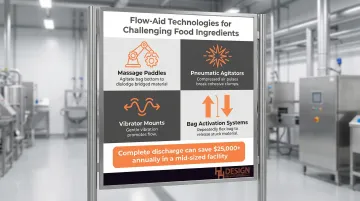
Many food ingredients — hygroscopic powders, cohesive dairy proteins, lumpy brown sugar — will bridge or rathole in the bag outlet without mechanical assistance. Available flow aids include:
- Massage paddles that mechanically agitate the bag bottom
- Pneumatic bag agitators using compressed air pulses
- Vibrator mounts for gentle material promotion
- FLOW-FLEXER-style activators that repeatedly inflate and deflate the bag
Matching the right flow aid to the specific ingredient prevents incomplete discharge and material waste. A 0.75% reduction in ingredient waste can save $25,000 annually for a mid-sized facility, while complete bag discharge eliminates the labor cost of manually emptying residual material.
Integration with Downstream Food Processing Equipment
Bulk bag unloaders in food plants rarely operate in isolation. They must feed screw conveyors, vibratory feeders, rotary valves, or pneumatic conveying lines at controlled rates. Specify the discharge outlet size, spout connection, and feeder interface in tandem with the unloader to ensure metered, contamination-free material transfer.
Key integration points to specify upfront:
- Loss-in-weight feeders for precision batching (±0.1% accuracy vs. ±1-2 lb manual variance)
- Rotary valves for pneumatic conveying systems
- Vibratory feeders for controlled flow to mixers
- Flexible screw conveyors for gentle handling of fragile ingredients
Working with a single-source provider reduces the coordination burden and ensures compatible interfaces between the unloader and every downstream component.
Customization for Facility Constraints
Many food plants face low headroom, limited floor space, or the need to fit unloaders into existing lines. The ability to engineer a custom frame height, discharge angle, or loading configuration is often the deciding factor between systems.
H&H Design Manufacturing's in-house engineering team handles non-standard configurations — angled discharge frames for tight spaces, custom-height structures for low-ceiling facilities — while maintaining 3-A Dairy sanitary standards. As a family-owned manufacturer with the flexibility to meet tight deadlines, H&H is well-suited for food facilities that can't conform to standard equipment footprints.
How We Chose the Best Bulk Bag Unloader Systems
Evaluation Framework
Manufacturers were assessed on sanitary design quality (material of construction, weld finish, cleanability), food industry experience (dairy, bakery, snack, ingredient handling), loading configuration range, dust containment capability, customization depth, and certification credentials.
Common buyer mistakes include:
- Prioritizing purchase price over hygienic design compliance
- Selecting a general-purpose unit without verifying food-grade material compatibility
- Failing to specify dust containment adequate for combustible dust regulations
- Overlooking integration requirements with downstream equipment
Due Diligence Requirements
Buyer due diligence should cover three areas:
- Request material test results or reference contacts from active food plant installations
- Confirm relevant certifications (UL, 3-A, NSF, cGMP alignment) before shortlisting vendors
- Verify local service support — unplanned downtime in food production can cost thousands per hour in lost output and product spoilage
Once you've cleared these checks, the next question is whether the investment makes financial sense.
Total Cost of Ownership Over Sticker Price
For most food facilities, three factors justify the price difference between a standard and a food-grade bulk bag unloader within the first one to two production years:
- Labor savings from eliminating manual bag handling
- Material recovery from more complete bag discharge
- Contamination risk reduction and the regulatory costs that come with it
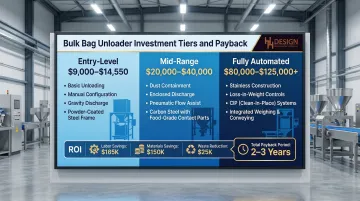
Documented ROI example: One food manufacturer achieved a 2.35-year return on an $800,000 automation investment through:
- $165,000 in annual labor savings (reduced manual handling hours)
- $150,000 in annual material savings (15% discount on bulk vs. bag formats)
- $25,000 in annual waste reduction (0.75% spillage prevention)
While basic bulk bag unloaders can start around $9,000-$14,550, automated food-grade systems typically range from $80,000 to over $125,000. Key cost drivers include sanitary finishes, dust containment features, and automation controls—but the upfront investment prevents long-term costs associated with contamination recalls, worker injuries, and cleaning downtime.
Conclusion
Selecting a bulk bag unloader for food applications carries direct consequences for product safety, regulatory compliance, and operational efficiency. The right system must align with your plant's specific ingredients, hygiene standards, and facility layout.
It also needs to satisfy FSMA preventive controls, 3-A sanitary standards, and NFPA combustible dust regulations — requirements that vary by ingredient type and production environment.
When evaluating manufacturers, look beyond catalog specs. Key factors include:
- Proven experience with food-grade builds and sanitary design
- Willingness to engineer custom configurations for your layout
- UL-certified control panel construction for electrical safety compliance
- Post-installation support and service availability
H&H Design and Manufacturing brings all of these to food industry projects, backed by their UL Industrial Control Panel Shop certification and a design team with hands-on experience in dry bulk food applications.
Ready to discuss a bulk bag unloader built around your food production requirements? Contact H&H Design and Manufacturing at (620) 421-9800 or sales@hhdesignmfg.com to speak with their engineering team about your application, facility constraints, and integration needs.
Frequently Asked Questions
Frequently Asked Questions
What is a bulk bag unloader system and how is it used in food manufacturing?
Bulk bag unloaders (FIBC dischargers) support and discharge 500–2,000 kg bags of dry food ingredients into processing lines, replacing manual bag handling. They improve safety by eliminating manual lifting (a leading cause of MSDs), increase batch accuracy from ±1-2 lb to ±0.1%, and boost throughput in food plants.
What food-grade certifications should a bulk bag unloader have?
Look for FDA food contact compliance (21 CFR Parts 174, 177, 178), NSF certification, cGMP/FSMA alignment, and UL-listed control panels. Dairy applications also require 3-A sanitary standards (304/316 stainless, 32 µin Ra finish); allergen-handling lines may carry additional requirements.
What is the difference between a forklift-loaded and a hoist-loaded bulk bag unloader?
Forklift-loaded units require external forklift access for bag positioning and are suited for low-headroom facilities or plants with existing forklift fleets. Hoist/trolley units include an integral lifting mechanism (electric or pneumatic) for safer, more controlled bag positioning without external equipment. Choice depends on facility layout, ceiling height, and available material handling equipment.
How do bulk bag unloaders handle sticky or hygroscopic food ingredients like sugar or dairy powder?
Flow aids prevent bridging and channeling in cohesive materials. Common options include massage paddles, pneumatic agitators, vibrator mounts, and bag activation systems that repeatedly inflate/deflate the bag bottom. Selecting the right aid ensures complete discharge, reducing material waste by 0.75% or more.
What features are most important for sanitary bulk bag unloader design in a food plant?
Prioritize 304/316 stainless on product-contact surfaces, smooth welds (32 µin Ra finish), no horizontal ledges, CIP/washdown compatibility, and enclosed dust-tight discharge with sealed spout clamping. Dairy lines require full 3-A sanitary standards compliance.
How much does a food-grade bulk bag unloader system typically cost?
Entry-level systems run $9,000–$14,550; mid-range dust-containment units cost $20,000–$40,000; fully automated sanitary systems with stainless construction and loss-in-weight controls reach $80,000–$125,000+. When factoring in documented labor, material, and waste savings, premium systems typically pay back within 2–3 years.