Introduction: Why FIBC Filling, Discharge, and Loop Design Matters
FIBC bulk bags move dry bulk materials across food, dairy, chemical, mining, and agricultural industries — but the wrong filling top, discharge bottom, or loop configuration creates real operational problems. Companies lose product when material hangs up in flat-bottomed bags designed for fine powders. Loops fail under loads exceeding their Safe Working Load (SWL). Spout-top bags paired with open-top fill heads cause dust leakage and weight inaccuracy. Discharge designs that don't match material flow slow production and waste material.
The stakes are high. The global FIBC market, valued at $5.64 billion in 2024, is projected to reach $9.69 billion by 2033, driven by demand in food (32% market share) and chemicals (39.88% market share). OSHA records document fatalities from FIBC failures — including a 2017 incident where a worker was crushed when a damaged bag exceeded its 2,500 lb SWL. Every one of those incidents traces back to a specification error that was entirely avoidable.
This guide covers three critical decisions: how material gets in (filling/top options), how it gets out (discharge/bottom options), and how the bag gets lifted safely (loop configurations). The right combination depends on material type, facility automation level, and industry requirements.
Quick Reference Summary:
- Spout tops suit powders and automated systems, offering dust control and precise fill targeting
- Conical bottoms prevent material hang-up in food/pharma applications, ensuring complete product recovery
- 4-loop configurations are the standard for forklift operations, distributing load evenly across the bag
- Mismatched discharge designs cause product waste, dust exposure, and avoidable safety risks
- Never exceed loop SWL — a 5:1 safety factor minimum is required across the industry
FIBC Filling Options: Choosing the Right Bag Top
The top design determines dust containment, fill speed, and whether the bag integrates with automated filling equipment. Material characteristics—particle size, moisture content, free-flow behavior—and production volume should drive this choice.
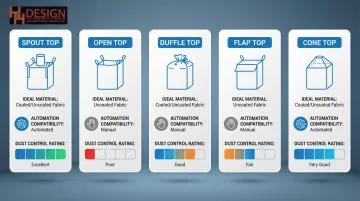
Spout Top (Fill Spout)
The spout top is the most common filling option: a narrow cylindrical inlet (typically 140-180 mm diameter) that connects directly to a fill head on automated or semi-automated filling stations. This design creates a sealed connection that minimizes dust escape during filling operations.
Key advantages:
- Dust-tight control through sealed fill head connection
- Accurate weight targeting via coarse-to-fine feed systems
- Ideal for powders, fine granules, and food-grade products requiring contamination prevention
- Automated systems achieve throughputs 3-4 times faster than manual methods
Spout tops work particularly well with inflatable fill heads — the preferred choice for flour, cement, and chemical powders where any airborne release creates compliance or safety issues.
Open Top and Duffle Top
Open top bags feature a fully open top with no closure mechanism, while duffle top bags include fabric that extends outward with a drawstring closure. Both designs prioritize speed over precision.
Best applications:
- Quick, high-volume filling of coarse, irregular, or large-particle materials
- Mining aggregates, construction materials, landscaping products
- Operations where dust control is less critical
Neither design integrates with automated fill heads, so expect manual or semi-automated setups — and plan for dust management in the surrounding environment.
Tie-Down Flap Top
The flap top design features a fabric flap that folds over and ties shut after filling. This configuration optimizes rapid manual filling when a secure closure is needed post-fill, making it suitable for mid-volume operations where speed matters more than precision.
Cone Top
Cone top designs suit light, fluffy, or low-density materials—flour, plastic pellets, certain agricultural products—that tend to pile unevenly. The cone shape guides material into the bag evenly, reducing voids and improving load stability during transport and storage.
FIBC Top Selection Guide:
| Top Type | Ideal Material | Automation Compatibility | Dust Control |
|---|---|---|---|
| Spout Top | Fine powders, granules, food ingredients | Fully automated/semi-automated | Excellent |
| Open Top | Coarse aggregates, construction materials | Manual only | Poor |
| Duffle Top | Large particles, irregular materials | Manual/semi-automated | Fair |
| Flap Top | Mixed materials, mid-volume operations | Manual/semi-automated | Fair |
| Cone Top | Low-density, fluffy materials | Manual/semi-automated | Good |
FIBC Discharge Options: Controlling How Materials Exit
Discharge design is the most consequential FIBC specification. It determines discharge speed, flow control precision, material waste, dust exposure, and contamination risk. Choosing the wrong discharge option for a material type leads to hang-up, spillage, or inability to fully empty the bag.
Spout Bottom (Discharge Spout)
The discharge spout is the most widely used option: a fabric tube at the bottom that can be tied, clamped, or fitted with a valve for controlled, metered discharge. Iris or star closures provide the highest level of control, allowing operators to regulate flow rate and tie off the bag if flow needs to stop.
Optimal for:
- Powders, fine chemicals, grains, pharmaceutical ingredients
- Applications where dust control matters—OSHA limits respirable dust to 5 mg/m³ for 8-hour exposure
- Situations requiring precise flow rate control
- Materials where complete product recovery is essential
Conical Bottom
Conical-bottomed FIBCs use a cone-shaped base that funnels all material toward the discharge point, eliminating "dead corners" where material hangs up and cannot be recovered. The geometry ensures gravity naturally moves material to the outlet, reducing the need for manual agitation during discharge.
Optimal for:
- Food ingredients and pharmaceutical powders requiring complete product recovery
- Fine chemical materials where contamination prevention is non-negotiable
- Applications where any residual material left in the bag represents measurable cost or compliance risk
Full Open Bottom (Full Bottom Discharge)
Full-open or duffle bottom discharge is designed for rapid, complete discharge in one motion—the entire base opens at once. This suits coarse, dense, or clumpy materials (gravel, certain agricultural products, waste materials) where flow control is less critical and speed is the priority.
Tradeoff: No flow control capability. The entire load discharges simultaneously, so structural containment and positioning controls must be in place before the base is opened.
Plain / Flat Bottom
The plain bottom is a sealed base with no discharge mechanism—the bag must be cut open or tipped to discharge. This is appropriate only for single-use, one-way applications where cost is the primary driver. However, this design lacks reusability and presents sustainability drawbacks, making it unsuitable for most industrial operations.
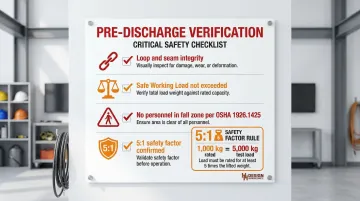
Critical Safety Reminder:
Before any discharge operation, verify the following:
- Loop and seam integrity are confirmed before lifting
- The bag has not exceeded its Safe Working Load (SWL)
- No personnel are within the fall zone of the suspended load (per OSHA 1926.1425)
- FIBC loops meet the minimum 5:1 safety factor over SWL — a bag rated for 1,000 kg must withstand a 5,000 kg test load without failure
Lifting Loop Configurations for Safe FIBC Handling
Lifting loops are the structural foundation of every FIBC lift cycle. Incorrect loop design for available lifting equipment—or using damaged loops—is a leading cause of FIBC-related workplace injuries. Loop selection must account for the lifting equipment used (forklift, crane, spreader bar), the bag's filled weight, and the number of lift cycles expected.
Three primary loop configurations cover the majority of industrial FIBC applications. Each suits different lifting equipment, load weights, and facility layouts.
4-Loop Configuration (Standard)
The 4-loop FIBC is the industry standard: four individual loops, one at each corner, designed to spread load evenly across the bag body when lifted by forklift or crane. Compatible with handling equipment across food, chemical, mining, and agricultural facilities, it's the default choice for most operations.
Key considerations:
- Loop length matters—longer loops for crane/spreader bar use, shorter for direct forklift tine engagement
- Tines must be spaced to keep loops vertical; improper spacing creates lateral forces that can tear loops
- Standard for bags ranging from 100 to 4,400 lbs capacity
2-Loop Configuration
2-loop bags and stevedore strap variants—where fork tines pass through a strap rather than individual loops—suit specific lifting scenarios. Two common variants:
- Single stevedore: Lower cost, suited for lighter loads
- Double stevedore: Greater load distribution for heavy bags where standard loops create instability
Tunnel Lift Design
The tunnel lift bag features a fabric sleeve (tunnel) sewn horizontally through the upper body of the bag, through which forklift tines or a spreader bar passes. This design is commonly used for very large or heavy bags where loop-based lifting creates instability, keeping the bag upright and stable even at high weights.
Pre-Lift Inspection Checklist
Before each lift, operators must check:
- Fraying: Inspect loops for fiber separation or wear
- Seam separation: Verify stitching integrity where loops attach to bag body
- UV degradation: Check for discoloration or brittleness from sun exposure
- Load rating markings: Confirm SWL rating is clearly visible and not exceeded
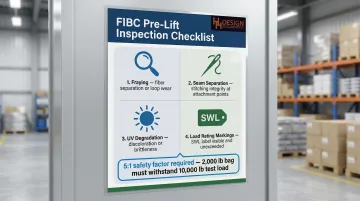
A bag should never be reused if loops show structural compromise. Industry standards require loops tested to a minimum 5:1 safety factor over SWL—meaning a 2,000 lb bag must withstand 10,000 lb test loads.
Matching Fill, Discharge, and Loop Combos to Your Industry
The most effective FIBC specification combines the right top, bottom, and loop design as a system. Industry context drives this combination.
Industry-Specific Configurations:
| Industry | Recommended Top | Recommended Discharge | Loop Config | Special Requirements |
|---|---|---|---|---|
| Food/Dairy | Spout top | Conical bottom | 4-loop | FDA 21 CFR 177.1520 (virgin PP) |
| Chemicals/Pharma | Spout top with dust-tight seal | Iris closure discharge | 4-loop | Type C/D anti-static if flammable |
| Mining/Aggregates | Open/duffle top | Full open or flat bottom | Stevedore or 4-loop | Heavy-duty construction |
| Agriculture (grain, seed) | Spout or duffle top | Discharge spout | 4-loop | Moisture barrier if needed |
| Plastics/Resins | Cone top | Discharge spout | 4-loop | Anti-static for low MIE materials |
Regulatory Overlays
Compliance requirements vary by industry and material. Key regulatory considerations include:
- Food/Dairy: FDA-compliant materials required — 21 CFR 177.1520 permits 100% virgin polypropylene
- Chemicals: Type C bags (grounded, resistance < 10⁸ ohms) or Type D (static dissipative, no grounding required) for flammable materials
- Hazardous materials: UN-certified bags with design type testing for drop, stack, tear, and topple resistance
Production Volume Considerations
Once compliance is confirmed, throughput requirements shape the final specification. Spout tops integrate directly with automated filling stations for high-volume operations, achieving throughputs of 20-30 containers per hour in premium systems. Open tops work for lower-volume manual operations but give up the speed and accuracy that automation provides. Match your fill rate targets to your downstream equipment before locking in the design.
How FIBC Bag Design Affects Your Filling Equipment Performance
The interface between the FIBC bag and filling equipment is where specification choices become operational outcomes. A spout top bag that doesn't match the fill head diameter creates dust leakage and weight inaccuracy. A bag without proper structural integrity during filling leads to unstable fills and off-spec weights.
Equipment-Bag Compatibility Factors
Critical alignment points:
- Matches fill head/spout diameter (standard automated heads use 140–180 mm) — mismatches cause dust escape and fill inefficiency
- Supports pre-inflation fans that remove folds and creases so product settles evenly
- Withstands vibration densification forces without tearing during compaction
- Works with direct mount load cell designs that achieve ±1 lb per 1,000 lbs accuracy with consistent product feed
Semi-automated and fully automated filling systems deliver the most consistent results — but only when bags are designed specifically for those systems. Selecting bag design and filling equipment in tandem, rather than independently, is what prevents costly production mismatches.
H&H Design and Manufacturing's Filling Solutions
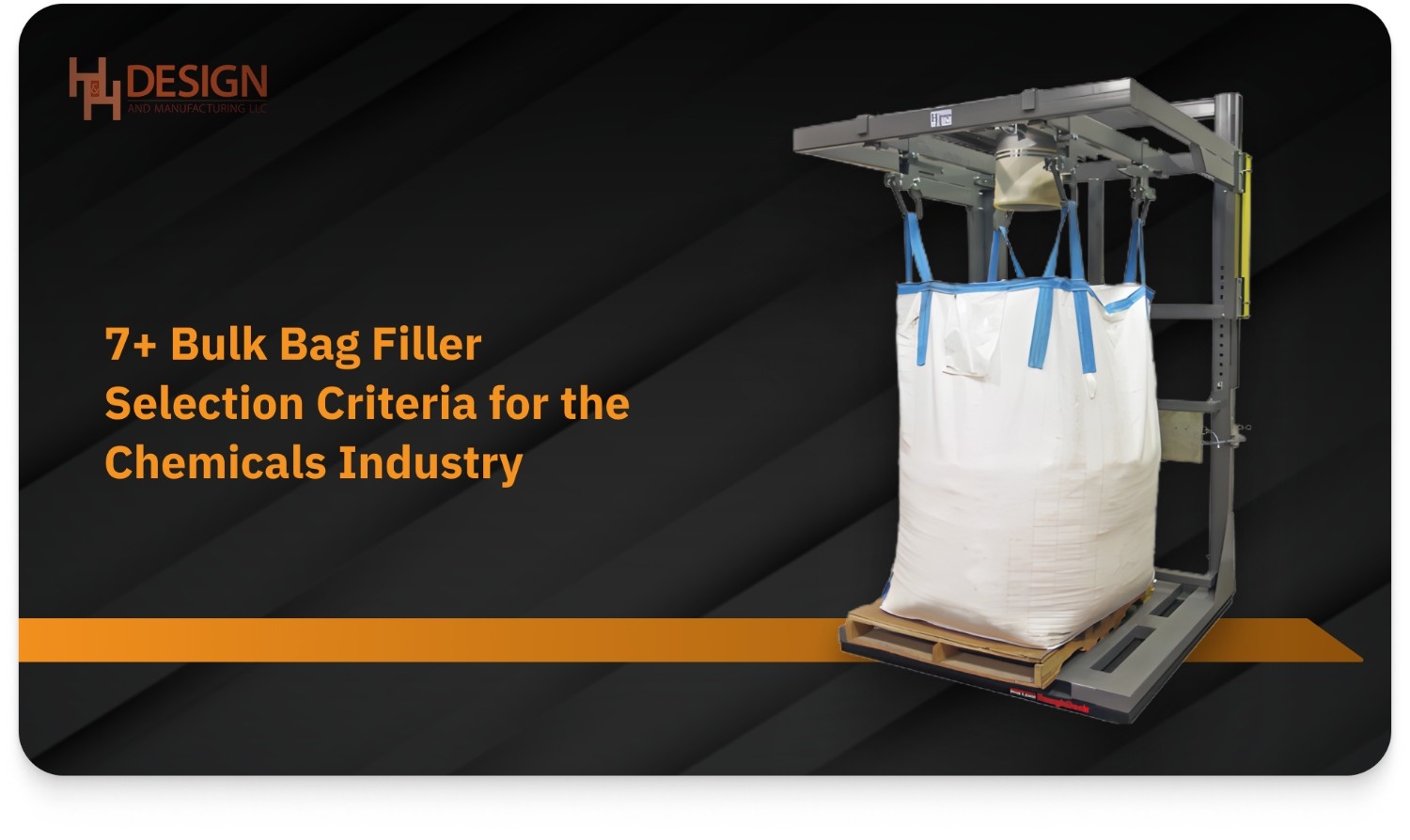
Since 2008, H&H Design and Manufacturing has built filling stations configured for specific FIBC bag top designs — spout, duffle, and open configurations — serving dry bulk material industries across food, dairy, chemical, mining, and agricultural applications.
Their equipment line covers three primary tiers:
- Series 110DS — 10–25 containers/hour, economy solution
- Series 330E — 20–30 containers/hour, heavy-duty premium system
- Series 2000 — top-tier automated solution for continuous-duty operations
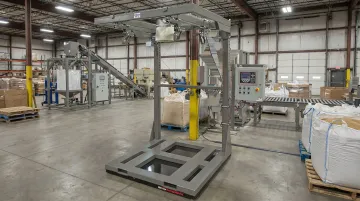
All systems feature:
- Pin and ladder adjustable frames accommodating multiple bag sizes
- Inflatable fill heads ensuring dust-tight filling for fine powdered products
- Direct mount load cell design for ultra-high weight repeatability
- NTEP Conformance Standards certification
H&H's custom engineering capabilities allow their team to match the right bag specification to your filling system — ensuring accurate weights, clean operation, and high throughput. When standard equipment can't accommodate unique FIBC specifications, they design from scratch.
For facilities upgrading or replacing filling equipment, H&H provides consultation to ensure FIBC bag design and filling system compatibility—preventing the costly mismatches that lead to production inefficiency.
Common Mistakes to Avoid When Selecting FIBC Fill and Discharge Options
Cost-Driven Discharge Selection
Choosing a discharge option based on cost alone — rather than material flow characteristics — is a specification mistake that compounds quickly. Using a flat bottom for fine powder leads to:
- Material waste from product trapped in corners
- Dust exposure exceeding OSHA's 5 mg/m³ respirable dust limit
- Inability to fully empty the bag, inflating per-unit product loss
Ignoring Automation Compatibility
Specifying an open-top bag when the facility uses automated fill heads designed for spout tops creates three immediate problems: dust leakage, weight inaccuracy, and production slowdowns. Automated systems are optimized for spout-top bags that seal tightly to the fill head; duffle and open tops generally require manual or semi-automated setups.
Under-Specifying Loop Strength
Selecting a 2-loop or light-duty configuration for bags that will be lifted repeatedly in high-cycle operations creates safety risks. Loops must be rated for the filled bag weight with a 5:1 safety factor minimum. Never gather multiple loops onto a single hook unless the bag is specifically designed for single-point lifting—this creates dangerous lateral stress that can tear loops.
Skipping Pre-Fill Inspection
Pre-fill inspection is the step most often skipped — and the one most likely to cause in-process failures. Establish a documented pre-fill inspection protocol checking:
- Loop integrity (fraying, UV damage, seam separation)
- Seam condition along all stress points
- Label accuracy confirming SWL rating
- Spout/closure condition before filling begins
Each inspection takes under two minutes and catches the defects responsible for most FIBC-related incidents before they reach the fill station.
Frequently Asked Questions
Frequently Asked Questions
What is the difference between a spout top and a duffle top FIBC?
A spout top features a narrow cylindrical inlet (140-180 mm diameter) for controlled, dust-contained filling and compatibility with automated fill heads. A duffle top is a wide, extendable opening suited to rapid manual filling of coarse materials with less dust control but faster fill times.
Which FIBC discharge option is best for fine powders or chemical materials?
Spout bottom with an iris (star) closure or a conical bottom design is best for fine powders and chemicals. These options minimize dust exposure, enable controlled flow rate, and reduce material waste — conical designs also prevent hang-up in corners for complete product recovery.
How many lifting loops does an FIBC bag need?
4-loop is the industry standard for most forklift and crane applications, offering even load distribution across the bag body. 2-loop and stevedore designs suit specific equipment configurations. Select your loop configuration based on lifting equipment type and filled bag weight — always verify against equipment specifications before committing.
What is the Safe Working Load (SWL) for FIBC lifting loops?
FIBC lifting loops are tested to a minimum 5:1 safety factor over SWL — a bag rated for 1,000 kg must withstand 5,000 kg test loads. Always verify the bag's SWL rating before filling and never exceed it.
Can FIBC bags with different top designs be used with the same automated filling equipment?
Automated filling systems are designed for spout top bags that seal tightly to the fill head; duffle and open top bags require manual or semi-automated setups. Mismatching bag design to equipment causes dust leakage, weight inaccuracy, and throughput losses of 50% or more.
How do I choose between a flat bottom and a discharge spout for my FIBC?
A flat/plain bottom is only appropriate for single-use applications where the bag will be cut or tipped to discharge. A discharge spout is recommended whenever controlled, repeatable, and cleaner material flow is needed—particularly for powders, granules, food ingredients, or chemicals where product recovery and dust control matter.