Bag filling equipment rarely fails without warning. It starts with inconsistent weights. A batch hits tolerance, then the next one misses. Dust escapes around the neck ring, and operators wipe surfaces again and again. Production slows. One hour later, bags per hour have dropped, and no one knows why.
Does your filler stall when the bag inflates? That moment of hesitation is not a mystery. It is a maintenance signal. Material that once flowed smoothly now hangs in the hopper. Product cakes in corners. Operators tap the chute or shake the bag to compensate.
These frustrations are not random. They are preventable. If you want direct bag filling equipment maintenance tips, this guide delivers them. You will learn how to control material flow, protect weighing accuracy, train operators, and extend service life.
Fast Insights for Busy Operators
Maintenance failures start upstream. If the product hangs, pulses, or forms dust at the fill head, you have a flow issue, not a scale issue.
Drift is never random. Residue, cable strain, or shock loads corrupt weigh data long before you see rejected bags.
A consistent feed rate is worth more than any calibration. Stable augers, proper venting, and controlled entry eliminate overshoot and top-offs.
Seals tell the truth. When the grip weakens, dust appears, or clamps slip, replacement cannot wait for a scheduled service window.
Documentation makes machines predictable. Logged events uncover humidity trends, abrasive wear, and operator behaviors that no inspection can catch.
What Makes Bag Filling Equipment Maintenance Critical
Ignoring small maintenance signals is what leads to full shutdowns. A minor drift in weighing systems results in rejected bags by the end of the shift. A bit of residue inside the hopper becomes full bridging during a 2,000 lb bag run. Worn seals start as light dust and end as product loss and contamination on the floor. Nothing fails suddenly. It fails gradually.
You see these symptoms on the line, not in manuals.
Bags weigh correctly at 7 AM, then fail tolerance by noon.
Material flows smoothly during first 100 fills, then begins pulsing and choking.
Operators tighten clamps harder because fill heads are no longer sealing cleanly.
Each behavior has a direct cause.
Weigh drift happens when contaminants settle on load cells or when cables are under tension. This changes readings by grams or pounds and creates rejected batches.
Bridging or caking happens when humidity changes a material's shape. Particles lock together, forming a dome that starves the feed.
Bad feed control happens when the auger wear dulls the edge profile. Flow becomes inconsistent, forcing the scale to chase a moving target.
You do not fix these problems by pushing for more production. Maintenance with calibrated reference weights, vibration-free mounting, and regular hopper cleaning keeps your line stable instead of forcing shutdowns under pressure.
Tip 1: Create a Maintenance Schedule Built Around Bag Filling Equipment Maintenance
Bag filling equipment does not suddenly fail. Wear accumulates in load cells, seals, auger edges, air regulators, and conveyor bearings. Reactive repairs happen only after the process breaks. A schedule prevents that chain reaction.
You build your schedule around the points of predictable degradation.
Daily checks should confirm:
Clean hopper interior and chute surfaces
Weigh cell readings within tolerance
No dust leakage around fill heads
Stable cycle times and bag inflation
Weekly checks should confirm:
Seal and gasket wear
Conveyor belt alignment
Auger tip erosion
Sensor cleanliness and free movement
Seasonal checks should address:
Changes in moisture content
Hopper liner integrity
Filter replacement and vent capacity
Abrasive or high-throughput plants benefit from hour-based maintenance, recorded per shift. Each line event should be logged and signed by operators. These signatures track accountability and reveal patterns that trend toward failures.
Tip 2: Maintain Product Flow Paths to Reduce Hopper Problems
Most breakdowns begin where the product enters your filler. Flow starvation, pulsed discharge, and uncontrolled surges do not originate at the scale. They originate in the hopper and the feed path. You correct the flow and the weighing becomes predictable again.
Prevent Bridging and Chute Blockage
Bridging forms when particles interlock or cling to surfaces. This produces a starving flow that the filler tries to compensate for by chasing a false weight target. Any manual tapping or shaking is proof of upstream failure.
Common causes include:
High humidity or hygroscopic powders forming clumps
Angular or flaky particles interlocking and locking the chute
Hopper angles that are too shallow
Worn or damaged liners that increase friction
You detect bridging through:
Delayed discharge at the beginning of each fill
Pulsed product flow that appears in short bursts
Clean hopper walls with material stuck at the center
You solve bridging by:
Installing mechanical agitation or vibratory assistance
Replacing worn liners with smooth, low-friction surfaces
Adjusting hopper geometry to match material flow properties
Preventive Cleaning for Bag Filling Equipment Maintenance
Residue inside hoppers, chutes, and fill heads changes how product releases. Buildup turns steady flow into irregular slugs. You prevent that by treating cleaning as a process, not a chore.
Maintenance intervals should follow your material:
Fine powders require surface cleaning each shift
Pelletized or granular product may require cleaning every two or three shifts
Safe cleaning tools matter.
Use soft brushes or dedicated non-scratch scrapers
Avoid metal or abrasive tools that score liners or damage hopper geometry
Dust and buildup are not cosmetic problems. They signal uncontrolled flow, unstable scale readings, and premature seal degradation. Reducing residue stabilizes your line and prevents operator workarounds.
Increase throughput and maintain weight accuracy with the Series 110DS. If your plant needs a bulk bag filler that adapts to multiple bag sizes and materials without slowing production, the 110DS is the right fit.
Tip 3: Inspect Weighing Systems to Minimize Drift
A scale never drifts by accident. Contamination adds weight to load cells and shifts readings. Shock loads from dropping bags hit the frame and distort internal sensors. Cable strain changes how the system interprets signals. Drift is mechanical, electrical, or environmental, and you correct each source directly.
Your inspection must focus on real wear patterns. Use this table as a guide:
Drift Source | Observable Symptom | Corrective Action |
Residue on weigh cell | Gradual weight increase | Clean surfaces with non-abrasive tools |
Shock load from bag drops | Random spikes | Install bag support or cushioning pads |
Cable tension or bent conduit | Weigh instability | Relieve strain and secure cables |
Moisture or humidity | Slow drift over shift | Store reference weights dry and recheck |
If operators repeatedly re-tare the scale, that is a drift warning. Cleaning, sensor alignment, and strain relief stabilize readings long before you lose tolerance.
Set Calibration Frequency and Verification Standards
Calibration is not a yearly ritual. You set it based on wear, throughput, and drift patterns. Reference weights provide a stable baseline, not an opinion. They show when the scale is lying.
Follow a structured process:
Keep one certified reference weight per filler
Test before a shift and after high-throughput runs
Record the reading and deviation every time
Acceptable drift is a defined threshold. A 2 lb deviation on a 2,000 lb bag is manageable. A 7 lb deviation means a failure trend is forming. Each calibration event should be logged with time, operator signature, and environmental notes such as humidity or temperature shifts.
Tip 4: Maintain Fill Heads, Seals, and Gaskets to Control Dust and Spillage
Fill heads take direct abuse. They clamp, inflate, release, and repeat for thousands of cycles. Seals grind against bag mouth fibers and pull away product dust. Gaskets absorb force during inflation. These parts wear faster than structural components and become a maintenance priority.
You identify seal problems visually and audibly. Look for:
Dust streaks down the fill head or bag neck
Bags slipping during inflation
Residue buildup around clamp points
Hanging material after fill completion
Seal material must match product characteristics. Use this table to choose correctly:
Product Type | Recommended Seal Material | Reason |
Abrasive powders | High-durometer rubber | Resists surface erosion |
Oily or fatty materials | Nitrile or EPDM | Maintains grip without swelling |
Hygroscopic powders | Silicone | Resists moisture absorption |
Replacement should be tied to bag count rather than calendar weeks. A line that fills 3,000 bags per day stresses components faster than one that fills 300. Operators should inspect seals at the start of each shift and replace them when grip or suction weakens. Spillage and dust are early failure signals, not cosmetic issues.
Achieve consistent fill rates and clean operation with the Series 52 OM. If you handle fine powders and want better dust control with a stable auger-driven feed, the 52 OM delivers reliability on every run.
Tip 5: Maintain Feeders, Augers, and Conveyors Linked to Bag Filling Equipment Maintenance
You do not get accurate weighing if the machine is fed inconsistently. Stable feed keeps the scale from constantly chasing peaks and drops. Augers, conveyors, and gates are the real regulators of flow, and when they degrade, every downstream sensor tries to correct errors you could have prevented upstream.
A feeder that delivers steady flow gives the scale a flat baseline to measure. When the flow pulses, the scale reacts late, overshoots, and then compensates. That cycle repeats across every shift and destroys consistency.
Maintain Feed Rate Stability
Surges make the filler overshoot the target weight. Starving the line makes it undershoot. Both problems show up as rejected bags or repeated top-off cycles.
Use mechanical and electronic controls to stabilize feed:
Tune your VFD to slow ramp-down when approaching target weights
Adjust gravity gates or rotary valves to smooth material entry
Add hopper venting to prevent pressure buildup that pushes product unpredictably
Consistent feed gives the weighing system a predictable pattern. Operators should not need to tap the hopper or delay cycles to compensate.
Inspect Mechanical Wear Points
Wear does not announce itself. Bearings run hotter. Belts stretch unevenly. Auger tips lose sharp edges and start pushing product in clumps. These are maintenance signals.
Focus on the components that carry physical stress:
Bearings and bushings that accumulate friction
Belts and pulleys that lose tension or alignment
Auger tips and threads that erode from abrasion
Couplings that loosen and introduce vibration
You identify failure trends through vibration, irregular noise, or heat at contact points. Replace parts before they affect throughput. Waiting until failure forces the filler to correct problems that should never reach the scale.
Tip 6: Maintain Air Systems and Venting
Air systems control how the bag mouth inflates, how dust is captured, and how product moves through the fill head. When airflow is unstable, clamps slip, powder escapes, and bag inflation stalls. The operator sees a mechanical issue, but the root cause is often restricted or unregulated air.
Your checks must verify airflow at each stage of the cycle:
Inspect vent filters for clogging or saturation
Confirm regulator PSI matches the bag material and product type
Check ducts and hoses for buildup or collapsed sections
Air restriction creates a chain of failures. Bags inflate unevenly. Dust escapes around the neck. Product falls into the bag in pulses instead of a clean stream. Stable airflow stabilizes the entire system and reduces operator intervention.
Tip 7: Protect Electrical and Sensor Integrity
Electrical failures often look mechanical. The scale shakes, feeds stall, or the inflation cycles become slow, and you assume something is jammed. In many cases the wiring, sensor feedback, or grounding is at fault. A loose connector produces the same symptoms as a worn auger or misaligned chute, and the line behaves unpredictably.
You prevent this by controlling how signals move from the equipment to the controller. Use this inspection checklist:
Clean photo eyes, weight sensors, and proximity switches so they send accurate signals
Relieve strain on cables at load cells and junction boxes to prevent false readings
Avoid pinch points created by conduit bends, trays, or panel doors
Confirm grounding of all modules to eliminate electrical noise
Vibration is a hidden threat. Continuous shaking shifts sensor alignment over time. A sensor that was calibrated yesterday can misread today simply because a bracket loosened. When operators complain that readings are “jumpy,” you inspect wiring before replacing mechanical parts.
Tip 8: Train Operators to Follow Practical Bag Filling Equipment Maintenance Rules
Most machines do not fail because they were built incorrectly. They fail because operators react to symptoms instead of reporting them. When your staff guesses at calibration values, increases clamp pressure, or slows cycle times to “fix” a problem, the filler breaks faster.
You give operators rules they can follow every shift. Focus on what they should spot early:
Dust plumes at the fill head
Random feed surges during fill cycles
Bags hanging or slipping after inflation
Unusual delays between clamp and discharge
Operators should never adjust:
Calibration values
VFD speed settings
Pressure regulator limits
Sensor sensitivity
These adjustments mask symptoms and create new failures. Teach your team to document issues, tag the station, and escalate to maintenance. A small note in the logbook protects the filler more than an improvised fix does.
Tip 9: Track Performance Metrics That Matter
Observations without measurement are guesses. You may notice that bags seem heavier in the afternoon or the filler feels slower after a hopper cleanout, but without data these are just impressions. Tracking turns behavior into evidence. It shows you when a pattern is beginning instead of when the failure already arrived.
The metrics you track should reflect how the system behaves:
Cycle time variance to monitor how long each bag takes to fill
Reject rate to track accuracy and seal performance
Weigh drift to monitor load cell stability
Stoppage frequency to identify upstream flow issues
Analyze performance monthly. A 2 percent drift over four weeks is a warning that no one sees when they stare at daily numbers. Long-term trends show wear, humidity effects, and operator habits far more clearly than short-term snapshots.
Move more product per shift with the Series 330E. If your operation needs a bulk bag filler built for high throughput and automated handling, the 330E keeps production moving without bottlenecks.
Tip 10: Use Quality Replacement Parts and Consumables
Cheap parts do not save money. A low-cost seal loses grip faster, dust escapes, and the filler runs with half the stability. Generic sensors lag or misread, forcing operators to compensate until the system collapses.
You protect uptime with parts that match the material you run:
OEM seals and gaskets maintain correct elasticity and grip
Industry-rated filters and regulators maintain airflow consistency
Certified sensors provide stable readings for weigh systems
Material compatibility matters:
Abrasive powders destroy soft rubber quickly
Hygroscopic powders swell and crack standard seals
Food-grade applications require approved materials to avoid contamination
Tip 11: Document Everything: Logs, Repairs, and Operator Notes
Problems repeat because no one remembers when they started. A drift in July often looks identical to a drift in September, but without records you treat them as unrelated events. Documentation makes maintenance predictable.
Your records should capture every event:
Maintenance book entries for all repairs
Digital logs with timestamps and operator signatures
Service notes that record conditions such as humidity, bag type, or material batch
Patterns appear only when entries accumulate:
Moisture increases during monsoon months
Seals wear faster on night shifts
Fillers drift after abrasive product runs
You do not wait for a failure to teach you the lesson twice. Logs prevent you from solving the same problem all year.
H&H Design & Manufacturing: Maintenance Support You Can Count On
At H&H Design & Manufacturing, we focus on engineering and maintaining dry bulk weighing and packaging systems. When you call us, you speak with people who build and service the equipment every day. We understand how powders, pellets, and granular materials behave inside a filler, not just on a spec sheet. If your machine is bridging, drifting, or leaking dust, we approach it from material flow physics, not guesswork.
We control the full lifecycle of our systems.
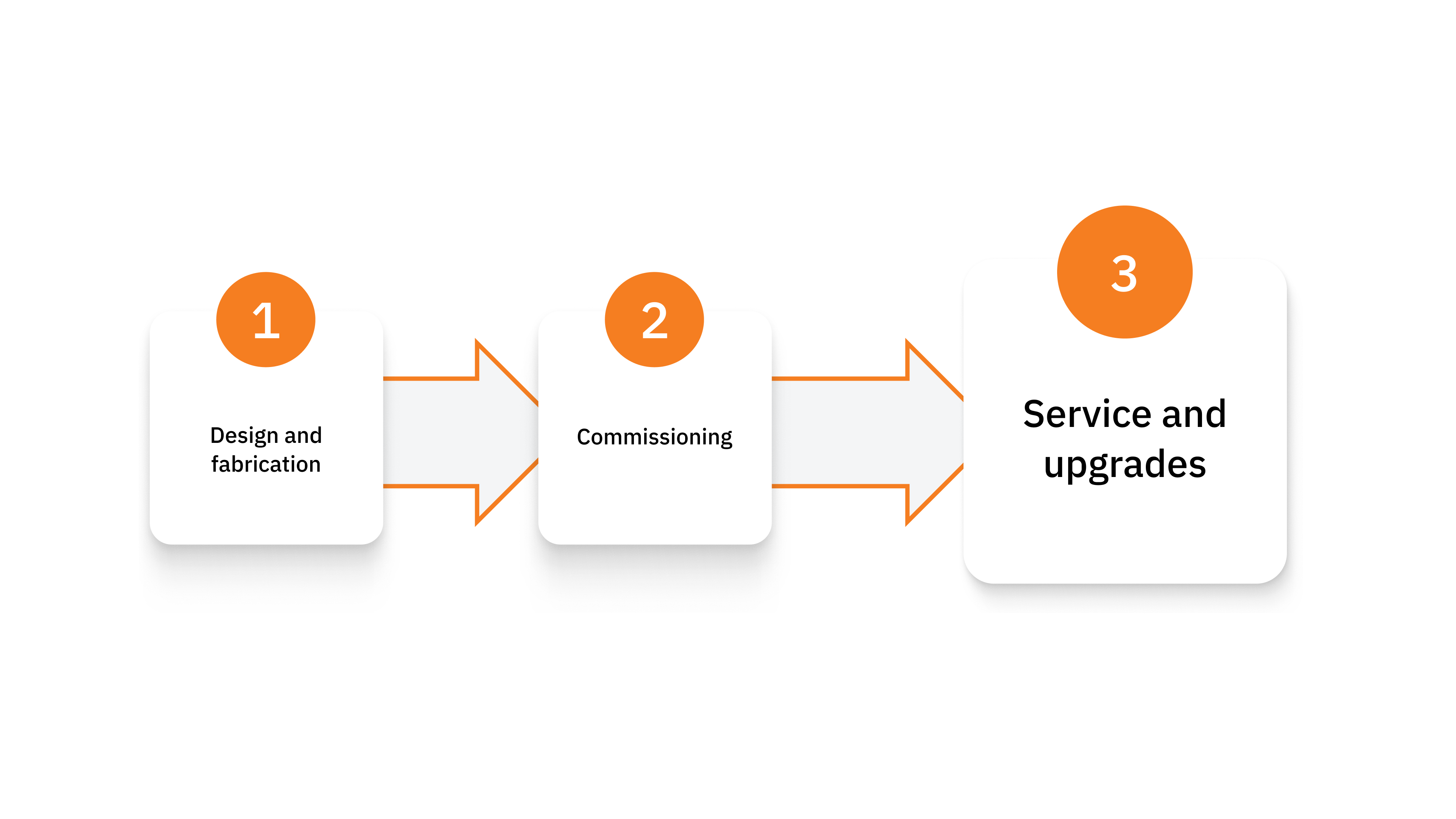
Design and fabrication are handled in-house, which keeps quality consistent and ensures every weld, scale mount, and feed mechanism matches the intended product.
Commissioning is done with real material, so auger speeds, weight logic, and seal pressures are tuned to your operation.
Service and upgrades focus on uptime, predictable maintenance, and practical improvements that operators can manage without improvising.
You may be running compact open-mouth fillers or heavy-duty bulk bag equipment. We support both, including legacy Tech Packaging Group models that still run in many plants. Parts, retrofits, and conversions are not outsourced decisions. You work directly with an engineer who evaluates your application and provides the right fit, not a catalog match.
Below are examples of the systems we design and support:
Small Bag Filling Equipment
Series | Feed Method | Bag Type | Best For |
Gravity | Open Mouth | Free-flowing materials such as grains and pellets | |
Gravity | Open Mouth | Entry-level electronic gross weigh for granules | |
Single auger | Open Mouth | Fine powders needing dust control and consistent rate | |
Dual auger | Open Mouth | Faster powder filling with a fine feed finish |
Bulk and FIBC Filling Equipment
Series | Capacity | Bagging Rate | Ideal Use |
100–4,400 lb | 10–25 bags/hr | Adjustable frame for multiple bag sizes and materials | |
100–4,400 lb | 10–25 bags/hr | Dust-tight pneumatic filling for fine powders | |
100–4,400 lb | 20–30 bags/hr | High-throughput operations with automation | |
Up to ~4,400–6,000 lb | High volume | Continuous-duty industrial plants and heavy materials |
When you work with us, you get direct communication and clear answers. No tiered ticketing. No generic troubleshooting templates. If our name is on your system, we stay accountable for its performance over time.
Conclusion
Bag filling equipment maintenance is predictable when you read the signals early. Wear shows up in feed rates, weight drift, seals, and airflow long before breakdowns happen. You prevent shutdowns by acting before the machine forces your hand. Which of these tips will improve uptime this week? What is the first metric you will start tracking?
If you want equipment that lasts, fills accurately, and stays easy to maintain, contact H&H Design & Manufacturing today and tell us what you are running. We will guide you to the right solution.
FAQs
Q: How often should I rotate operators on a bag filling line to reduce maintenance issues?
A: Rotating operators every few hours reduces fatigue and pattern-blindness. When one operator becomes comfortable with minor deviations, another operator is more likely to notice early signs of blockage or drift. This keeps simple issues from turning into costly shutdowns.
Q: What material property impacts filler performance the most when switching products?
A: Particle shape affects discharge more than density or bag size. Angular or flaky particles interlock, which causes pulsed flow and inconsistent fills. Smooth, round particles slide evenly, keeping cycle times stable across shifts.
Q: How do I confirm if my dust extraction is actually helping production rather than just cleaning the air?
A: Watch cycle times and bag mouth stability after extraction starts. Effective dust capture reduces turbulence near the fill head and keeps seal grip consistent. Poor extraction increases cross-contamination and makes every fill event unpredictable.
Q: Should I adjust bag clamp pressure when using thinner bags during seasonal production changes?
A: No, adjust clamp design, not clamp force. Thin bags deform under excess pressure and cause micro-leaks that appear as dust clouds. Switch to softer contact surfaces or inserts designed for low-gauge film.
Q: Why do performance issues often appear after a product batch change even if the machine was running fine earlier?
A: Material moisture and temperature shift when storage conditions differ between batches. These changes alter flow behavior, creating surges or hang-ups that mimic equipment faults. Monitor how the product behaves rather than assuming hardware failure.
Q: What is the best way to evaluate whether my filler is oversized or undersized for current output?
A: Compare achieved bags per hour to the filler’s rated capacity over a full week. If you constantly run 15 to 20 percent below rating, the machine is fighting material conditions or feeding inconsistencies. If you exceed rating through manual workarounds, the system is undersized for your volume.