Introduction
A single off-spec batch in food, chemicals, or agriculture can trigger devastating consequences: product recalls averaging $10 million in direct costs, regulatory fines, and shareholder value losses reaching $109 million within five days of a severe recall announcement. For industrial operations, imprecision in weighing isn't just a quality issue—it's a financial and regulatory survival threat.
Quality control weighing systems catch these problems before they reach customers. This guide covers the core precision measurement techniques that power modern QC weighing systems and the equipment types used across industries. It also walks through practical implementation strategies for dry bulk and packaged goods operations — whether you're filling 2-ounce food packages or 4,400-pound bulk bags.
Key Takeaways:
- Off-spec batches trigger recalls averaging $10 million and regulatory enforcement actions
- QC weighing systems verify product consistency against target weight and tolerance ranges
- Load cells, SPC integration, and tare subtraction form the core of precision measurement
- Systems range from bench scales to automated in-line checkweighers with rejection mechanisms
- Calibration, environmental controls, and system selection directly impact accuracy
What Is a Quality Control Weighing System?
A quality control weighing system is any automated or semi-automated setup that uses weight measurement to verify product consistency, completeness, or compliance against a pre-set target weight and tolerance range. The target weight represents the desired value—for example, 50 pounds for a bag of flour. The tolerance range defines the acceptable variance band around that target, typically expressed as upper and lower control limits (such as 49.9 to 50.1 pounds).
The fundamental logic is straightforward: products within the tolerance band pass inspection; those outside are flagged or rejected. This binary decision replaces or supplements manual inspection, reducing human error and speeding up throughput.
Manual spot-checking is prone to inconsistency—quality errors more often trace back to process design than to individual operator mistakes. Automated weighing systems inspect 100% of products in motion, eliminating sampling bias and documentation gaps.
The Spectrum of QC Weighing Solutions
QC weighing systems exist on a spectrum of complexity:
- Bench-scale checkweighing — Operators manually place samples on a precision balance in a lab or QC station. Suits low-volume runs, incoming ingredient verification, or periodic audits where line speed isn't a factor.
- Semi-automated platform scales — Add digital readouts, data logging, and preset tare functions. The system records weights and flags out-of-spec items automatically, reducing manual documentation.
- Fully integrated in-line checkweighers — Conveyor-mounted systems with automated rejection arms, real-time data feeds to plant control systems, and Statistical Process Control (SPC) integration. These handle hundreds of products per minute without interrupting the line.
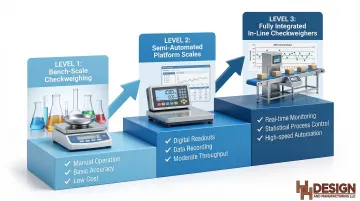
Choosing the right level of automation comes down to throughput volume, accuracy requirements, regulatory mandates, and how the system will connect with existing production infrastructure.
Core Precision Measurement Techniques in QC Weighing
Load Cell Technology: The Backbone of Accuracy
Modern weighing accuracy depends on load cell technology. Load cells convert mechanical force (weight) into an electrical signal using strain gauges arranged in a Wheatstone bridge circuit. When weight is applied, the strain gauges measure resistance changes—often in the order of 10⁻⁴ to 10⁻² Ω/Ω—which are amplified into a usable signal.
OIML R 60 classifies load cells by accuracy class, and that classification directly determines measurement precision:
- Class C3/C4: Standard industrial weighing applications
- Class C6: High-precision applications requiring verification intervals as low as 1.5 kg
Cell placement matters equally. Direct-mount load cell designs eliminate flex points in spout assemblies, ensuring that weight measurements aren't distorted by mechanical interference. Environmental protection—sealed enclosures, temperature compensation, and vibration dampening—prevents drift and maintains accuracy in harsh industrial settings.
Target Weight and Tolerance Methodology
Engineers set upper and lower control limits based on product specifications and regulatory requirements. The difference between tight and wide tolerances reflects application criticality:
Pharmaceutical and specialty chemical applications typically require ±0.1% variance — a 100-gram dose allows only 99.9 to 100.1 grams. Bulk aggregates and agricultural commodities can accept ±1-2%, meaning a 2,000-pound bulk bag might range from 1,960 to 2,040 pounds.
Getting this wrong has consequences. Tolerances too tight increase false rejects, wasting good product and slowing throughput. Tolerances too loose allow non-compliant products to pass, risking recalls and regulatory action.
Checkweighing Technique for High-Speed Operations
In-motion checkweighers measure product weight at production speed without stopping the line. Three factors most affect accuracy in high-throughput environments:
- Faster conveyor speeds reduce dwell time on the scale, demanding more sensitive load cells and quicker signal processing
- Adequate product spacing lets the system isolate individual weights — overlapping items cause direct measurement errors
- External vibrations from nearby machinery induce noise in the weight signal, requiring digital filtering and vibration compensation algorithms
Modern systems meeting OIML R 51 standards can reliably weigh products at speeds up to 600 packs per minute while maintaining accuracy within specified tolerances.
Statistical Process Control Integration
Modern QC weighing systems log every data point, transforming raw measurements into actionable quality insights. SPC integration distinguishes between common cause variation (inherent to the process) and special cause variation (requiring intervention).
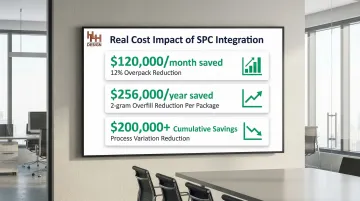
The financial impact across industries is well-documented:
- One manufacturer identified a 12% overpack issue using real-time SPC charting, saving $120,000 per month
- Another discovered a 2-gram overfill per package on a confectionery line—30,000 pounds of annual giveaway—saving $256,000 per year on a single line
- A plastics manufacturer achieved cumulative savings exceeding $200,000 by reducing process variation through automated weight monitoring
SPC software flags trends like drift (gradual movement away from target weight) or spikes (sudden out-of-control events), allowing quality managers to intervene before products are rejected in bulk.
Tare Subtraction and Formulation Weighing
Precise measurement doesn't stop at the product itself — the container holding it introduces weight that must be accounted for. Accurate net weight requires careful tare handling: weighing empty containers per NIST Handbook 133 guidelines (unused dry tare), then subtracting from gross weight to isolate actual product mass.
Formulation weighing applies this technique to batch manufacturing in food and chemical mixing. Two approaches exist:
Gain-in-weight systems weigh the receiving vessel as ingredients are added, isolating only the discharged ingredient mass. This delivers higher accuracy for small, critical batches — pharmaceutical applications in particular.
Loss-in-weight systems weigh the dispensing vessel as ingredients are removed, enabling simultaneous dosing of multiple ingredients. The trade-off is that the scale must span the full storage bin weight, which compresses resolution — making this approach better suited to continuous, multi-ingredient food processing where speed outweighs marginal precision differences.
Types of Quality Control Weighing Systems
In-Line Checkweighers and Conveyor Scales
In-line checkweighers verify the weight of individual discrete items—packages, bottles, cartons—as they move along a production line. Governed by OIML R 51 standards, these systems weigh 100% of products and automatically reject non-compliant items without stopping production.
Conveyor belt scales measure continuous flow of bulk material rather than individual packages. Following ISA-RP74.01 and NIST HB 44 standards, they integrate weight per unit length multiplied by belt travel to calculate total material flow.
| Feature | In-Line Checkweigher | Conveyor Belt Scale |
|---|---|---|
| Function | Verify individual package weight | Measure continuous bulk flow |
| Operation | Compare against target weight with pass/fail output | Integrate total material over time |
| Typical Use | Packaged food, pharma cartons, chemical drums | Mining, aggregate flow, bulk food processing |
Automated rejection mechanisms remove non-compliant products without manual intervention:
- Air jet/blast: Blows light products off the belt
- Pusher: Pneumatic arm pushes heavier cartons or cases aside
- Flip-flap/drop-down: Diverts products by dropping a conveyor section
These mechanisms integrate with high-speed load cells for reliable rejection at rates up to 600 packs per minute.
Filling and Batching Weighing Systems
These systems control the dispensing of dry bulk materials—powders, granules, pellets—by weight. Common in food, dairy, chemical, and agricultural operations, they prevent both underfill (regulatory violations, customer complaints) and costly overfill (giveaway, margin erosion).
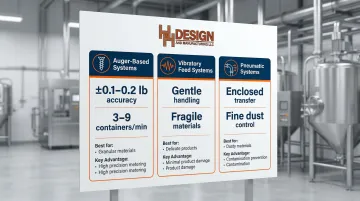
Three feed approaches handle different material characteristics:
- Auger-based systems use single or twin screw augers with variable speed drives. H&H Design Manufacturing's Series 52 and Series 54, for example, achieve ±0.1 to 0.2 lb accuracy at 3–9 containers per minute for 50-pound fills.
- Vibratory feed systems offer gentler handling for delicate or fragile materials, using controlled vibration to meter product into containers.
- Pneumatic systems transfer materials through enclosed piping — the right choice for fine powders that require dust control and contamination prevention.
Bench and Platform Scales for Manual QC
Manual weighing plays a key role in sampling, incoming inspection, and lab-based quality testing. The right instrument depends on required readability and capacity:
| Scale Type | Readability | Typical Use |
|---|---|---|
| Precision analytical balance | 0.0001 g | Pharmaceutical formulation, ingredient testing |
| Industrial platform scale | 0.1 lb | Incoming inspection, production sampling |
Both must meet NIST Handbook 44 specifications and maintain calibration traceability for regulatory compliance.
Loss-in-Weight vs. Gain-in-Weight Systems
The choice between these approaches depends on application priorities:
| System Type | Best For | Advantage | Trade-off |
|---|---|---|---|
| Gain-in-Weight | Small, critical batches (pharmaceuticals) | Higher accuracy—weighs only discharged amount | Slower—ingredients typically added sequentially |
| Loss-in-Weight | Continuous, multi-ingredient processing (food) | Faster—allows simultaneous dosing | Lower accuracy—scale range covers entire storage bin |
Automated Weigh-Labeling and Data-Capture Systems
Combining weighing with label printing and barcode/RFID integration prevents mislabeled products from leaving the facility and creates a complete audit trail for regulatory compliance.
These systems handle the full sequence automatically:
- Weigh each product and compare against declared weight
- Print labels with actual weight, lot codes, and traceability data
- Apply labels or RFID tags at line speed
- Log all data to quality management systems
- Flag discrepancies for immediate intervention
The result: no manual transcription errors, and weight declarations that consistently match actual product content — a direct FDA and USDA compliance requirement.
Industry Applications: Where QC Weighing Systems Deliver the Greatest Value
Food, Dairy, and Agriculture
QC weighing keeps food production on spec at every stage. FDA 21 CFR Part 101 mandates accurate net quantity declarations, and USDA FSIS frequently initiates recalls for inaccurate net weight statements. That means every package, batch formula, and ingredient ratio needs to be verified — not sampled.
Food recalls triggered by net weight violations average $10 million in direct costs. Automated weighing prevents these violations by verifying 100% of products before they leave the facility.
H&H Design Manufacturing builds dry bulk weighing and filling equipment for exactly these environments. Their systems handle materials from 2 ounces to 3,000 pounds at ±0.1 to 0.2 pound accuracy, and are available in stainless steel and 3A Dairy construction for washdown and sanitary compliance.
Chemicals and Mining
Weighing systems protect process integrity in chemical manufacturing and mining operations. Measurement errors compound fast — an incorrect reagent ratio can trigger hazardous reactions or render entire batches unusable.
ISO 9001 and process safety standards govern these environments. Accurate weighing of reagents prevents safety incidents and keeps material classification consistent through every production run.
Pharmaceuticals and Specialty Manufacturing
Pharmaceutical operations face the tightest tolerance requirements in industry. Key regulatory standards include:
- USP <905>: Sets acceptance criteria for dosage unit uniformity, verified via weight variation
- USP <1251>: Establishes standards for analytical balance repeatability and accuracy
- FDA 21 CFR Part 211: Requires routine equipment calibration and inspection
- EU GMP Annex 15: Mandates validation of critical equipment
Data logging supports regulatory audits by providing documented evidence that every batch met specifications throughout production.
Logistics and Post-Packaging Verification
QC weighing after packaging confirms box completeness (right number of components, no missing inserts), catches underfilled or overfilled containers before they ship, and reduces costly returns and customer complaints.
Calibration and Maintenance Best Practices
Why Calibration Frequency Matters
Load cells drift over time due to temperature changes, mechanical wear, and vibration. OIML R 60 specifies that load cells exhibit "creep"—a change in output over time under constant load. The standard requires that the difference in reading between 20 and 30 minutes under load must not exceed 0.15 times the absolute Maximum Permissible Error.
Calibration frequency should match application criticality:
| Application Type | Routine Checks | Certified Calibration |
|---|---|---|
| Critical (pharmaceuticals, high-value products) | Daily zero/span checks at startup | Quarterly external calibration |
| Standard (food, chemicals) | Weekly zero/span checks | Semi-annual calibration |
| Low-risk (bulk aggregates) | Monthly checks | Annual calibration |
NIST Handbook 44 and ISO 9001 require weighing instruments to be calibrated against standards traceable to national or international standards (SI units), with documentation maintained to prove traceability.
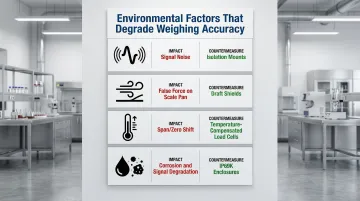
Environmental Factors That Degrade Accuracy
Several environmental factors compromise weighing precision:
| Environmental Factor | Impact | Countermeasure |
|---|---|---|
| Vibration from nearby machinery | Induces noise in weight signals | Isolation mounts; relocate scales away from vibration sources |
| Air currents (HVAC, open doors) | Creates upward or downward force on scale pan | Draft shields; position away from air movement |
| Temperature fluctuations | Shifts load cell span and zero point; OIML R 60 requires compliance between -10°C and +40°C | Temperature-compensated load cells (Class C3: <±13.3 ppm/°C); climate-controlled areas |
| Moisture and dust | Corrodes enclosures, degrades signal | IP69k-rated sealed enclosures; regular cleaning protocols |
Preventative Maintenance Steps
A consistent daily and periodic routine catches most issues before they affect production:
- Verify zero point at startup — confirm the scale reads zero before each production run
- Clean load cell areas — remove accumulated product, dust, and debris that can bind or load the cell
- Inspect cable connections and indicator displays — catch loose connections or display faults early
- Document every calibration event — audit trails support ISO 9001 and regulatory compliance requirements
Skipping documentation is the most common gap found during compliance audits, even when the physical equipment is well maintained.
How to Choose the Right QC Weighing System for Your Operation
Key Selection Criteria
- Capacity and readability: Match the scale's capacity to your heaviest product. Readability (the smallest displayable increment) must be fine enough to catch tolerance deviations — a 100-lb capacity scale with 0.1-lb readability suits 50-lb bag filling; a 5,000-lb capacity with 1-lb readability suits bulk bags.
- Decide between static weighing (bench scales, batching systems) for higher accuracy or dynamic weighing (in-line checkweighers) for higher throughput speed.
- Dry bulk materials — powders, granules, pellets — require different handling than packaged goods or liquids. Auger systems suit free-flowing powders; vibratory feeders handle delicate materials; pneumatic systems control dust.
- Washdown environments require stainless steel construction and IP69k-rated enclosures. Dusty environments need sealed load cells. Explosion-hazardous areas require certified explosion-proof equipment.
- Match automation level to volume: manual systems for low-volume operations, semi-automated for a cost-efficiency balance, fully automated for high-volume production.
Integration Requirements
Choose systems that communicate via standard protocols so weighing data feeds into plant control systems, ERP software, or SPC platforms:
- Modern plant networks: EtherNet/IP, PROFINET, Modbus TCP, OPC UA
- Legacy equipment: RS-232 and RS-485 for older control architectures
- Simple PLC integration: digital I/O for pass/fail signals and rejection mechanisms
The more complex your control architecture, the more integration planning matters upfront. H&H Design Manufacturing — a certified UL Industrial Control Panel Shop — builds custom weighing and filling systems with Allen-Bradley PLC interfaces designed to fit established control architectures, supporting data exchange with plant systems and quality management software.

The Value of Custom-Designed Systems
When integration requirements are tight, off-the-shelf systems frequently expose their limits. Operations with unusual material characteristics, space constraints, or high variability in product SKUs often end up forcing costly workarounds — custom mounting brackets, manual adjustments between products, or process compromises that chip away at efficiency.
Working with a manufacturer experienced in custom dry bulk systems eliminates these workarounds. H&H Design Manufacturing handles projects ranging from small modifications to complete custom designs from the ground up. Their family-owned structure provides the agility to meet tight deadlines and fulfill custom requests that larger competitors can't always accommodate.
Custom systems address:
- Non-standard container sizes or shapes
- Unique material flow characteristics
- Tight space constraints in existing facilities
- Multi-product flexibility requiring minimal changeover
- Integration with legacy equipment and control systems
Frequently Asked Questions
What is the difference between a checkweigher and a conveyor scale?
A conveyor scale measures total load or flow rate continuously, integrating material weight over time. A checkweigher measures individual product weight in motion and compares it against a target weight with pass/fail output, automatically rejecting non-compliant items.
How often should a quality control weighing system be calibrated?
Critical applications (pharmaceuticals, high-value products) call for daily zero/span checks and quarterly or annual certified calibration with documentation. Standard industrial applications typically require monthly checks and semi-annual certified calibration. Regulatory requirements and usage intensity may tighten those intervals.
What industries use quality control weighing systems most?
Food and beverage, dairy, pharmaceuticals, chemicals, agriculture, and manufacturing are the primary users. Any industry where product consistency, regulatory compliance, or ingredient accuracy matters benefits from QC weighing systems—particularly those subject to FDA, USDA, or international net weight regulations.
What do "target weight" and "tolerance" mean in a QC weighing system?
Target weight is the desired product weight (for example, 50 pounds). Tolerance is the acceptable upper and lower variance band around that target (such as 49.9 to 50.1 pounds). Products within tolerance pass; those outside are flagged or rejected.
Can a QC weighing system be integrated with an existing production line?
Yes. Most modern systems support integration via standard protocols (EtherNet/IP, Modbus TCP, PROFINET) and PLC connections. Custom-engineered systems can fit existing line layouts and control architectures, enabling real-time data exchange with plant systems.
What causes inaccurate readings in industrial weighing systems?
Common causes include load cell drift, vibration, temperature extremes, overloading the scale, poor calibration practices, and environmental contamination (dust, moisture). Regular maintenance, proper installation away from vibration sources and air currents, and scheduled calibration prevent most accuracy issues.