Introduction
When dry bulk material drops from a conveyor or loading spout into a truck, railcar, or container, the problem isn't just the visible dust cloud—it's the cascade of risks that follows. Fine particles separate during free-fall, becoming airborne and dispersing across the facility. What looks like a housekeeping issue is actually a multi-layered liability: workers face chronic respiratory exposure, facilities risk combustible dust explosions, material loss chips away at margins, and regulatory inspectors arrive with citation books open.
According to Dust Safety Science, the US averages 28 dust explosions per year, resulting in approximately 25 injuries and one to six fatalities annually. Separately, an estimated 2.3 million US workers face exposure to respirable crystalline silica each year, contributing to silicosis, lung cancer, and chronic obstructive pulmonary disease.
OSHA's Combustible Dust National Emphasis Program (NEP) and tightened Permissible Exposure Limits (PELs) have made enforcement a real operational risk — citations follow facilities that haven't addressed dust at its source.
This article covers:
- Core dust hazards in bulk loading operations
- Proven control technologies that address the problem at its source
- Industry-specific challenges across food, chemicals, mining, and agriculture
- Mandatory OSHA and NFPA compliance requirements
- How to select the right dust control system for your operation
Key Takeaways
- Uncontrolled dust creates respiratory hazards, combustible dust explosions, material loss, and OSHA violations
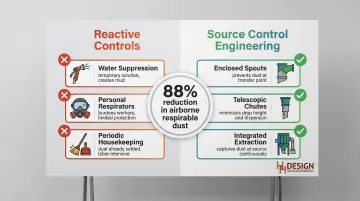
- Source-control systems (enclosed spouts, telescopic chutes) reduce dust generation by 88% compared to reactive suppression
- Each industry — food, chemical, mining, agriculture — faces a distinct dust profile that requires material-specific engineering
- OSHA PELs and NFPA 652 set enforceable dust limits — non-compliance carries real penalties
Why Dust in Bulk Loading Is More Dangerous Than It Looks
Bulk material free-fall is the primary dust generation mechanism in loading operations. As dry material—grain, cement, chemicals, fertilizer—drops from height, fine particles separate from the bulk stream and become airborne. Velocity and turbulence accelerate dispersal, turning what should be a contained transfer into an exposure event.
The risks fall into two categories: health hazards and physical hazards. Chronic respiratory disease, silicosis in mining operations, and occupational asthma represent the health dimension. OSHA identifies respirable crystalline silica as a cause of silicosis, lung cancer, COPD, and kidney disease, with approximately 2.3 million workers exposed annually across US industries.
Physical hazards center on combustible dust explosions. Between January 2023 and January 2024, global monitoring recorded 263 fires and 53 explosions related to combustible dust. Common at-risk materials include grain, sugar, flour, coal, and certain chemical powders—materials routinely handled in bulk loading operations.
Operational consequences add up fast:
- Fine particle buildup on conveyor belts and motors accelerates wear and increases maintenance costs
- Material lost to dust represents measurable yield reduction, particularly significant with high-value chemicals or food ingredients
- Neighbor and community complaints can escalate to regulatory action, especially in residential-adjacent industrial zones
- Equipment performance degrades as dust infiltrates bearings, sensors, and control systems
Traditional reactive methods—water spraying, personal respirators, periodic housekeeping—treat symptoms rather than eliminate the source. Water suppression risks contaminating moisture-sensitive materials, and respirators shift the burden onto workers instead of engineering it away. Neither approach prevents dust from escaping in the first place.
Engineering controls applied at the source deliver measurable results. NIOSH field studies at silica sand plants found that source-control hoppers reduced airborne respirable dust by 88% compared to rigid loading spouts. Small leaks in sealing systems or improper spout configurations can escalate into serious safety events—which is why catching them early through proper equipment selection matters.
Core Dust Control Technologies in Modern Bulk Loading Systems
Enclosed Bulk Loading Spouts and Telescopic Chutes
Enclosed loading spouts work by reducing the drop height between the discharge point and the material pile surface, keeping the entire flow path enclosed. Shorter drop height equals lower material velocity, which equals less dust generation. Research confirms that dust liberation increases as falling height increases—controlling that variable at the source prevents the problem before it starts.
The spout extends downward as the container fills, maintaining minimal distance between the discharge point and the rising material surface. This continuous adjustment keeps material velocity low throughout the loading cycle: highest when the container is empty, then maintained as material accumulates.
Key design elements include:
- Bellows or skirt sealing systems around the spout body block fugitive dust from escaping at connection points
- A continuous material column inside the spout closes off the upward air pathway, suppressing dust through positive material flow
- Cone-shaped discharge ends seal directly against loading ports on enclosed vehicles like pneumatic trucks and railcars
For fine, dusty materials like cement, fly ash, or powdered chemicals, cascade or spiral-flow spout designs slow material descent in stages. Rather than allowing free-fall, these designs use a series of inclined cones or spiral flights to force material to flow smoothly from one level to the next. This staged descent cuts dust generation and protects product integrity — a genuine concern for fragile materials or high-value chemicals where particle breakage is a quality issue.
Dust Collection and Extraction Integration
Integrated dust extraction ports on loading systems provide a complementary control layer. Rather than relying solely on enclosure, a low-volume airflow draws fine particles away from the loading zone and into a bag filter or dust collector. Because enclosed systems already minimize dust at the source, required extraction airflow is much lower than open capture hoods, which translates to smaller, more energy-efficient collection equipment.
Balancing that airflow matters. Manufacturers recommend exhaust air volumes of 1.8 to 4.9 times the spout's rated loading volume, accounting for air displaced by material flow (induced air). The range matters: too high and valuable product gets pulled into the collector; too low and dust escapes containment.
Dust hoods positioned at transfer points — hopper inlets, conveyor discharge zones — serve as a complementary layer when full enclosure isn't feasible. They create a localized negative pressure zone that captures dust before it disperses. The tradeoff: capture hoods require significantly higher airflow rates than enclosed systems and lose effectiveness in outdoor or high-wind conditions.
Dust Suppression Systems (Chemical and Water-Based)
Wet suppression systems use water or surfactant misting to bind dust particles before they become airborne. Chemical dust binders create a surface crust on stockpiles or open material surfaces. Both approaches work as supplemental controls — useful for outdoor stockpiles or open loading areas — but neither is sufficient as a standalone solution for enclosed bulk loading operations.
Moisture is the core limitation: water suppression can damage cement, certain fertilizers, and food-grade materials. Chemical binders risk product contamination or downstream processing complications. Both methods treat dust after liberation rather than preventing it at the source.
Industry-Specific Dust Challenges Across Key Sectors
Food and Dairy Processing
Food-grade dry bulk materials carry dual risk: combustible dust hazards and contamination concerns. Agricultural products such as egg whites, powdered milk, cornstarch, sugar, flour, grain, potato, and rice are explicitly identified as combustible dust hazards. NFPA 61 addresses fire and explosion protection in facilities handling these materials.
Dust control in food processing must be cleanroom-compatible. Chemical suppression systems that might work in mining or aggregates are unacceptable when product purity is paramount. Enclosed mechanical systems—telescopic spouts with integrated extraction, inflatable fill heads that create dust-tight seals—are preferred over chemical or water-based approaches.
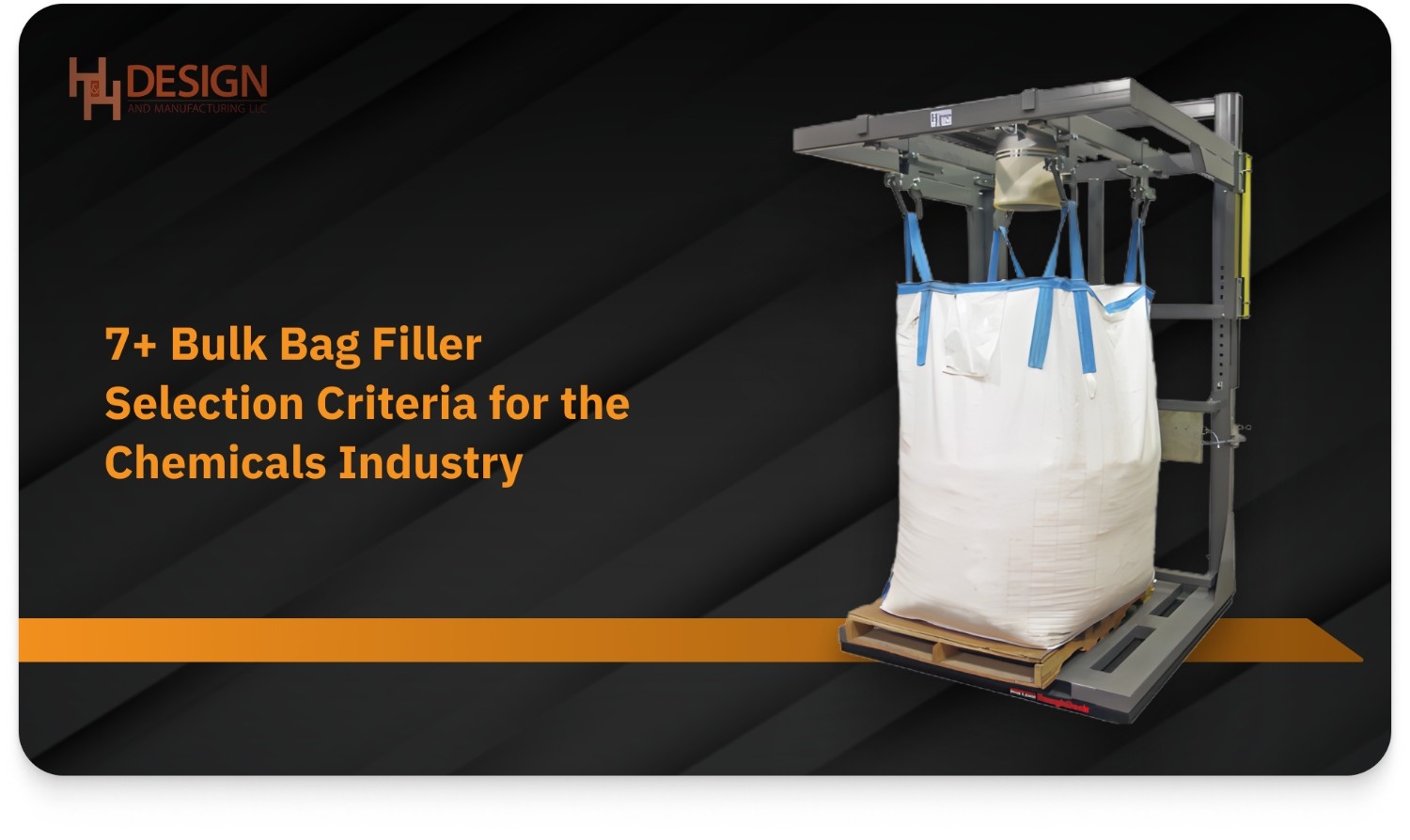
H&H Design manufactures filling equipment in 3A Dairy construction, a specialized certification required for dairy industry applications. Their Series 52 and Series 54 systems feature wide-range filling heads with excellent dust control and air-purged shaft seals to prevent product leakage while maintaining containment. For bulk bag applications handling fine powders like flour, their Series 110DS-P includes pneumatic bag inflation and dust control with inflatable seals and dust extraction ports.
Chemicals and Fertilizers
Chemical dusts can be toxic, corrosive, or reactive. Equipment must be designed for material compatibility from the start:
- Stainless steel or coated internals resist corrosion from aggressive materials
- Explosion-proof rated control panels are required when handling combustible chemical powders
- Air-purged shaft seals prevent chemical dust from escaping at rotating components
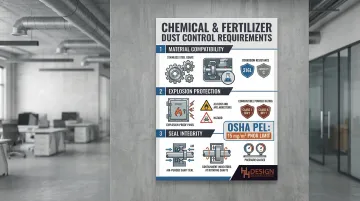
Regulatory thresholds for chemical dust are often stricter than general industry limits. OSHA enforces a PEL of 15 mg/m³ (total dust) for particulates not otherwise regulated (PNOR), covering materials like ammonium nitrate and ammonium sulfate. Ammonium nitrate carries both explosion and toxicity risk, with specific storage requirements under 29 CFR 1910.109(i).
All-stainless steel construction options, like those available in H&H Design's Series 54 systems, provide reliable corrosion resistance that holds up against aggressive chemical exposure, maintaining both worker safety and product containment.
Mining and Aggregates
In mining, quarrying, and aggregate handling, respirable crystalline silica is the defining hazard. OSHA's silica standard (29 CFR 1910.1053) sets a Permissible Exposure Limit of 50 µg/m³ and an Action Level of 25 µg/m³ (8-hour TWA)—thresholds tied directly to silicosis and lung cancer risk.
Wet suppression is more commonly used in outdoor mining environments, combined with enclosed transfer chutes at processing points. However, water creates handling challenges in freezing conditions and with moisture-sensitive materials. Enclosed loading spouts with integrated extraction provide year-round control without introducing moisture.
The standard requires employers to use engineering and work practice controls to limit exposure. Respirators serve only as a secondary measure when controls are not feasible. This hierarchy makes source-control loading systems a compliance necessity, not an option.
Agriculture (Grain Handling)
Grain dust is one of the most common—and persistently dangerous—combustible dust types. Purdue University data shows grain dust explosions have held steady over the past decade, meaning facilities cannot treat this as a solved problem.
NFPA 61 compliance is mandatory for grain loading and unloading systems, including proper equipment grounding and explosion venting at loading zones. Enclosed loading spouts must incorporate static dissipation features to prevent spark generation, and control systems require emergency shutoff interlocks that halt flow when dust levels exceed safe thresholds.
Equipment serving agriculture must balance dust control with throughput demands during harvest season. When trucks are queued during peak season, systems that throttle throughput to control dust create real operational problems. Properly engineered telescopic spouts with optimized extraction let facilities hit both targets without compromise.
OSHA and NFPA Compliance: What Bulk Handling Facilities Must Know
OSHA Standards Applicable to Bulk Loading
| Regulation | Citation | Key Requirement |
|---|---|---|
| General Duty Clause | Section 5(a)(1) of OSH Act | Provide workplace free from recognized hazards likely to cause death or serious harm |
| Housekeeping | 29 CFR 1910.22 | Keep workplaces clean and orderly; often cited for visible dust accumulations |
| Respirable Silica | 29 CFR 1910.1053 | PEL of 50 µg/m³; Action Level of 25 µg/m³; requires written exposure control plans |
| Hazardous Locations | 29 CFR 1910.307 | Electrical equipment in dusty areas must be intrinsically safe or approved for Class II locations |
OSHA's Revised Combustible Dust NEP (effective January 30, 2023) outlines inspection procedures for facilities generating combustible dusts. Inspectors target industries handling metal, wood, coal, plastic, and organic dusts, checking for dust accumulations on elevated surfaces (beams, ledges) and verifying that dust collectors and transport systems are designed to prevent leakage.
The General Duty Clause applies when no specific standard covers a particular dust hazard — OSHA uses it to cite facilities for recognized combustible dust risks regardless. Properly enclosed loading systems are one of the most direct ways to demonstrate that feasible control measures are in place.
NFPA Standards for Combustible Dust
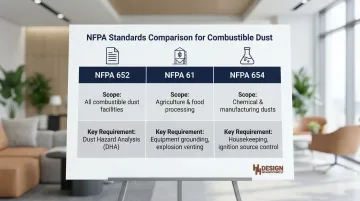
Three NFPA standards govern most bulk handling operations:
| Standard | Scope | Key Requirements |
|---|---|---|
| NFPA 652 | All facilities generating combustible dust | Dust Hazard Analysis (DHA) by a qualified person; reviewed periodically or after process changes |
| NFPA 61 | Agricultural and food processing (grain, oilseeds, sugar, flour) | Equipment grounding, explosion venting for loading and unloading operations |
| NFPA 654 | General chemical and manufacturing dusts | Housekeeping protocols, ignition source control, explosion protection |
Meeting these standards is an ongoing operational responsibility, not a one-time certification. Facilities need active inspection, maintenance, and housekeeping programs to stay in compliance — and equipment that can't be easily accessed for cleaning or inspection creates recurring gaps that auditors will find. When evaluating loading system designs, prioritize components that support routine maintenance without taking the line offline.
How Automated Control Systems Enhance Dust Management in Bulk Loading
Modern bulk loading systems integrate sensors with automated loading controls, eliminating the need for manual monitoring and response. Opacity monitors and dust particle counters detect when dust levels exceed a threshold, triggering the system to slow or pause loading, activate extraction, or alert operators.
Programmable control panels sequence the loading process to minimize turbulence. For example, controlling fill rate at the start of a load cycle—when the container is empty and drop height is greatest—reduces the initial dust burst. As the container fills and drop height decreases, flow rate increases automatically to maintain throughput without generating additional dust.
Key automation capabilities include:
- Real-time dust monitoring with threshold-based response triggers
- Variable speed drives on auger feeds that adjust material flow based on container fill level
- Interlocks that prevent loading if extraction systems are not operating
- Automated spout extension and retraction synchronized with fill level
H&H Design's UL-certified industrial control panels (certified for both US and Canada) build automated dust management logic, interlocks, and safety shutoffs to verified safety standards. This matters most in chemical and combustible dust applications, where control system failures can trigger catastrophic events.
UL certification means the panel design, construction, and wiring have been reviewed and tested by an independent third party—not just self-declared compliant by the manufacturer.
How to Choose the Right Dust Control Solution for Your Operation
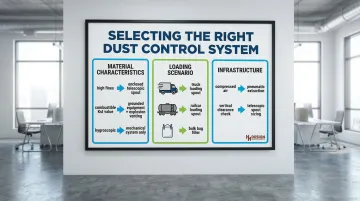
Selecting the appropriate dust control system requires evaluating material characteristics against process constraints and facility infrastructure.
Key evaluation criteria:
Material Characteristics:
- High fines content (<500 microns) requires enclosed telescopic spouts with active extraction
- Materials with documented Kst and Pmax values need bonded/grounded equipment and explosion venting
- Hygroscopic materials rule out wet suppression — enclosed mechanical systems are required instead
- Chemical dusts require material-compatible sealing (stainless steel, coated internals) and explosion-proof controls
Loading Scenario:
- Truck, railcar, bulk bag, drum, and open stockpile applications each require different spout configurations
- High-volume throughput (tons per hour) demands extraction airflow scaled to 1.8–4.9x material volume
- Outdoor loading faces wind interference; enclosed spouts with weighted skirts maintain seal integrity
Existing Infrastructure:
- Compressed air availability drives pneumatic extraction options; electrical capacity determines dust collector sizing
- Telescopic spouts require adequate vertical clearance for full extension — measure headroom before specifying
- Confirm compatibility with existing conveyors, silos, and control systems before finalizing design
One-size-fits-all solutions don't work in bulk loading. Facilities with non-standard container sizes, unusual materials, or tight installation footprints need systems engineered around their specific constraints — not catalog products forced into mismatched applications. H&H Design builds dust-controlled bulk loading systems from the ground up to fit both material requirements and site realities.
Working with a manufacturer who covers the full project lifecycle — design, manufacturing, commissioning, and ongoing support — ensures the system performs as intended from day one and stays compliant over its service life. As a Certified UL Industrial Control Panel Shop, H&H Design maintains quality control at every stage, from initial drawings through field commissioning.
Frequently Asked Questions
What is combustible dust and which bulk materials are most at risk?
Combustible dust is any finely divided solid that can ignite and cause fire or explosion when suspended in air. Common at-risk materials include grain, sugar, flour, coal, powdered milk, cornstarch, and certain chemical powders like aluminum or magnesium.
What OSHA regulations apply to dust control in bulk loading facilities?
OSHA's General Duty Clause (Section 5(a)(1)), housekeeping standards (29 CFR 1910.22), and the silica standard (29 CFR 1910.1053) apply to most bulk loading operations. Facilities should also reference NFPA 652 and any industry-specific NFPA codes relevant to their materials.
How does an enclosed bulk loading spout reduce dust compared to an open chute?
Enclosed spouts reduce drop height by extending downward as the container fills, contain the material flow path within a shroud, and use flexible sealing to prevent turbulent air from carrying fine particles into the surrounding environment. This reduces dust generation by up to 88% compared to open chutes.
What is a Dust Hazard Analysis (DHA) and is it required?
A DHA is a systematic review of combustible dust processes, required under NFPA 652 for any facility handling combustible materials. It must be documented, performed by a qualified person, and reviewed periodically or whenever process changes occur.
Can dust control systems be added to existing bulk loading equipment?
Retrofit dust control solutions—extraction ports, enclosed spout replacements, dust hoods—are available for many existing systems. However, a qualified engineer should assess the full system first, since adding extraction without addressing source control often falls short of compliance targets.
How do automated loading controls help reduce dust generation?
Automated controls manage fill rate and loading sequence to minimize drop turbulence, particularly at the start of the loading cycle when drop height is greatest. They integrate with real-time dust monitoring to trigger extraction or slow loading before levels become hazardous, reducing reliance on manual intervention.