What happens when an industry can’t find the people it needs to keep production moving?
Many manufacturers are already living this challenge every day. Workforce gaps, rising productivity demands, and the growing difficulty of maintaining consistent manual operations have pushed companies to rethink how they keep their lines running smoothly.
Material handling automation, systems that move, store, sort, or package products with minimal human input, has quickly become one of the most effective answers. As plants face increasing throughput expectations, tighter accuracy requirements, and ongoing labor shortages, automation offers a reliable way to reduce variability, improve flow, and scale without constantly depending on additional staffing.
In this article, we’ll break down the different types of material handling automation, the benefits they offer, and how these systems integrate seamlessly with modern packaging lines.
Key Highlights
Material handling automation removes manual bottlenecks and ensures consistent flow in plants facing labor shortages and rising throughput demands.
Systems such as automated fillers, conveyors, and bulk bag equipment provide accurate dosing, smoother movement, and safer material handling.
Automation improves output, reduces overfill, minimizes dust and ergonomic risks, and lowers long-term operating costs.
Integrated controls enable fillers, conveyors, and sealing/palletizing equipment to work in sync for stable, high-efficiency packaging lines.
H&H’s Design mfg offer scalable, precision-engineered solutions tailored for powders, granules, and pellets across dry-bulk operations.
What Is Material Handling Automation?
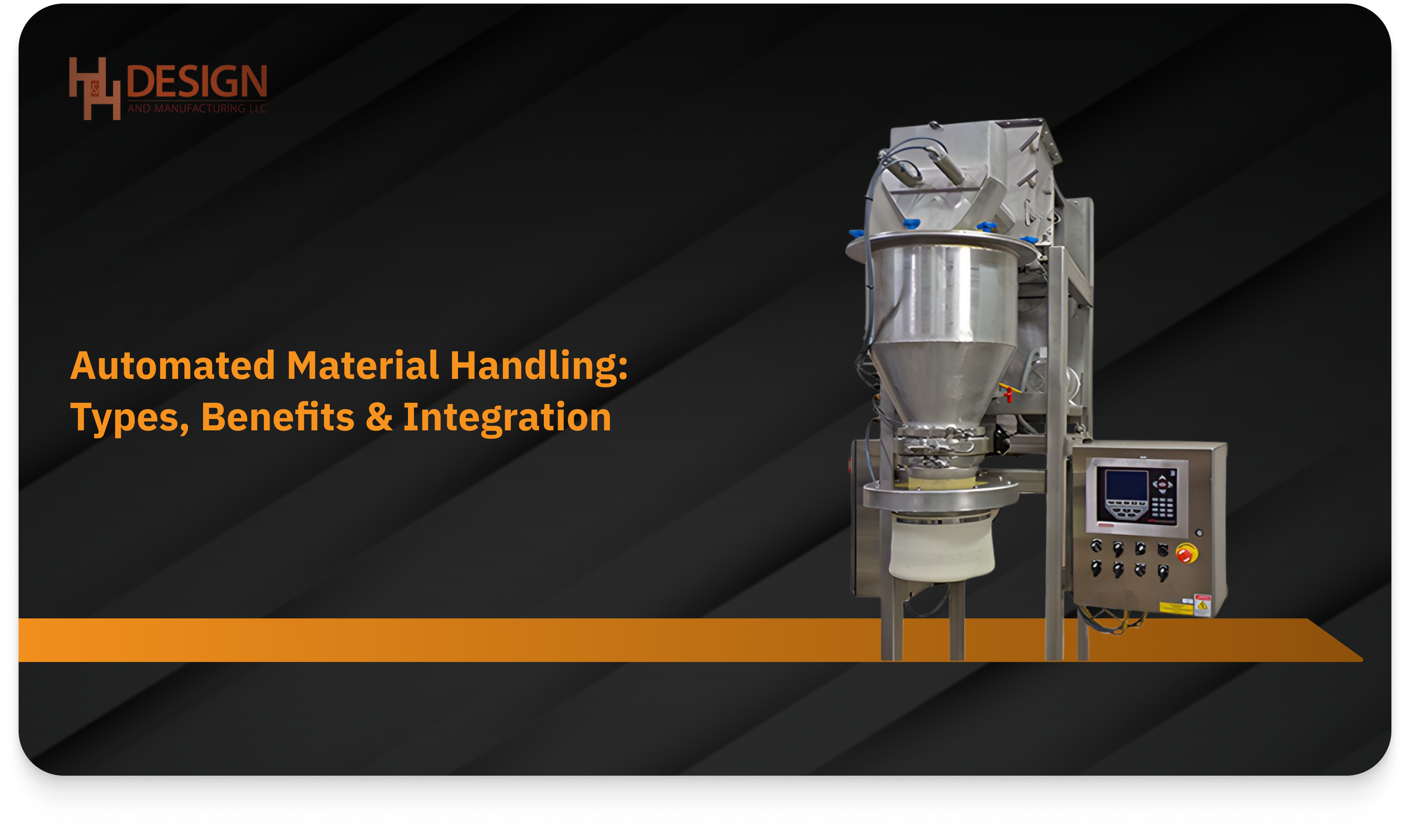
Material handling automation simply means using machines, controls, and integrated systems to move, weigh, fill, or transport materials, tasks that would otherwise require manual labor. Instead of operators lifting bags, moving totes, or monitoring flow by hand, automated equipment handles these steps consistently and safely.
This automation applies to a wide range of materials common in manufacturing, including powders, granules, seeds, pellets, chemicals, and other dry bulk solids. Whether the product is free-flowing or dusty, light or dense, automated systems are designed to manage it efficiently.
Material handling automation spans the entire production journey:
Upstream systems that receive and convey raw materials
Midstream systems that measure, dose, or blend
Downstream systems that package, seal, palletize, or prepare products for shipment
For H&H, the core focus is dry bulk weighing and packaging automation, solutions that ensure materials are accurately metered, filled, and packed with minimal manual intervention. This improves consistency, reduces labor strain, and keeps production lines running smoothly.
Types of Material Handling Automation
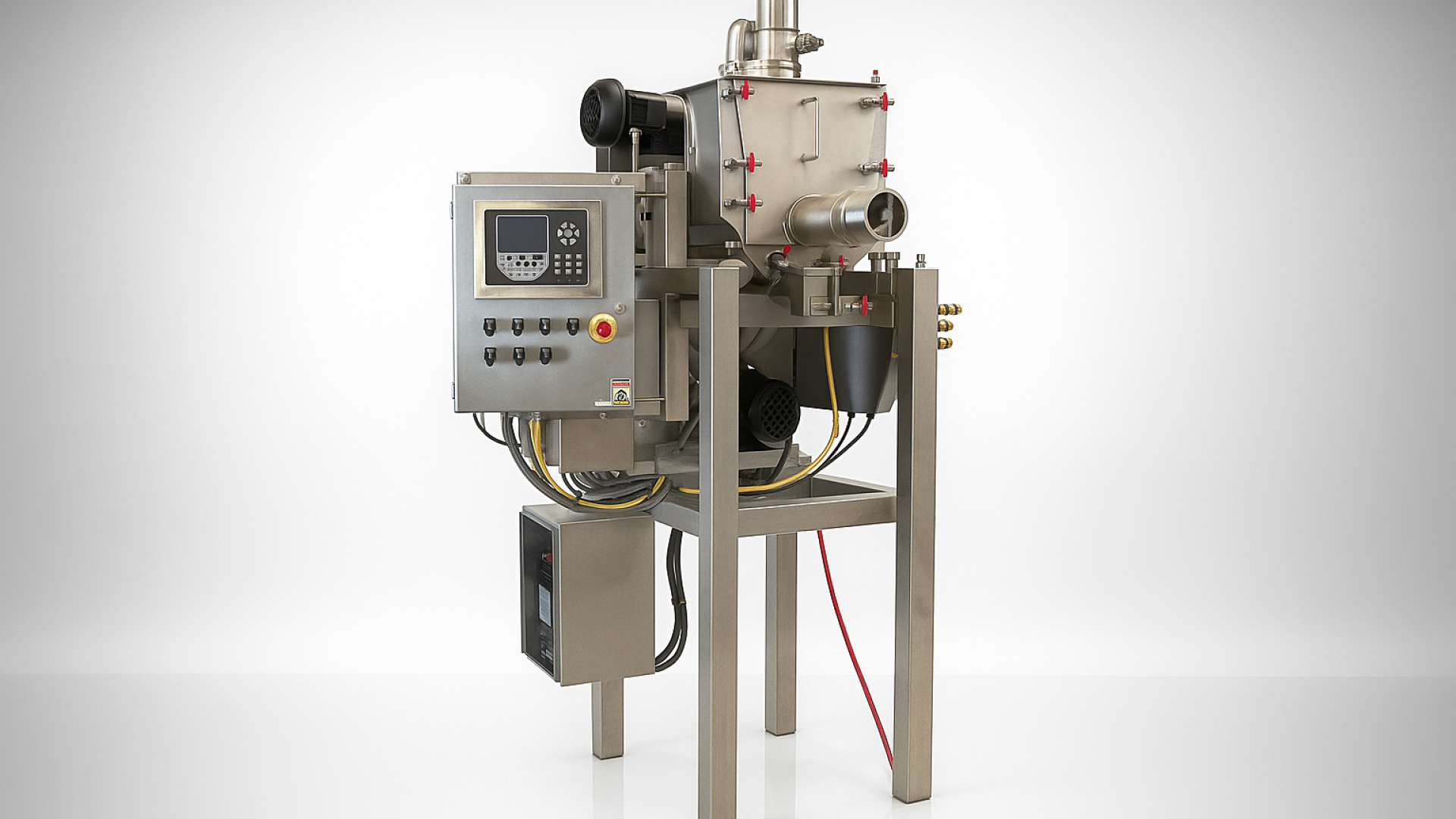
Modern material handling automation covers a wide spectrum of technologies that move, measure, and package dry bulk materials with speed and consistency. Below is an overview of the most common system types and how they support reliable, high-output production.
A. Automated Weighing & Filling Systems
Automated weighing and filling systems ensure every bag, box, or bulk container receives the right amount of product, reducing giveaway, improving quality, and standardizing throughput. This is the foundation of H&H’s product line, spanning small bags to large bulk bags.
Automated filling systems generally fall into four main categories:
1. Gravity-Based Automation
Gravity-fed systems let material flow naturally from a hopper into the package, making them one of the simplest and most reliable approaches.
Ideal for free-flowing materials such as grains, pellets, and consistent powders
Low maintenance, fast cycle times, excellent durability
Best suited for operations prioritizing high throughput with dependable accuracy
2. Auger-Based Automation
Auger fillers use a screw mechanism to precisely meter powders, critical when dust control and accuracy matter.
Designed for fine, dusty, or poor-flowing powders
Enables tight fill control and reduces airborne dust
Excellent for applications requiring repeatable accuracy or hygienic powder handling.
For fine, dusty, or poor-flowing powders, H&H auger fillers (e.g., Series 52 OM, 52 Valve, 52 QC, 54) provide tight fill accuracy, hygienic handling, and repeatable performance.
3. Vibratory Automation
Vibratory feeders move material gently using controlled vibration, protecting delicate products and improving consistency.
Ideal for fragile, irregular, or mixed materials
Reduces breakage and ensures consistent product presentation in the package
4. Automated Net Weigh Systems
Net weigh systems pre-weigh product before dispensing, delivering the highest accuracy and minimizing giveaway.
Perfect for recipe-driven or high-value products where precision matters
Allows multi-material blends and programmable targets
B. Automated Conveying Systems
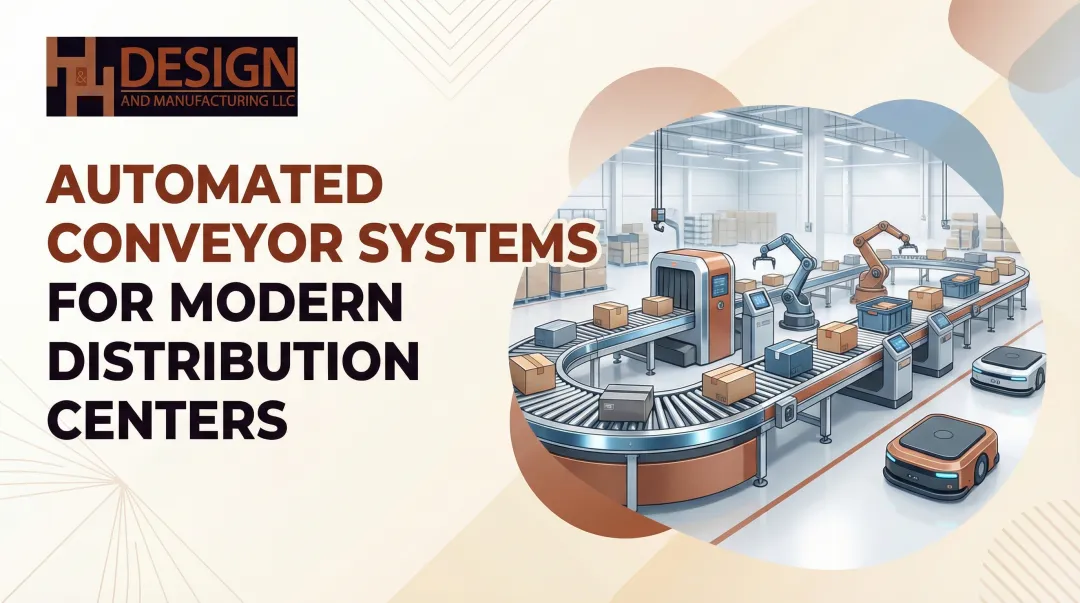
Conveying automation creates continuous, predictable product movement between stations, reducing manual handling and keeping production flowing smoothly. Reliable conveying is essential to achieving line-wide efficiency.
Common conveyor types include:
Belt Conveyors – general-purpose movement of bagged or loose materials
Transfer Conveyors – connecting transitions between equipment
Incline Conveyors – elevating product to higher processing or filling points
Integrated Conveyor Lines – complete, synchronized transport for full bagging systems
Key Benefits:
Boosts throughput by eliminating manual transport delays
Reduces labor strain and ergonomic risk
Maintains steady downstream flow, preventing bottlenecks
C. Bulk Bag Handling Automation
Bulk bag automation supports safe, accurate, and dust-controlled handling of super sacks ranging from 100 to 4,400 lb. These systems are critical for plants dealing with large-volume dry bulk movement.
Automated Bulk Bag Fillers
Ensure accurate, repeatable fills with integrated weigh scales
Use inflatable bag seals and dust-tight connections for clean loading
Increase consistency while reducing operator involvement
Automated Bulk Bag Unloaders
Provide controlled discharge of powders and granules
Prevent bridging, rat-holing, and surging
Improve downstream accuracy and keep process flow stabilized.
D. Line-Level Automation & Integration
Line-level automation connects individual machines into one coordinated, efficient system. This transforms standalone equipment into a fully integrated packaging line.
Common integrations include:
Automated bag clamps, sealers, and closers
Robotic or semi-automatic palletizing
Dust control systems for cleaner operation
PLC controls & HMI interfaces for centralized operation.
Recipe-based changeovers that minimize downtime and operator error.
Benefits of Material Handling Automation
Material handling automation delivers measurable gains across production, quality, labor efficiency, and safety. For plants running dry bulk materials, the advantages become even more significant as requirements around accuracy, dust control, and throughput continue to rise.
1. Higher Throughput & Consistency
Automated equipment runs at predictable speeds and removes the variability inherent in manual filling and handling.
Cycles are faster, more repeatable, and less dependent on operator skill.
Production plans become easier to forecast since every shift performs the same task.
Equipment such as automated bag clamps and conveyors keeps product moving continuously.
For plants struggling with uneven output across shifts or operators, automation stabilizes performance and increases daily throughput.
2. Better Accuracy & Less Product Giveaway
Precision matters, especially with powders, costly ingredients, or high-volume product lines. Automated systems deliver tighter fills and reduce costly overfill.
Fine powders: Auger fillers provide controlled dosing and improved weight accuracy
High-accuracy applications: Net weigh systems (e.g., H&H Series 70) ensure consistent, recipe-driven fills
Bulk operations: Modern bulk bag fillers routinely achieve ±1 lb accuracy, preventing major yield losses
Reduced giveaway means higher margins and more saleable product per shift.
3. Improved Safety & Less Dust Exposure
Automation reduces direct human contact with dusty materials and heavy bags.
Automated valve bag fillers limit airborne particles
Enclosed auger systems contain powders during dosing
Dust-tight spouts and seals keep material where it belongs
Plants benefit from a safer work environment, improved housekeeping, and easier compliance with OSHA and air-quality standards.
4. Reduced Labor Requirements
Automated equipment handles repetitive, labor-intensive tasks so operators can focus on higher-value work.
Less manual lifting, shoveling, and bag positioning
Fewer weight checks and adjustments
Lower staffing demands to maintain the same or higher output
This is especially valuable amid labor shortages or high turnover in packaging and material handling roles.
5. Faster Changeovers
Modern systems shorten downtime between material or bag changes.
Tool-less adjustments and easy-access components
Quick-clean designs like the H&H 52 QC simplify sanitation and material swaps
PLC-based recipes allow operators to change formats with a single command
Shorter changeovers allow plants to run more SKUs without sacrificing efficiency.
6. Lower Total Cost of Ownership
Automation pays for itself through long-term operational savings.
Fewer operator errors and less rework
Reduced downtime from manual bottlenecks
Less product loss, dust cleanup, and wasted labor hours
Longer equipment life with consistent, controlled operation
Together, these savings make automated systems a cost-effective upgrade, not just in capital ROI, but in ongoing operational performance.
When Should a Plant Invest in Material Handling Automation?
Plants benefit most from automation when operational pressures start affecting cost, throughput, or product quality. Key indicators include:
Throughput bottlenecks that limit daily output signaling that manual processes can no longer match production demand
Excess labor tied to manual bagging and handling, driving up operating costs, or making staffing difficult
Dust generation that threatens safety, compliance, or housekeeping standards, especially with fine powders
Tightening accuracy requirements, where even small overfill deviations impact the margin or product consistency
Growth plans that require scalable, repeatable production capacity beyond what manual processes can deliver
Frequent product changeovers, making faster, recipe-driven setups essential to maintain efficiency
When these conditions appear, automation typically offers rapid ROI by stabilizing production, reducing labor strain, and improving overall process control.
The Smart Way to Integrate Automation for Real Results
Automation is most effective when every machine in the packaging process works together. A filler, conveyor, or sealer on its own can improve a single step, but true efficiency comes from a fully integrated system that moves product smoothly from start to finish.
When equipment isn’t connected or synchronized, plants experience surging, slowdowns, inconsistent fills, and unnecessary downtime. Integration ensures that each stage operates at the same pace and supports the next.
How a Packaging Line Should Flow
A properly designed dry bulk line follows a coordinated sequence:
Upstream product feed → Weighing & filling → Conveying → Sealing/closing → Palletizing
Each transition must be balanced. For example, consistent product feed upstream is critical, without stable material flow, even the most accurate filler cannot maintain repeatable weights.H
How H&H Design's Approach to Smooth Line Integration
Modern plants often reach a point where manual processes slow production, create inconsistency, or make it difficult to meet growing demand. H&H Design Mfg builds equipment specifically to solve these issues by automating the most labor-intensive and accuracy-critical steps in dry bulk packaging.
This includes:
Equipment matched to material flow and fill-rate requirements
Fillers designed to communicate with upstream and downstream systems
Conveyor and sealing equipment that maintains smooth product movement
Bulk bag and small bag systems that share common integration standards.
How H&H Provides the Solution
H&H offers a full range of automated fillers and integrated systems for powders, granules, and pellets. Their equipment is built to improve accuracy, reduce dust, and increase speed, while fitting into the layout and workflow of real production environments.
Key examples include:
Series-based fillers for a wide range of dry bulk materials
Dual-auger precision systems like the Series 54 for high-speed powder filling
Dust-tight auger fillers, such as the Series 52 Valve, for cleaner operation
Quick-clean designs like the Series 52 QC for food, dairy, and frequent changeovers
High-accuracy net weigh automation with the Series 70
Integrated conveyors for smooth movement from filler to sealer
Custom configurations to match unique plant layouts or bagging requirements
Each system is engineered for stability, repeatability, and long-term industrial use.
H&H is a dependable, right-sized automation partner, easy to work with and engineered to help plants scale production with confidence.
Controls & Communication That Make It All Work
Reliable integration depends on smart, compatible controls. H&H supports this with:
UL-certified control panels for compliant, safe operation
PLC compatibility (Allen-Bradley, Siemens, and others) for easy system-wide communication
Custom control configurations to match plant automation standards and preferred network protocols
H&H-integrated systems unlock smoother flow, precision fills, reduced downtime, and higher output from end to end.
It’s how H&H transforms standalone equipment into a unified, production-ready powerhouse.
Conclusion
Material handling automation plays a critical role in helping plants increase throughput, improve weighing accuracy, reduce product giveaway, and strengthen safety. By minimizing dust exposure and relieving labor-intensive tasks, automated systems create a more consistent and efficient production environment, one that performs reliably across every shift.
H&H Design Mfg provides automation solutions built for mid-sized manufacturers that need dependable, scalable equipment without unnecessary complexity. With configurable fillers, precision weighing systems, bulk bag solutions, and fully integrated line components, H&H delivers automation that fits real operational constraints and supports long-term growth.
Ready to explore automation for your dry bulk handling operation?
Talk to an H&H engineer about your bagging or bulk bag application.
FAQs
1. Which industries benefit the most from automated material handling systems?
Industries that handle powders, granules, and bulk solids see the greatest impact, such as food and ingredients, agriculture, chemicals, minerals, plastics, building materials, and animal feed. Any operation that fills bags, drums, or bulk bags can gain measurable improvements in throughput, accuracy, dust control, and labor efficiency.
2. Does automation reduce labor in bulk packaging lines?
Yes. Automated fillers, conveyors, and bag-handling systems significantly reduce manual lifting, positioning, and repetitive tasks. Instead of several operators manually managing each stage, one operator can often oversee an automated line, lowering labor costs and minimizing ergonomic risks.
3. How do automated bag fillers integrate with conveyors?
Fillers and conveyors are designed to work as a synchronized system. Once a bag is filled, the conveyor automatically advances it toward sealing, inspection, or palletizing. This coordinated flow eliminates downtime between stations and ensures consistent line speed and throughput.
4. What factors determine the ROI of material handling automation?
Key ROI drivers include reduced labor requirements, decreased product giveaway, higher throughput, lower maintenance costs, improved safety, and fewer quality issues. Plants often see the fastest payback when replacing outdated manual processes or addressing bottlenecks that limit production.
6. Can automated systems fit into my existing bagging line layout?
In most cases, yes. Many fillers, conveyors, and bulk bag systems are designed for flexible integration. H&H offers custom configurations and PLC-compatible controls to adapt equipment to available space, product flow, and plant automation standards.