Introduction
Grain producers, feed mills, and agricultural packagers face relentless pressure to fill 50 lb bags quickly, accurately, and at scale. Manual scooping and imprecise filling lead to costly product giveaway, regulatory compliance headaches, and labor strain that erodes profitability. With nearly 15,000 grain elevators and feed mills operating across the United States—generating over $401.7 billion in economic activity—even small inefficiencies in the bagging line compound into significant losses across a season.
This guide covers the main types of 50 lb bag fillers for agricultural grains, the components of a complete bagging line, and how to match equipment to your throughput targets and grain type—whether you're filling deer corn for retail or packaging soybeans for bulk distribution.
What Is a 50 lb Bag Filler for Agricultural Grains?
A 50 lb bag filler in the agricultural context is a gravity-fed or pneumatic machine that simultaneously weighs and fills open mouth or valve-style bags with free-flowing grains to a precise target weight of 50 pounds. These machines replace manual scooping with automated weighing systems that control product flow, ensuring consistent weight compliance on every bag.
Who Uses This Equipment
Agricultural bag fillers serve a diverse market:
- Grain elevators packaging shelled corn and wheat for retail sale
- Deer corn packagers supplying hunting and wildlife feed markets
- Feed mills producing livestock and poultry rations
- Seed companies packaging certified seed for growers
- Agricultural cooperatives selling bagged product to retailers and distributors
Standalone Filler vs. Complete Bagging System
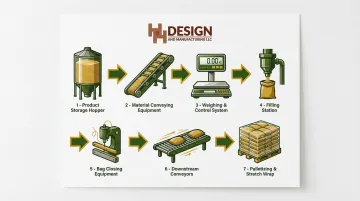
A standalone bag filler is one component — the machine that dispenses and weighs product into bags. A complete bagging system integrates that filler with everything upstream and downstream:
- Product storage hoppers
- Material conveying equipment
- Weighing and control systems
- Filling stations
- Bag closing equipment (sewing or sealing)
- Downstream conveyors
- Palletizing and stretch wrapping
Specifying only a filler without accounting for the surrounding system is one of the most common sources of throughput bottlenecks — particularly when bag closing speed can't keep pace with fill rate.
Types of 50 lb Bag Fillers for Grain Operations
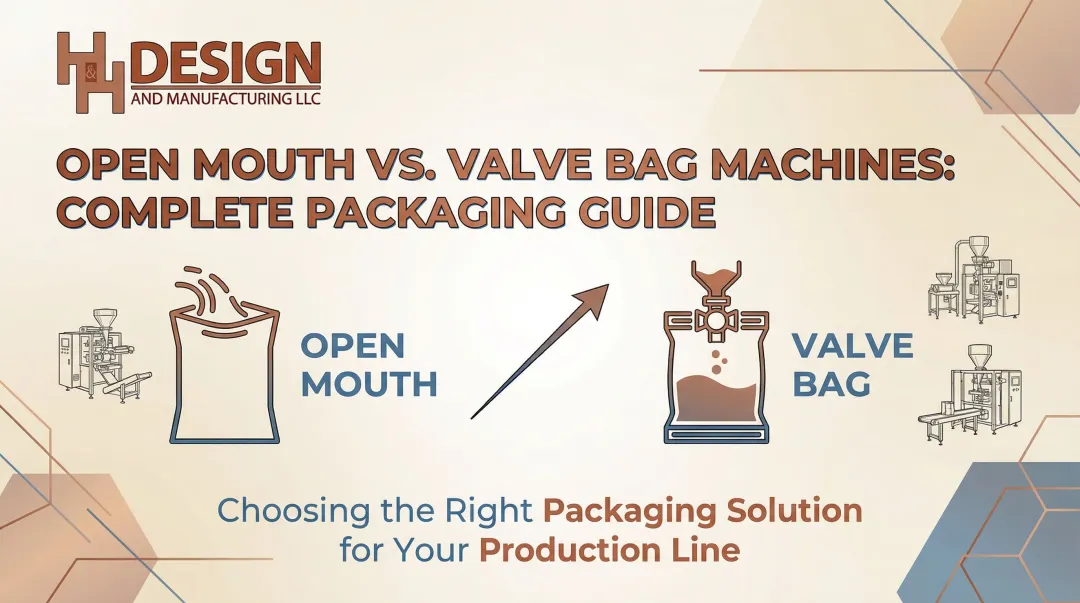
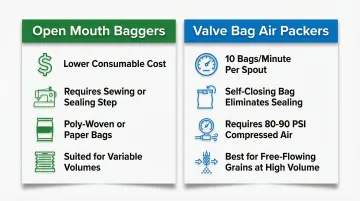
The right filler depends on bag type preference, throughput target, and grain characteristics. Two primary categories dominate agricultural grain applications: open mouth baggers and valve bag fillers.
Mechanical Gross Weigh Bagging Machines
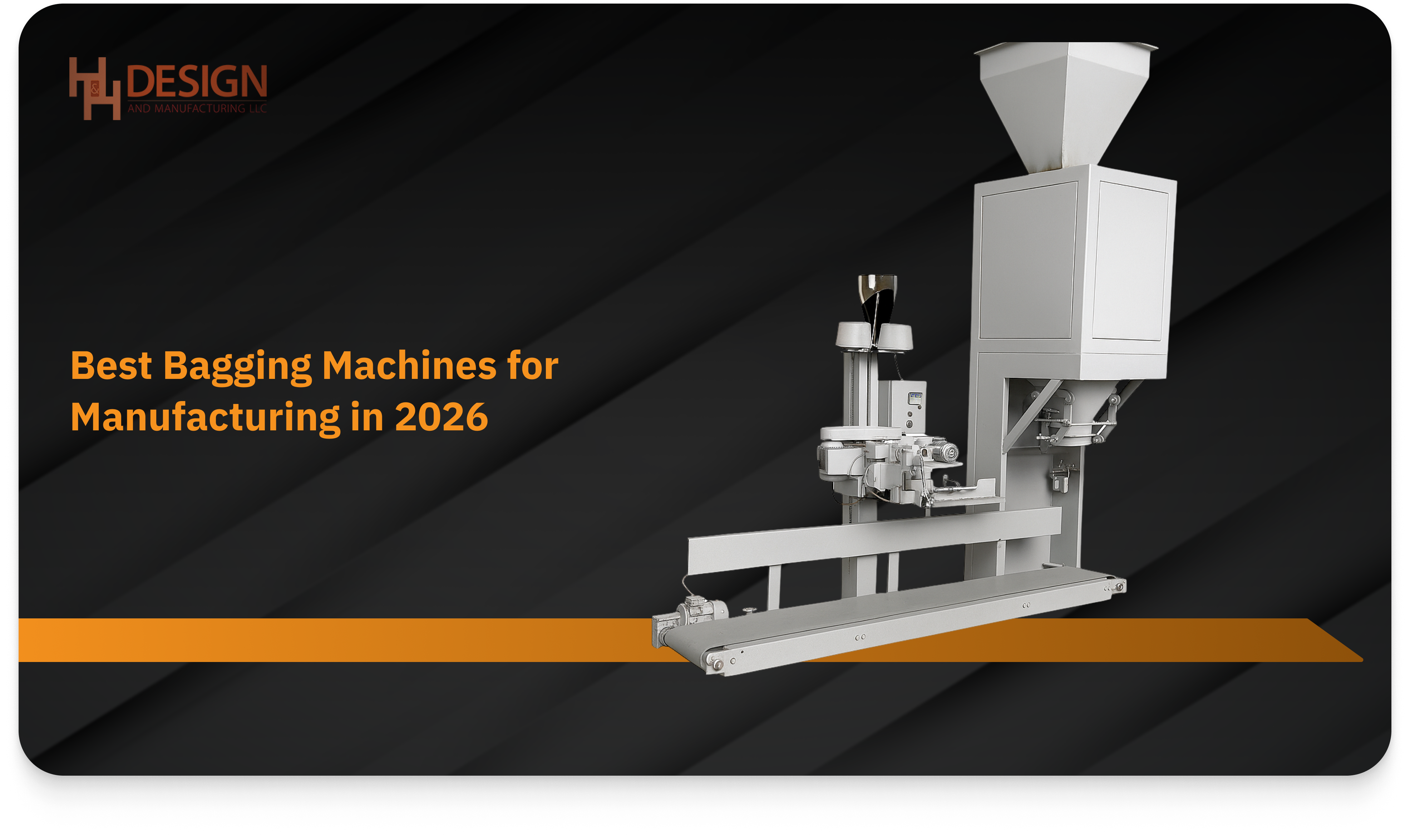
Mechanical gross weigh machines are gravity-style open mouth fillers that simultaneously fill and weigh product into paper or poly-woven bags without requiring electricity or compressed air for basic operation. The bag hangs directly on a mechanical counterbalance scale, and the weight of the product triggers a mechanical gate to close.
These systems offer:
- Lowest capital cost entry point
- Simple maintenance with minimal moving parts
- No electricity or compressed air required
- Bulk-flow-only design (no dribble flow cutoff)
- Throughput: typically 10–12 bags per hour for manual operations
- Reduced weight accuracy compared to digital systems
These machines suit low-volume operations where simplicity and low upfront cost outweigh throughput and precision requirements.
Digital Gross Weigh Bagging Machines
Digital gross weigh machines upgrade mechanical systems with electronic controls, load cells, and programmable logic. Standard capabilities include:
- Automatic tare for consistent net weights
- Bulk and dribble flow control for precision filling
- Pneumatic bag clamps to reduce operator fatigue
- Programmable product memory for multiple grain types
- Weight accuracy: ±0.1 to 0.2 pounds typical
- Throughput: 3–9 bags per minute depending on configuration
The dribble flow function slows product discharge near target weight, allowing the scale to stabilize before cutoff. For retail-labeled 50 lb bags, that precision directly affects regulatory compliance and per-bag giveaway costs.
H&H Design Manufacturing's Series 52 and Series 54 systems are purpose-built digital gross weigh fillers, rated at 3–6 bags per minute (Series 52) and 3–9 bags per minute (Series 54) on 50 lb fills with direct mount load cell design for ultra-high weight repeatability.
Valve Bag Fillers (Air Packers)
Air packers use compressed air to fluidize grain and blow it into self-closing multiwall paper valve bags. Product flows by gravity into an air pressure chamber, which then pressurizes and forces grain through a spout into the bag's valve sleeve.
For high-volume grain operations, air packers offer clear throughput advantages:
- High throughput: 10 bags per minute per spout (600 bags/hour)
- No bag sewing or sealing required
- One operator can manage filling and palletizing
- Square, stackable bags for efficient shipping
The tradeoff is higher infrastructure and consumable requirements:
- Compressed air: 80–90 PSI at approximately 1 CFM per spout
- Dust collection: 200–300 CFM recommended
- Higher per-bag cost for valve bags
- Best suited for free-flowing granular grains (shelled corn, soybeans)
- Less compatible with fine powders or irregular-shaped seeds
When volume is high enough, the per-unit speed advantage of air packers offsets the higher consumable and infrastructure costs.
Key Components of a Complete 50 lb Grain Bagging System
A bag filler is one piece of a larger system. Buyers need to understand all components to specify a complete, integrated line and avoid throughput bottlenecks.
Product Storage and Hopper
The supply hopper sits directly above the bag filler, providing consistent gravity head to maintain steady fill rates. Hopper sizing depends on:
Capacity considerations:
- Small hoppers (25 cu ft) suit 150-300 bags/day operations with frequent refills
- Large hoppers (70 cu ft) support 500-1,000+ bags/day with less frequent refilling
Refill methods:
- Auger conveyors for horizontal transfer
- Bucket elevators for vertical lift from ground-level storage
- Gravity discharge directly from overhead bins
Properly sized hoppers prevent production interruptions and maintain consistent product flow, which directly affects fill accuracy and throughput.
Weighing and Control System
The weighing system determines fill accuracy and directly affects giveaway cost and regulatory compliance.
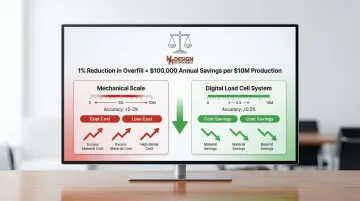
Mechanical beam scales:
- Counterbalance design requires no electricity
- Manual weight adjustments mean lower accuracy and repeatability
Digital load cell systems:
- Programmable controllers with electronic load cells
- Automatic tare removes bag weight from the net weight calculation
- Bulk-to-dribble flow cutoff (slows feed near target weight) sharpens final precision
- Weight memory stores parameters for multiple grain types
- Typical accuracy: ±0.5% to ±1 oz
Financial impact: A 1% reduction in overfill can save $100,000 annually for a facility producing $10 million in product. Digital weighing systems pay for themselves through giveaway reduction alone.
Bag Closing Systems
Once the bag is filled and weighed, it needs to be closed — and the method depends on bag type. Open mouth bags require an active closing step; valve bags are self-closing.
Bag sewing conveyors:
- Pedestal-mounted sewing head stitches poly-woven and paper bags closed
- Closing speed must match filler output (14-16 bags/minute)
- Capital cost: approximately $20,000-$25,000
Heat sealers:
- Seal polyethylene-lined bags without sewing
- Faster than sewing for compatible bag materials
- Lower maintenance than sewing heads
Valve bags:
- Self-closing design eliminates the need for a separate closing machine
- Reduces capital expenditure by $20,000-$25,000 per line
- Reduces labor and maintenance costs
- Higher per-bag consumable cost
Bag Handling Conveyors and Palletizing
Closing the bag is the last step before it leaves the line — but how it gets from the filler to the pallet determines labor requirements and end-of-line throughput. Filled bags move downstream via conveyor systems:
Incline conveyors:
- Transport bags vertically to pallet loading stations
- Compress bags to uniform thickness for stable stacking
- Adjustable height for different pallet configurations
Gravity roller tables:
- Provide staging area for manual palletizing
- Allow operators to build pallets at comfortable working height
Manual-assisted palletizing:
- Scissor lift pallet jacks lower pallets as layers build
- Gravity roller tables facilitate bag positioning
- Suitable for 150-500 bags/day operations
Automated robotic palletizers:
- Handle 1,000+ bags/day consistently
- Typical payback period: 12-24 months
- Reduce labor requirements by 2-3 full-time employees
- Eliminate repetitive motion injuries
Pallet stretch wrapping:
- Final step for secure shipping
- Protects bags from moisture and tampering
- Stabilizes pallets during transport
H&H Design Manufacturing builds complete bag lines from filling to palletizing — including custom controls and multi-unit integration. As a UL-certified control panel shop, H&H handles the electrical and mechanical coordination across every component, which matters when throughput targets and grain types change over time.
Agricultural Grains and Products Compatible with 50 lb Bag Fillers
Most 50 lb bag fillers handle free-flowing, dry grains with consistent particle size and low moisture content.
Primary Agricultural Grain Types
Compatible products include:
- Whole corn (shelled/deer corn)
- Feed corn and cracked corn
- Soybeans
- Rice (rough and milled)
- Wheat and wheat berries
- Bird seed mixes
- Cattle and livestock feed
- Alfalfa pellets and cubes
- Poultry feed pellets
Material Flow Characteristics Matter
Bulk density, particle size, and moisture content affect filler selection:
Ideal characteristics for gravity fillers:
- Bulk density: 40-60 lb/ft³
- Free-flowing (angle of repose <40°)
- Dry (moisture content <12%)
- Consistent particle size
Dense, dry grains like shelled corn (56 lb/ft³) and soybeans (60 lb/ft³) work well with air packers. Finer seeds or irregular-shaped materials may require adjustments to spout size or flow control settings.
Borderline Products Requiring Special Consideration
Gross weigh open mouth baggers aren't limited to grain. With the right spout sizing, these fillers also handle:
- Flour and grain meals
- Granulated sugar
- Salt and mineral supplements
- Fine powders with flow additives
If your operation packages more than one product type, confirming compatibility upfront — before specifying a machine — prevents costly retrofits later.
How to Choose the Right 50 lb Grain Bag Filler for Your Operation
Selection hinges on four key variables:
- Target throughput (bags per hour)
- Preferred bag type (open mouth vs. valve)
- Available utilities (electricity, compressed air)
- Budget (initial equipment vs. long-term labor savings)
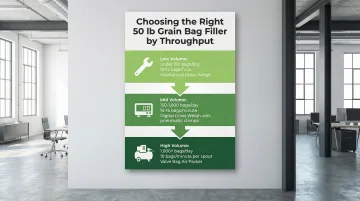
Throughput Decision Tree
Low-volume operations (<150 bags/day, 10-12 bags/hour):
- Mechanical gross weigh units offer the lowest capital cost
- Manual bag hanging and removal keeps complexity minimal
- Best fit when labor availability isn't constrained
Mid-volume operations (150-1,000 bags/day, 20-30+ bags/hour):
- Digital gross weigh machines with pneumatic bag clamps hit 14-16 bags per minute
- Accuracy holds at ±0.1 to 0.2 pounds
- ROI comes from reduced product giveaway and lower labor costs
High-volume operations (1,000+ bags/day, 50+ bags/hour):
- Valve bag air packer systems or multi-station setups reach 10 bags per minute per spout (600 bags/hour)
- Eliminates the bag closing step entirely
- Requires compressed air infrastructure (80 PSI, ~1 CFM per spout)
The Modular Upgrade Path
Volume requirements evolve — and well-designed bagging systems account for that. A mechanical bagger can be paired with a hopper and later upgraded to digital controls and a bag sewing conveyor without replacing the entire line. This reduces upfront capital risk for smaller operations while preserving the option to scale.
H&H Design Manufacturing's Custom Design Capability
As a UL-certified industrial control panel manufacturer in operation since 2008, H&H Design Manufacturing engineers 50 lb grain bagging systems tailored to specific throughput targets, grain types, and facility layouts.
Single-source solution advantages:
- Custom hopper sizing based on production volume
- Control panel integration with existing systems
- Full system commissioning and startup support
- Eliminates coordination issues from piecing together components from multiple vendors
H&H's Series 52 and Series 54 systems deliver 3-6 and 3-9 bags per minute respectively on 50 lb fills, with accuracies of ±0.1 to 0.2 pounds. Both systems feature direct mount load cell design, fully programmable controls with product memory, and can fill valve bags, open mouth bags, drums, or boxes with minimal changeover.
Contact H&H at sales@hhdesignmfg.com or (620) 421-9800 to discuss system configuration for your grain type, throughput target, and facility layout.
Frequently Asked Questions
What types of grains can a 50 lb bag filler handle?
Most 50 lb bag fillers handle free-flowing dry grains—shelled corn, soybeans, rice, wheat, bird seed, and feed pellets—with moisture content below 12% and particle size up to 1/4" diameter. Denser, uniform grains work best with air packers, while irregular seeds may require flow control adjustments during equipment selection.
What is the typical fill rate for a 50 lb grain bag filling machine?
Fill rates vary by machine type. Mechanical gross weigh units fill 10-12 bags per hour in manual operations. Digital gross weigh machines with pneumatic clamps achieve 14-16 bags per minute (840-960 bags/hour). Air packer valve bag systems reach 10 bags per minute per spout (600 bags/hour), with multi-spout configurations exceeding 1,200 bags/hour.
What is the difference between an open mouth bagger and a valve bag filler for grains?
Open mouth baggers fill bags that must be sewn or heat-sealed after filling, using poly-woven or paper bags with open tops. Valve bag fillers (air packers) fill self-closing bags that seal automatically when filling stops, eliminating the closing step. Open mouth systems have lower consumable costs; valve systems offer higher throughput and eliminate closing equipment.
Do I need electricity or compressed air to operate a 50 lb grain bag filler?
Basic mechanical gross weigh machines run on gravity and mechanical counterbalance alone—no electricity or compressed air needed. Digital gross weigh units require electricity (115V or 230V, 3-phase), and air packer valve bag systems need both electricity and compressed air (80 PSI at ~1 CFM per spout).
Can a 50 lb bag filler be integrated into a complete automated bagging line?
Yes. Fillers connect to upstream hoppers and conveyors for material supply, and downstream closing equipment, palletizers, and stretch wrap systems for a fully or semi-automated line. Modular designs let operators start with the basics and add automation as volume grows.
How accurate are the weighing systems on 50 lb grain bag fillers?
Digital gross weigh systems with bulk and dribble flow control deliver accuracies of ±0.1 to 0.2 pounds (±0.2% to 0.4%), significantly better than mechanical units. This accuracy matters for regulatory compliance—NIST Handbook 133 sets the Maximum Allowable Variation at 0.50 lb for 50 lb bags—and for reducing product giveaway, which can save $100,000 annually per $10 million in production volume.
Have specific throughput or grain-type requirements? Call H&H Design Manufacturing at (620) 421-9800 or email sales@hhdesignmfg.com to discuss your facility layout and production volume. The engineering team designs both standard and custom 50 lb bagging systems built to your exact specs.