Introduction
Grain producers and feed packagers lose time and money when one component in a packaging line can't keep pace. A single undersized hopper, a mismatched conveyor, or an overworked operator can bring an entire shift to a crawl.
Weight inconsistencies make the problem worse — wasted product, compliance exposure, and customer complaints all trace back to a system that wasn't matched correctly from the start.
Corn bagging equipment is a coordinated system. Storage, weighing, filling, bag closing, conveying, and palletizing must all run at matched throughput rates — and getting that match right is the difference between a line that hums and one that constantly stalls.
This guide walks through each stage of that system so you can identify where your current line falls short — and what a properly matched setup actually looks like.
TLDR:
- Corn bagging requires a complete system—hopper, filler, closer, conveyor, and palletizer—matched in throughput
- Mechanical gravity baggers deliver ~200 bags/hour; digital systems reach 300-500 bph; fully automatic lines hit 1,200-1,800 bph
- Open-mouth bags need sewing or sealing; valve bags self-close but cost more
- Modular systems allow upgrades from semi-automatic to fully automatic without replacing core equipment
- Custom-integrated lines ensure component compatibility and single-source accountability
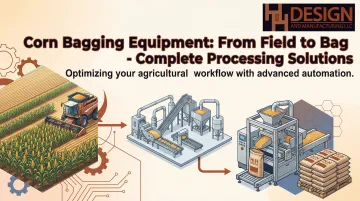
From Field to Bag: How a Complete Corn Bagging Line Works
A complete corn bagging line moves product through several linked stages — each one dependent on the one before it. Shelled corn arrives from a storage silo or bin, gets cleaned and conveyed upward, and is staged above the bagging machine. Gravity-fed systems need that elevation: without sufficient head pressure, flow becomes erratic and fill weights drift.
The Role of the Surge Hopper
A surge or supply hopper acts as a buffer between the upstream conveyor and the bagging machine. High-level and low-level sensors regulate flow, triggering the conveyor to refill the hopper when product levels drop. This prevents the bagger from "starving" and ensures consistent fill weights.
Hopper sizing depends on throughput:
- 25 cubic foot hoppers suit low-volume lines producing fewer than 200 bags per hour
- 70 cubic foot hoppers are necessary for mid-volume operations running 300-500 bags per hour
- Custom or bin discharge stands support high-volume lines exceeding 800 bags per hour
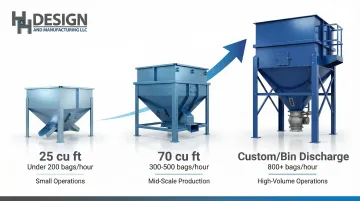
Undersized hoppers force frequent refills, creating stoppages that bottleneck the line. Oversized hoppers waste floor space and capital but rarely cause operational problems.
Filling and Weighing
Product flows from the hopper into the weighing and filling mechanism, which doses corn into the bag at a set target weight. Both mechanical and digital weigh systems exist:
- Mechanical systems use beam scales and manual adjustments, achieving accuracies around ±1% of target weight
- Digital systems employ load cells, programmable controllers, and dual-stage flow (bulk + dribble feed), tightening accuracy to ±0.5%
This step determines throughput and weight accuracy. A fast filler paired with a slow operator or inadequate downstream equipment creates a bottleneck.
After the Bag is Filled
Once filled, bags move to a closing station — sewing, heat sealing, or self-closing valve — and then onto a discharge conveyor that carries them toward a palletizing area. The conveyor must match the filler's output. A 500-bag-per-hour filler feeding a conveyor rated for 300 bags per hour creates backups. Operators end up manually staging bags, slowing the entire line.
Each stage must be matched in throughput capacity. Mismatched components are the most common cause of underperforming lines — and the hardest to fix after installation. Coordinating all equipment from the design phase is what separates a line that runs at rated speed from one that never reaches it.
Types of Corn Bagging Equipment: Filling Technologies Compared
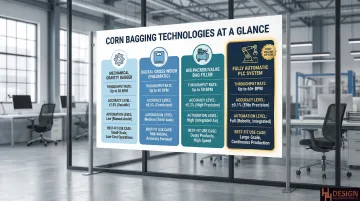
Before diving into individual systems, here's how the four main corn bagging technologies compare at a glance:
| System Type | Throughput | Accuracy | Automation Level | Best For |
|---|---|---|---|---|
| Mechanical Gravity Bagger | ~200 bags/hr | ±1% | Manual | Small ops, tight budgets |
| Digital Gross Weigh (Pneumatic) | 300–500 bags/hr | ±0.5–1% | Semi-auto | Mid-volume, accuracy-critical |
| Air Packer / Valve Bag Filler | 600–960 bags/hr | ±0.5–1% | Semi-auto | Free-flowing shelled corn |
| Fully Automatic PLC System | 1,200–1,800 bags/hr | ±0.5% | Full auto | High-volume commercial grain |
Mechanical Gross Weigh (Gravity-Style) Open-Mouth Baggers
The simplest and most budget-friendly option, mechanical gravity baggers require no electricity or compressed air for basic operation. Product flows by gravity into a weigh hopper; the operator manually hangs and removes bags.
- Bag types: Paper or poly-woven open mouth
- Common weights: 30–50 lbs
These systems suit smaller operations or tight budgets where labor is available. They're reliable, easy to maintain, and forgiving of inconsistent bag quality — a practical starting point before committing to automation.
Digital Gross Weigh Bagging Scales with Pneumatic Bag Clamps
Upgrading to digital controls and pneumatic automation improves both speed and precision. These systems use load cells, programmable controllers, and automatic bag clamps to speed up operation.
- Throughput: 300–500 bags/hr (6–8 bags/minute)
- Accuracy: ±0.5–1% of target weight
- Features: Auto tare, bulk + dribble feed modes, programmable weight memory
Dual-stage flow is the key differentiator here. A large gate handles fast "bulk" filling to ~90% of target weight, then a smaller gate or vibratory feed takes over for precise "dribble" filling — typically about two seconds of dribble flow before cutoff. The result: speed without sacrificing accuracy.
Air Packer / Valve Bag Fillers
Air packers use compressed air to blow corn into self-closing multiwall paper valve bags. No bag sewing required — the bag seals itself under product weight or ultrasonic sealing.
- Throughput: 10–16 bags/minute (600–960 bags/hr)
- Accuracy: ±0.5–1%
- Bag type: Valve bags only
Valve bags cost more than open-mouth bags, but they produce squarer, more stackable pallets and eliminate a separate closing station. For whole corn specifically, the higher bag cost often tips operators back toward open-mouth systems — worth factoring into your total cost per bag.
Fully Automatic / High-Speed Open-Mouth Bagging Systems
For large-scale commercial grain operations, fully automatic PLC-controlled systems integrate bag feeding, weighing, filling, and closing in one machine.
- Throughput: 1,200–1,800 bags/hr (20–30 bags/minute)
- Automation: Automatic bag placement, filling, and closing
- Requirements: Surge hoppers exceeding 70 cubic feet, substantial headroom, significant capital investment
These systems make economic sense when labor costs are high and sustained output consistently exceeds 20 bags per minute. Below that threshold, a semi-automatic system with an extra operator often delivers better ROI.
Control Panel Sophistication Matters
Digital controllers with auto tare, fill weight memory, and PLC integration improve consistency and cut down on operator error. For operations requiring UL-certified industrial control panels — mandatory for US and Canada compliance — verify that your equipment supplier holds that certification. H&H Design & Manufacturing is a certified UL Industrial Control Panel shop, which matters for integrated automated lines where electrical safety standards and insurance requirements are non-negotiable.
Bag Types and Closing Methods for Corn Packaging
Open-Mouth vs. Valve Bags
Two bag formats dominate corn packaging, each with distinct tradeoffs:
- Open-mouth bags are filled through the top and require a separate closing step. They're the standard for agricultural grains — lower cost, flexible across bag sizes, and gentler on product to reduce breakage.
- Valve bags have a small corner opening that self-seals after filling. They cost more upfront but produce squarer, more stackable pallets and eliminate the need for a sewing station. They work well with free-flowing shelled corn but are harder to make completely airtight.
Closing Methods for Open-Mouth Bags
- Sewing is the industry standard for grain bags. High-speed sewing heads run at 55–75 linear feet per minute. Pedestal-mounted and handheld machines are both common; conveyor speed and head positioning affect overall line throughput.
- Heat sealing handles poly-lined or plastic bags, using enhanced airflow for efficient heat transfer. It's faster than sewing but limited to poly materials.
- Pinch-top or fold-and-stitch delivers a sift-proof seal — typically reserved for higher-value or dusty products.
Closing method selection is closely tied to the bag material itself — some closures simply won't work with certain substrates.
Bag Material Options
- Kraft paper (multi-wall) is common for feed and seed, often paired with a poly liner for moisture-sensitive product. It's also printable, making it a practical choice for branded retail bags.
- Poly-woven (WPP) is the workhorse for corn and grain. Durable, compatible with both sewing and heat sealing, and naturally moisture-resistant.
- Laminated variants add enhanced printability and moisture resistance over standard WPP. Higher cost, but better shelf appeal for retail-facing products.
Standard bag weights in the US corn market run 30 lb, 40 lb, and 50 lb — a factor worth confirming early when sizing filling and closing equipment.
Conveying and Downstream Handling for Bagged Corn
Incline and Flat-Belt Conveyors
Conveyors move filled bags from the filler to the closing station and then to the palletizing area. Adjustable heights and variable speeds are essential to operator ergonomics and line flexibility.
Incline conveyors provide vertical transfer between bagging lines and palletizers, often compressing filled bags to uniform thickness for improved stacking stability.
Flat-belt bag conveyors transport bags horizontally through sealing or sewing stations. Slider bed designs with adjustable height and speed controls allow operators to maintain consistent working heights and pace bags for closing operations.
Bag conditioning conveyors use dual-belt compression systems to ensure stable pallets by conditioning bags before palletizing—especially important when corn bags vary in density or have not fully settled.
Palletizing Options
- Manual stacking with gravity roller tables — Entry-level option for low-volume operations. Scissor-lift stations keep working height constant, reducing back strain. Units handle loads up to 4,000 lbs with 360-degree rotating platforms.
- Semi-automated incline + gravity roller setups — One operator can stack bags efficiently with powered incline conveyors feeding gravity rollers, eliminating excessive lifting at mid-range volumes.
- Robotic or conventional palletizers — Justified when production exceeds 20 bags per minute consistently. Robotic systems handle payloads from 30 kg (66 lbs) to 800 kg, outpacing manual labor and cutting injury risk.
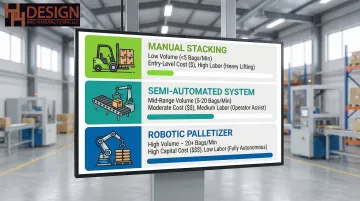
Manual systems keep capital costs low but trade throughput for labor. Automated systems require higher upfront investment—one that pays off quickly when volumes are consistent and labor costs are high.
Pallet Stretch Wrapping
Once pallets are stacked, stretch wrapping is the final step before storage or shipment. Automated stretch wrappers integrate in-line with high-speed baggers, keeping pace with production without manual intervention. For 30-50 lb grain bags, proper wrapping addresses several risks:
- Prevents load shifting during transport
- Protects bags from moisture and contamination
- Maintains pallet integrity through stacking and storage
How to Choose the Right Corn Bagging System for Your Operation
Frame the Decision Around Three Variables
Three factors drive every corn bagging system decision:
- Throughput target — sustained average bags per hour matters more than peak capacity
- Available labor — more automation reduces headcount but raises capital cost
- Budget vs. labor cost — automation ROI improves when labor is expensive or hard to find
Throughput-Based Selection Guide
Low-volume operations (up to 200 bags/hour):
- Mechanical gravity baggers
- Manual bag hanging and removal
- Pedestal or handheld sewing machines
- Manual palletizing with gravity rollers
- 1-2 operators per line
Mid-volume operations (300-500 bags/hour):
- Digital gross weigh scales with pneumatic clamps
- Semi-automated bag handling
- Sewing conveyors with adjustable speed
- Semi-automated palletizing with incline conveyors
- 2-3 operators per line
High-volume operations (1,200-1,800+ bags/hour):
- Fully automatic PLC-controlled systems
- Automated bag feeding, filling, and closing
- Robotic or conventional palletizers
- Automated stretch wrapping
- 1-2 operators per line (for oversight and troubleshooting)
The global bagging machine market is projected to reach $9.4 billion by 2033, with fully automatic systems accounting for 60.3% of market share—driven by labor cost pressures and the ROI of automation.
When Modular/Upgradeable Systems Make Sense
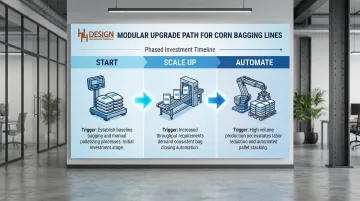
Operations that start semi-manually but anticipate growth should prioritize baggers and conveyor systems designed for upgrades. Adding a sewing conveyor, moving from mechanical to digital controls, or integrating a palletizer should all be possible without replacing the core filler.
Modular systems support phased investment:
- Start with a digital gross weigh scale and manual palletizing
- Add a sewing conveyor as throughput increases
- Integrate a robotic palletizer when labor becomes scarce or expensive
The Value of Custom-Integrated Systems
That phased approach only works when components are designed to work together. Sourcing a filler from one supplier, conveyors from another, and a palletizer from a third creates compatibility headaches, finger-pointing when something goes wrong, and mismatched throughput rates.
Working with a manufacturer that designs and builds a complete system ensures component compatibility, optimized throughput, and single-source accountability. H&H Design and Manufacturing engineers custom dry bulk weighing and packaging equipment—from surge hoppers and digital fillers through sewing conveyors and palletizing—all matched to your target throughput and budget.
Frequently Asked Questions
What is the difference between open-mouth bagging and valve bag filling for corn?
Open-mouth bags are filled through the top and require a sewing or sealing step to close. Valve bags are self-closing and sealed by the product weight itself or ultrasonic sealing. Valve bags work well with free-flowing shelled corn and eliminate the need for a bag closing station, but they cost more per bag.
How many bags per hour can a typical corn bagging system fill?
Throughput varies widely by equipment type: mechanical gravity systems fill ~200 bags per hour, digital gross weigh scales achieve 300–500, and fully automatic high-speed systems reach 1,200–1,800. The configuration of the full line—not just the filler—determines practical output.
What bag sizes and weights can corn bagging equipment handle?
Most corn bagging equipment handles 30–50 lb retail bags, with adjustable settings ranging from 20 lb to 110 lb (9–50 kg). Many machines accommodate multiple weight ranges through programmable controllers with product memory, though equipment must be configured to match the target bag size.
Do I need a bag sewing machine with a corn bagging system?
Sewing machines are needed for open-mouth bags but not for self-closing valve bags. Heat sealing is an alternative for poly-material open-mouth bags. The choice depends on bag type, throughput requirements, and whether you prioritize lower bag costs (open-mouth) or faster closing (valve).
Can corn bagging equipment also handle other grains and agricultural products?
Yes. Most corn bagging systems are designed for free-flowing granular products and can typically handle other grains (wheat, soybean, sorghum, bird seed), feed pellets, and similar dry bulk materials with minimal or no adjustment. Variable speed drives and programmable controls allow quick changeovers between products.
How do I decide between a semi-automatic and a fully automatic corn bagging system?
Weigh throughput requirements, available operator headcount, and capital budget. Semi-automatic systems suit lower-volume or startup operations with more operator involvement, while fully automatic lines pay off at higher volumes where labor savings justify the investment—typically when production exceeds 20-30 bags per minute consistently.