Introduction
When production volume scales faster than packaging capacity, the bottleneck doesn't just slow your line: it compounds across every downstream operation, from palletizing to shipping. Many manufacturers struggle with throughput limitations, inconsistent fill weights, and labor inefficiencies that erode margins and delay orders. Choosing the wrong bagging machine amplifies these problems, locking facilities into equipment that can't adapt to changing material specifications or production demands.
Bagging machines are critical infrastructure for throughput, product consistency, and labor efficiency in food processing, agriculture, chemicals, and mining.
The global bagging machines market was valued at $5.3 billion in 2023 and is projected to reach $9.3 billion by 2032, growing at a CAGR of over 6.5%. That growth reflects the widespread shift toward automation as manufacturers address labor shortages and tighter tolerances in material handling.
This guide evaluates the best bagging machine manufacturers for industrial applications, focusing on engineering capability, material compatibility, total cost of ownership, and adaptability to changing production demands.
Key Takeaways
- Bagging machines range from semi-automatic open-mouth fillers to fully automated valve bag and bulk bag systems— each suited to specific materials and production volumes
- Selection depends on material type, bag format, throughput rate, automation level, and how the machine integrates with downstream conveyors and palletizers
- Leading manufacturers provide custom engineering, industry certifications, and post-sale support alongside standard catalog equipment
- H&H Design and Manufacturing, Premier Tech, Payper, Paxiom, and Newlong are among the leading manufacturers for industrial applications
- Factor total cost of ownership — maintenance, downtime, and support — into any purchase decision, not just sticker price
Overview of Bagging Machines in Manufacturing
An industrial bagging machine is purpose-built for dry bulk, granular, powder, and heavy material handling in continuous production environments. Unlike lighter-duty commercial or retail packaging equipment, these systems are engineered for high-cycle durability, accuracy under load, and integration with upstream material handling and downstream palletizing.
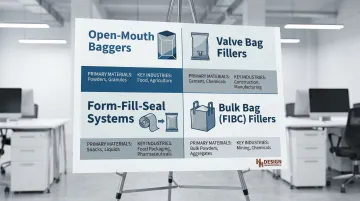
Core Machine Categories:
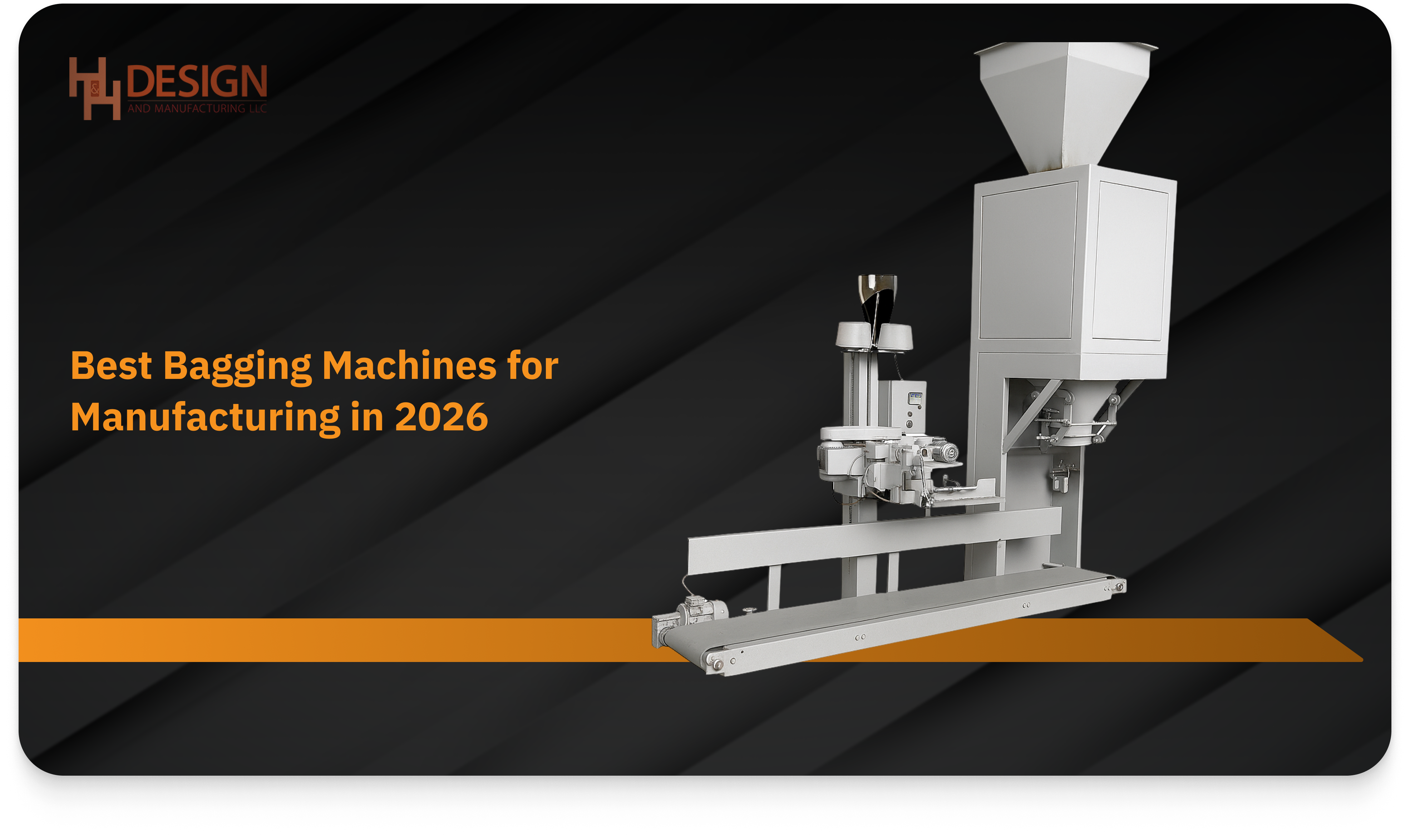
- Open-mouth baggers: Fill pre-made bags through an open top, then seal by sewing or heat — versatile across agriculture, food, chemicals, and minerals for powders, granules, flakes, and coarse aggregates.
- Valve bag fillers: Inject material through a one-way valve in a pre-formed bag, producing squared packages that stack cleanly on pallets. Common for powders, mixes, and pellets in chemicals, construction, and food.
- Form-fill-seal (FFS) systems: Form, fill, and seal bags from a continuous film roll in a single automated process — well-suited for free-flowing pellets and powders in petrochemicals and agriculture.
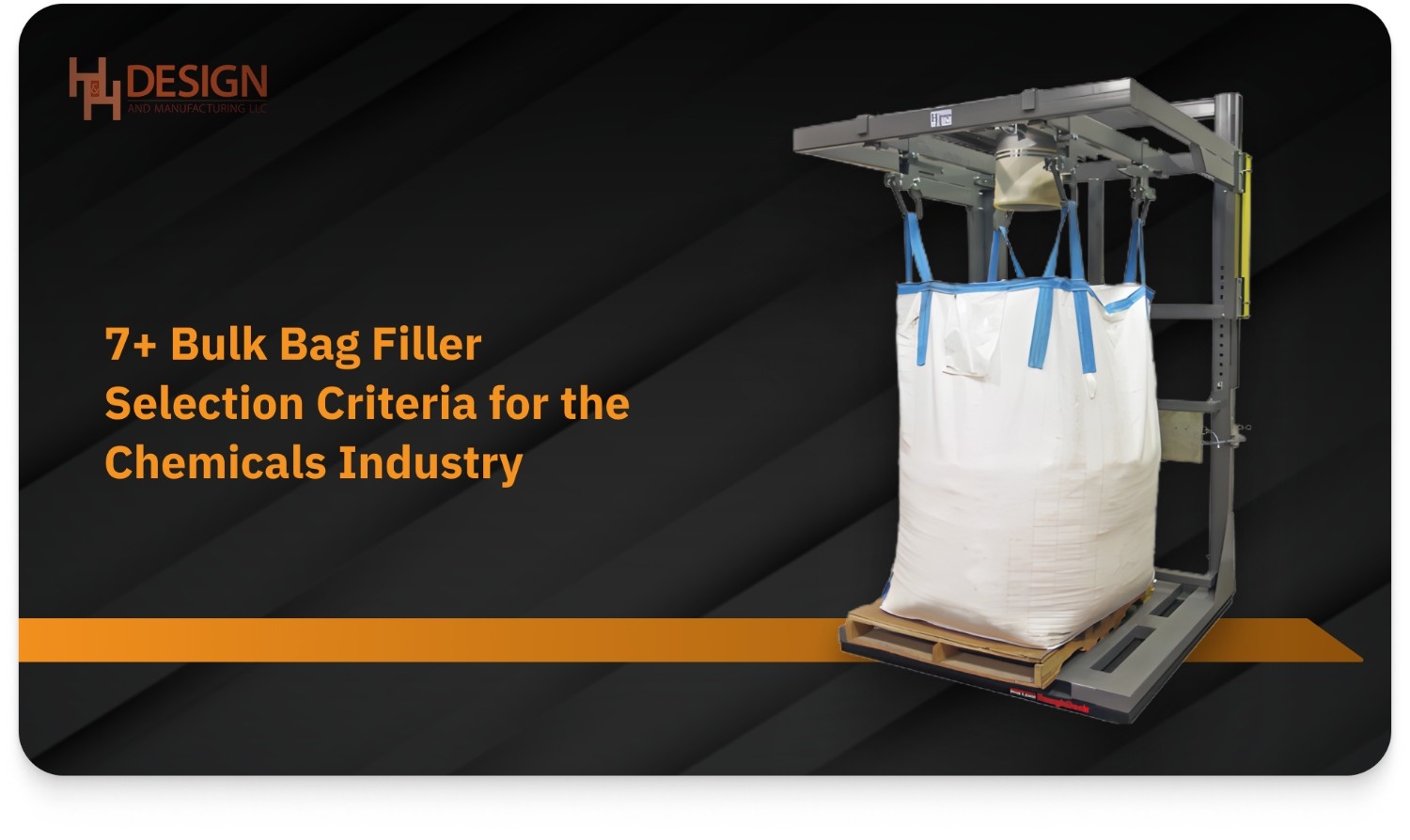
- Bulk bag (FIBC) fillers: Handle large-volume bags ranging from 500 to 2,000 kg for bulk transport in mining, chemicals, building materials, and agriculture.
The manufacturers below were selected based on engineering depth, industry-specific experience, customization capability, certifications, and track record serving North American manufacturing operations — not simply brand recognition.
Best Bagging Machines for Manufacturing
H&H Design and Manufacturing
Founded in 2008 and based in Parsons, KS, H&H Design and Manufacturing specializes in custom dry bulk weighing and packaging equipment for food, dairy, chemicals, agriculture, and mining industries. The company serves customers across the US, Canada, Mexico, South America, and the Middle East.
As a Certified UL Industrial Control Panel Shop for US & Canada, H&H controls quality at every stage of design, manufacturing, and commissioning. Being a smaller, family-owned operation lets them meet tight deadlines and fulfill custom engineering requests that larger manufacturers won't take on. Their 2011 acquisition of Tech Packaging Group also means they can service and support legacy Tech Pack equipment—a critical advantage for facilities with existing installations.
Their product line covers a wide range of applications:
- Small bag fillers: 2 oz to 110+ lbs capacity
- Bulk bag systems: 100 to 4,400 lbs, with 10–30 containers/hour throughput
- Series 52 and 54: 3–9 containers per minute for 50-pound bags at ±1 lb per 1,000 lbs accuracy
- Complete line integration: filling to palletizing, with custom controls and multi-unit coordination
| Key Machine Types | Dry bulk open-mouth baggers, custom weigh-fill systems, bulk bag (FIBC) fillers, integrated packaging lines | | Industries Served | Food, dairy, chemicals, agriculture, mining | | Key Differentiator | Custom engineering + UL-certified control panels + commissioning support |
Premier Tech
Premier Tech is a global industrial packaging company with decades of experience producing open-mouth bagging machines, valve bag fillers, and integrated palletizing systems. The company serves agriculture, pet food, building materials, and chemical sectors internationally.
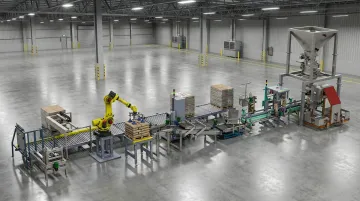
Premier Tech's standout capability is delivering fully integrated, end-of-line systems—bagging, conveying, and palletizing under a single engineering scope. Valve bag fillers achieve up to 16 bags per minute (960/hour) for 10–50 kg bags; open-mouth baggers reach 27 bags per minute. Bulk bag fillers handle up to 30 bags per hour at capacities up to 2,000 kg. Global service support and robotic palletizing integration round out the package for facilities running high-volume, turnkey lines.
| Key Machine Types | Open-mouth baggers, valve bag fillers, robotic palletizing systems, bulk bag (FIBC) fillers | | Industries Served | Agriculture, pet food, chemicals, building materials | | Key Differentiator | Integrated end-of-line automation with global service support |
Payper
Payper is a Spanish industrial packaging machinery manufacturer with a strong international presence, specializing in open-mouth and valve bag filling lines designed for high-throughput production in agriculture, food, and construction materials industries.
Payper's focus is precise net-weight dosing with hygienic-design equipment for food-grade environments. The CSA series open-mouth baggers reach up to 1,200 bags/hour, with high-speed models rated at 2,600 bags/hour for 5–50 kg bags. Their electronic dosing and weighing systems—controlled by the MSX controller—emphasize accuracy alongside dust-controlled, hygienic construction. For food and chemical facilities with strict contamination requirements, that combination of speed and cleanliness is hard to match.
| Key Machine Types | Net-weight open-mouth fillers, valve bag lines, automatic bag placers, tubular FFS systems | | Industries Served | Agriculture, food, cement, chemical | | Key Differentiator | High-precision dosing with food-grade construction options |
Paxiom (WeighPack Systems)
Paxiom, operating under the WeighPack Systems brand for primary packaging, is a North American packaging machinery group offering VFFS machines, premade pouch filling systems, and weigh-fill solutions for food, nutraceutical, and consumer goods manufacturing.
Paxiom spans semi-automatic to fully automatic configurations, with auger powder fillers and multi-head weighers available as pre-fill stages. Key performance specs:
- VF 1200 continuous motion bagger: up to 150 bags per minute (9,000/hour mechanical rate)
- VerTek 2400: handles large-format bags up to 24 inches wide for bulk applications
Their turnkey systems from weigh-fill to case packing are backed by a strong North American service network for parts, field service, and startup support—reducing vendor coordination for complete line installations.
| Key Machine Types | VFFS machines, premade pouch baggers, auger powder fillers, multi-head weighers | | Industries Served | Food, nutraceutical, pet food, snack, powder | | Key Differentiator | Turnkey systems from weigh-fill to case packing with strong North American service network |
Newlong
Newlong is a Japanese industrial machinery manufacturer known for heavy-duty bag closing and sewing equipment as well as open-mouth bagging systems—widely used in agriculture, flour milling, chemical, and feed manufacturing globally.
Newlong's reputation rests on durable, low-maintenance sewing and sealing systems built for high-cycle industrial environments. The 3CM-5 series achieves up to 250 bags/hour for 20–30 kg bags, while the 3CM-5FG powder configuration reaches 200 bags/hour for 5–25 kg bags at ±1/500 accuracy.
The DS-9C sewing head runs at up to 2,700 stitches per minute—a workhorse spec for high-volume operations. Holding 95% market share for industrial sewing machines in Japan and backed by a global distribution footprint, Newlong is a dependable option for heavy industrial applications where long-cycle durability is non-negotiable.
| Key Machine Types | Open-mouth bag fillers, bag sewing/closing machines, valve bag equipment | | Industries Served | Agriculture, flour milling, chemical, animal feed | | Key Differentiator | Long-cycle durability and global service presence in heavy industrial applications |
How We Chose the Best Bagging Machines for Manufacturing
Rather than ranking by brand size or price, selection focused on engineering capability, material compatibility, automation range, and certifications across North American manufacturing operations.
One mistake buyers consistently make: prioritizing upfront machine cost over total cost of ownership. Downtime, spare parts availability, and service response time often dwarf the initial equipment investment over a 10-year lifecycle.
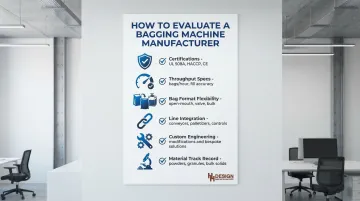
Key factors weighed include:
- Meets UL 508A certification for control panels (required in US/Canada), HACCP/FDA food-grade standards, and CE marking for export
- Verified throughput specs: bags per hour, weight ranges, and fill accuracy under real production conditions
- Handles multiple bag formats (open-mouth, valve, bulk) across weight ranges without extensive changeover
- Integrates natively with conveyors, palletizers, and upstream material handling through unified controls
- Capable of modifying standard equipment or engineering custom solutions for complex applications
- Documented track record with specific material types — fine powders, granules, and bulk solids — relevant to the buyer's industry
Conclusion
The right bagging machine comes down to material type, production volume, bag format, and how the equipment fits into your broader packaging line. A valve bag filler optimized for cement won't perform well with sticky food powders; a high-speed VFFS designed for snack foods will struggle with abrasive mineral granules.
Before finalizing any decision, evaluate scalability, total cost of ownership, and the manufacturer's ability to support custom requirements. A machine that fits today's specs but can't keep pace with tomorrow's production demands will cost more to work around than it ever saved. Factor in downtime risk, spare parts lead times, and service response.
On the financial side, ROI for automated bagging typically falls within 12 to 24 months, driven by labor savings, reduced product giveaway, and improved throughput.
For manufacturers in food, dairy, chemical, agriculture, or mining sectors looking for a custom-engineered dry bulk bagging solution, H&H Design and Manufacturing builds custom dry bulk filling and weighing systems with UL-certified controls — handling complex, project-specific requirements that off-the-shelf equipment can't address. Reach out at sales@hhdesignmfg.com or (620) 421-9800 to discuss your application.
Frequently Asked Questions
What is the difference between an open-mouth bagging machine and a valve bag filler?
Open-mouth machines fill bags through an open top that is then sealed by sewing or heat, offering versatility across diverse material types and bag sizes. Valve bag fillers inject material through a one-way valve in a pre-formed bag, creating squared packages that stack efficiently on pallets. Valve bags are better for dusty or fine powders due to their dust-tight filling process, while open-mouth systems offer more flexibility for coarse granules and mixed material forms.
How do I determine the right bagging machine speed for my production line?
Calculate required throughput by dividing your daily output target by available run hours to get bags per hour. Factor in changeover time between products, fill accuracy cycles (which slow throughput for precise weighing), and a capacity buffer of at least 15–20% above current needs. For example, if you need 5,000 bags per day across 8 hours, you need 625 bags/hour minimum—but should specify equipment rated for 750+ bags/hour to accommodate variability and growth.
Can one bagging machine handle both powder and granular materials?
Some machines can handle multiple material forms with auger or gravity-fed attachments, but performance and accuracy vary significantly by material flow characteristics. Fine powders may require auger feed for controlled dosing, while free-flowing granules work well with gravity or vibratory systems. Most reputable manufacturers will test your material samples before purchase to verify compatibility—always request a material trial before committing.
What certifications should I look for in an industrial bagging machine manufacturer?
Key certifications include UL 508A for control panels (required by most US and Canadian facilities), food-grade compliance (HACCP and FDA 21 CFR) for food and dairy applications, and CE marking for equipment destined for EU facilities. Certified manufacturers reduce liability during audits and streamline approvals with insurance providers and regulatory inspectors.
What is the typical ROI timeline for switching from manual to automated bagging?
Manufacturers typically see payback within 12 to 24 months, depending on labor costs and production volumes. Primary ROI drivers include labor savings (redeployment of personnel to higher-value tasks), reduced product giveaway through precision weighing, and improved throughput consistency. Facilities running multiple shifts or handling expensive materials often see faster payback, while lower-volume operations may extend to 24+ months.
What maintenance is typically required for industrial bagging machines?
A standard maintenance schedule covers daily air pressure and film alignment checks, weekly seal jaw inspection, monthly load cell calibration, and monthly bearing lubrication. Dust filter cleaning prevents airflow degradation in pneumatic systems. Skipping these steps leads to predictable failures: residue buildup causes bridging, worn seals create leakage, and uncalibrated load cells increase product giveaway.