Introduction
Process industry facilities face mounting operational pressure from multiple directions. Tighter fill tolerances mean every gram of product giveaway erodes margin. Stricter food safety regulations turn minor equipment shortcomings into audit findings. Unplanned downtime—now costing industrial businesses approximately $125,000 per hour—can wipe out a week's profit in a single shift.
That pressure makes equipment design more consequential than ever. Even so, custom equipment is still treated as a premium option rather than a practical one — this article challenges that assumption by showing where the real operational value actually shows up: throughput, quality consistency, and total cost of ownership.
Key Takeaways
- Custom equipment design means engineering industrial machinery around a facility's product, process, and environmental constraints—not adapting operations to fit off-the-shelf systems
- Generic equipment routinely introduces fill inaccuracies, contamination risks, and maintenance friction that compound over time
- Purpose-built equipment delivers process-specific operational fit, consistent output quality, and a lower total cost of ownership than generic alternatives
- Maximum impact comes when one accountable partner owns the full lifecycle: from initial design through installation and commissioning
- Facilities that rely on off-the-shelf systems tend to accumulate workarounds, absorb avoidable errors, and hit scaling walls that require costly re-investment
What Is Custom Equipment Design in Process Industries?
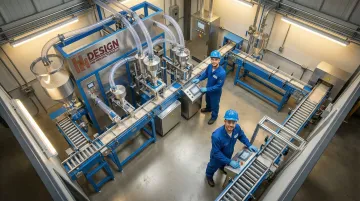
Custom equipment design is the process of engineering equipment from the ground up—or adapting a base design substantially—to match the specific material properties, throughput targets, spatial constraints, and compliance requirements of a given facility. Unlike selecting from a standard catalog, custom design tailors every critical parameter to the operation at hand.
In process industries, custom design is most commonly applied to:
- Dry bulk weighing and filling systems sized to specific throughput and accuracy targets
- Packaging lines configured around container formats and fill-rate requirements
- Material handling conveyors matched to facility layout and product flow
- Control panel systems built to manage automated process sequences
A dairy powder with hygroscopic characteristics and variable bulk density, for instance, requires different fill head configurations, control logic, and material contact surfaces than a free-flowing granular chemical.
Custom design is a means to operational outcomes: reduced variance, better uptime, and compliance readiness. It's not a luxury reserved for large operations. When equipment fits the process precisely, facilities avoid the hidden costs of workarounds, rework, and reactive maintenance that pile up when standard equipment is pushed beyond its intended application range.
Key Advantages of Custom Equipment Design
The advantages below focus on measurable operational impact—the kind of outcomes plant managers and operations leads actually track—rather than abstract claims about innovation or flexibility.
Advantage 1: Equipment That Fits the Process, Not the Other Way Around
Off-the-shelf equipment is engineered around the most common use case. Process facilities often have to modify their workflows, facility layout, or material handling practices to accommodate the machine—rather than the reverse. This creates friction at every handoff point.
Custom design inverts this relationship. The equipment is sized, positioned, and sequenced based on the facility's actual material flow, spatial dimensions, and production cycle. This eliminates the need for workarounds and adapter solutions that introduce manual interventions and slow down throughput.
Why this is an advantage:
Eliminating workflow workarounds reduces the number of manual interventions, handoffs, and adjustment steps in a production cycle. This directly lowers labor burden and the chance of human-introduced error. Research shows that 44% of industrial leaders experience equipment-related interruptions at least monthly, with 14% facing stoppages weekly—often due to equipment-workflow mismatches that force operators to intervene.
When equipment fits the process, production schedules become predictable. This has downstream effects on order fulfillment and customer confidence. A facility that can reliably hit its daily throughput target without unplanned stops can commit to tighter delivery windows and avoid the expediting costs that come with missed schedules.
KPIs impacted:
- Throughput rate (units per hour)
- Cycle time per batch
- Labor hours per unit
- Unplanned downtime frequency
Best-Fit Scenarios:
This advantage is highest-impact for facilities with non-standard material types (hygroscopic powders, variable bulk densities), irregular facility footprints, or multi-step packaging sequences where equipment handoffs introduce error. A facility handling cohesive dairy powders in a tight footprint, for instance, will see far greater benefit from custom-designed conveyors and fill heads than a facility running free-flowing granules in a greenfield layout.
Advantage 2: Consistent Output Quality and Reduced Product Variability
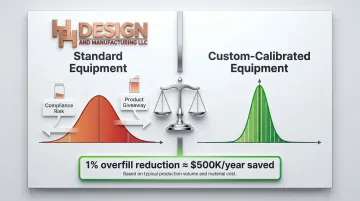
In dry bulk filling and packaging operations, output quality is defined largely by fill weight accuracy and repeatability. Standard equipment cannot consistently account for the variability in bulk density, particle size, or flowability that different materials exhibit. This forces operators to set higher target weights to avoid underfill, resulting in costly product giveaway.
Custom-designed weighing and filling equipment is calibrated around a specific product's material properties. The control systems, fill heads, and discharge mechanisms are tuned to deliver repeatable accuracy across production runs rather than approximating a target weight range.
Why this is an advantage:
Fill weight variance has direct cost implications. Reducing product overfill by just 1% on a high-volume line can save approximately $500,000 per year in material costs. Underfill creates compliance exposure and customer disputes. Facilities serving food, dairy, and chemical sectors face USDA, FDA, or chemical handling standards where equipment-driven product variability can trigger recalls, fines, or audit failures. The average direct cost of a food recall is estimated at $10 million, excluding brand damage and lost sales.
H&H Design Manufacturing maintains quality control across every phase: design, manufacturing, and on-site commissioning. When the same team that engineers the fill head also calibrates it during installation, there's no handoff gap between what was specified and what actually runs.
KPIs impacted:
- Fill weight accuracy (variance from target)
- Reject and rework rate
- Compliance audit pass rate
- Customer complaint frequency
When Precision Is Non-Negotiable:
This advantage is critical when handling materials with variable flow characteristics, when operating at high production volumes where small per-unit variance compounds quickly, and when serving markets with strict labeling or weight compliance requirements. For instance, a facility filling 1 million packages per week will see material cost savings scale rapidly with even minor improvements in fill accuracy.
Advantage 3: Lower Total Cost of Ownership Over Time
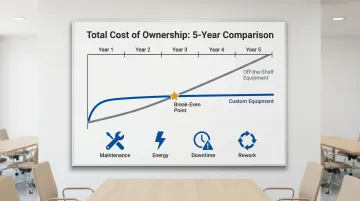
The upfront cost of custom equipment is typically higher than off-the-shelf alternatives. This creates a common decision-making bias toward standard solutions—often without accounting for the hidden costs that accumulate when equipment is not purpose-built.
Purpose-built equipment generates cost advantages across four areas:
- Reduced maintenance frequency, with fewer parts stressed by workflow workarounds
- Longer operational lifespan through right-sized mechanical components
- Lower energy consumption from correctly sized motors and actuators
- Fewer production interruptions requiring emergency service calls
Why this is an advantage:
Standard equipment used outside its intended application range tends to wear faster, require more frequent calibration, and accumulate maintenance labor that erodes the initial cost saving. Implementing predictive maintenance strategies can reduce maintenance costs by 10–40% and downtime by up to 50% compared to reactive approaches—but only if the equipment is designed to operate within its intended parameters. Mismatched equipment forces reactive maintenance cycles that cost up to 10x more than preventive programs.
Custom equipment designed with a facility's growth trajectory in mind can be modified or expanded more cost-effectively than replacing a generic system that has reached its operational ceiling.
Control panel integration also affects long-term costs. Equipment built around UL-certified industrial control systems reduces diagnostic time and supports faster fault resolution, which translates directly to less unplanned downtime.
KPIs impacted:
- Total maintenance spend per year
- Mean time between failures (MTBF)
- Energy cost per production unit
- Capital reinvestment cycle length
When the Math Favors Custom:
This advantage is most significant for high-utilization facilities running multi-shift operations, facilities with tight operating margins where cumulative maintenance costs are material, and operations planning capacity expansion within a 3–5 year horizon. A facility running 24/5 will amortize the custom equipment premium far faster than one running single-shift, five days a week.
What Happens When Equipment Design Is Ignored or Mismatched
Facilities that rely on standard or poorly-specified equipment tend to follow a predictable pattern: short-term savings give way to compounding operational problems that get harder and more expensive to fix over time. The consequences show up across the floor:
- Inconsistent fill weights and packaging outputs that generate rework, customer disputes, or compliance findings
- Higher reject volumes tied to equipment that cannot handle material variability
- Premature wear and reactive maintenance when machines run outside their design envelope
- Rising labor costs from manual workarounds compensating for equipment limitations
- No path to scale production without replacing equipment and restarting the capital investment cycle
Historical analysis shows that facilities handling bulk solids have operated at 64% of nameplate capacity compared to liquid/gas operations—largely due to flow problems, plugging, and equipment mismatches. Left unaddressed, those gaps don't stabilize — they compound until a full equipment replacement becomes the only option.
How to Get the Most from Your Custom Equipment Investment
Custom equipment delivers its full value when it is applied consistently and maintained in alignment with its original design parameters. The most common failure point is not the design itself, but the gap between commissioning and ongoing operation.
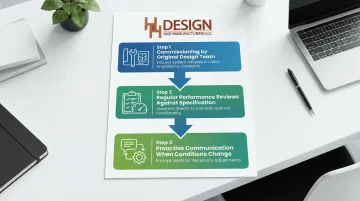
Three conditions under which custom equipment performs best over time:
- Commissioning by the original design team — operating parameters are set correctly from day one, not approximated by a third party
- Regular performance reviews against the original specification — catches calibration drift before it becomes a costly problem
- Proactive communication when process conditions change — material properties and throughput shifts should trigger a conversation with your equipment provider, not a breakdown
Working with a partner like H&H Design Manufacturing—who controls design, manufacturing, and commissioning under one roof—keeps accountability in one place throughout the entire process. When the same team that engineered the fill head also calibrates it on-site, the system performs as intended from the start.
That on-site accountability also extends to documentation and operator training—areas most facilities underinvest in at commissioning. Factory Acceptance Testing (FAT) and Site Acceptance Testing (SAT) are critical quality gates that verify the system meets design and functional requirements before and after installation. Facilities that treat these as non-negotiable handoff requirements tend to sustain efficiency and quality gains far longer.
Conclusion
Custom equipment design is not a premium add-on but a practical lever for process facilities that need reliable output quality, operational efficiency, and a defensible return on capital. Its advantages compound the longer it is applied consistently.
The choice between standard and custom equipment is a question of where the friction and cost will land. The options break down clearly:
- Upfront: design investment, engineering time, longer lead cycles
- Ongoing: workarounds, unplanned maintenance, quality variance, and product giveaway
When the full operational picture includes downtime costs and compliance exposure, the tradeoff rarely favors the off-the-shelf path. For facilities handling dry bulk materials — where fill accuracy, material flow, and throughput directly affect margin — equipment built to the specific process tends to outperform adapted equipment over any meaningful time horizon. That's the case H&H Design Manufacturing has made since 2008, handling custom requests across dairy, food, chemical, and mining applications without sacrificing the flexibility that makes tight-deadline projects possible.
Frequently Asked Questions
What is the difference between custom-designed equipment and off-the-shelf equipment for process industries?
Off-the-shelf equipment is designed for the broadest common use case, while custom equipment is engineered around a specific facility's material type, throughput, spatial constraints, and compliance requirements. Your process doesn't need to adapt to fit the machine.
How long does it typically take to design and manufacture custom process equipment?
Lead times vary based on complexity and scope, but working with a manufacturer who handles design, fabrication, and commissioning in-house tends to compress timelines compared to coordinating across multiple vendors. Early engagement with the equipment partner shortens the process significantly.
Is custom equipment design more expensive than buying standard equipment?
The upfront cost is higher, but total cost of ownership over the equipment's operational life typically favors custom design once you account for maintenance, energy, downtime, and rework. For high-utilization or compliance-sensitive applications, equipment mismatches tend to generate recurring costs that erode any initial savings.
What industries benefit most from custom process equipment design?
Food, dairy, chemical, mining, and agriculture sectors see the highest benefit due to their combination of strict quality or safety requirements, variable material properties, and the operational cost of fill inaccuracy or contamination.
How does custom equipment design improve fill weight accuracy in dry bulk operations?
Custom weighing and filling systems are calibrated to a specific product's bulk density, flow characteristics, and target weight range. Both the control logic and mechanical components are tuned to reduce variance directly, rather than stretching a standard configuration to fit the material.
What should I look for when selecting a custom equipment manufacturer for my process facility?
Look for a manufacturer who designs, builds, and commissions equipment under one roof — that single-source structure reduces handoff errors and keeps the project on schedule. Experience with your specific material type matters, as does relevant certification: UL listing for control panels, for example, signals both design rigor and regulatory readiness.