Introduction
Modern manufacturers face a relentless challenge: product mixes shift faster than ever, batch sizes shrink to accommodate custom orders, and production lines built for a single purpose struggle to keep pace. The days of "set it and forget it" infrastructure are over.
Facilities that can't reconfigure quickly face costly downtime, lost contracts, and equipment that becomes obsolete before it's paid off. Adaptability is now a core operational requirement.
Flexible conveyor workstations address this directly. These modular, reconfigurable conveyor setups let facilities adjust workflows without overhauling entire lines. Whether you're handling different product sizes, changing line speeds, or shifting between processes, flexible workstations adapt to your operation rather than forcing you to work around fixed infrastructure.
This post covers what flexible conveyor workstations are, why they matter now more than ever, key features to evaluate, which industries benefit most, and how to implement one successfully in your facility.
Key Takeaways
- Flexible conveyor workstations are modular systems that reconfigure as production needs change, eliminating costly line rebuilds
- They boost throughput, improve worker ergonomics, and optimize floor space using your existing infrastructure
- Food, chemical, agricultural, and bulk material manufacturers gain the most value from their flexibility during product changeovers
- Choosing the right setup means weighing product types, throughput variability, floor layout, and room to expand
What Are Flexible Conveyor Workstations and How Do They Work
A conveyor workstation is a dedicated station along a production or packaging line where workers interact with product on a conveyor—performing tasks like assembly, inspection, labeling, weighing, or filling. Together, these stations control the pace and accuracy of material flow across the entire line.
What Makes It "Flexible"
The defining characteristic is modularity. Flexible workstations use:
The core difference comes down to adaptability:
| Fixed Systems | Flexible Workstations | |
|---|---|---|
| Design | Optimized for one task or product | Modular, reconfigurable layout |
| Change cost | Full rebuild or replacement | Adjust components in hours |
| Best for | Stable, high-volume single SKU | Varied products, shifting demands |
When production requirements shift—new product sizes, different line speeds, updated workflow sequences—a fixed system can't keep up without significant downtime and cost. A flexible workstation adapts without requiring a complete rebuild.
Why Modern Manufacturing Demands Flexibility
Static, single-purpose lines can no longer keep pace with today's market demands — shorter runs, expanding SKU counts, and shifting regulations have made reconfigurability a core requirement.
SKU Proliferation and Shorter Runs
Product variety is exploding across industries. Craft breweries now manage 25 or more can varieties, driving demand for equipment that handles seasonal and event-based versioning. When SKU counts exceed 500 and production runs shrink, the ability to reconfigure quickly becomes essential.
The Financial Cost of Inflexibility
When fixed conveyor lines can't accommodate new products or process changes, the financial impact is severe:
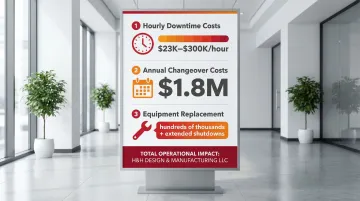
- Hourly downtime costs: $23,000 to $32,000 per hour in food processing, with larger facilities losing $50,000 to $300,000 per hour
- Changeover costs: A single daily one-hour changeover can cost $1.8 million annually on a significant packaging line
- Equipment replacement: Complete line rebuilds cost hundreds of thousands of dollars and require extended shutdowns
Flexible workstations reduce these costs dramatically. Reconfiguration happens in hours using standard tools, not days or weeks of fabrication work.
Regulatory and Formulation Changes
Changing regulations—especially in food, dairy, and chemical manufacturing—frequently require line reconfiguration. The FDA Food Safety Modernization Act (FSMA) emphasizes prevention over response, placing new demands on equipment design. Flexible workstations that meet sanitary standards while allowing quick changeovers give operations a measurable advantage: faster compliance without costly rebuilds.
Labor Efficiency and Ergonomics
Musculoskeletal disorders (MSDs) remain a primary cause of lost work time in manufacturing. Flexible workstations with adjustable heights reduce worker fatigue and repetitive strain injuries, directly impacting productivity and retention. Ergonomic interventions have been shown to reduce physical demands, eliminate unnecessary movements, and lower injury rates while increasing overall work efficiency.
Height-adjustable stations also support multi-shift operations where workers of different heights share the same station — each operator gets a safe, comfortable setup without manual modification between shifts.
Key Features of a Truly Flexible Conveyor Workstation
Not all "flexible" conveyors deliver equal adaptability. Look for these critical features:
Modular Frame Systems
Modular aluminum or steel extrusion frames allow sections to be added, removed, or repositioned without welding or special tooling. This enables rapid layout changes that match new production sequences. Pin-and-ladder designs provide quick height adjustments with positive locking at multiple positions.
Adjustable Speed and Direction
Variable frequency drives (VFDs) and motor-driven roller (MDR) technology allow speed to be tuned by zone. This enables:
- Gentle handling for fragile products
- Higher-speed throughput sections on the same line
- Synchronized operation with upstream and downstream equipment
- Reduced energy consumption by powering only active zones
Zero-Pressure Accumulation
Zero-pressure accumulation (ZPA) systems use independently controlled zones of rollers or belts. Sensors detect product presence, stopping upstream zones when downstream areas are occupied. This prevents product-to-product contact damage — critical when downstream processes like filling or weighing operate at variable rates.
ZPA also cuts energy costs by powering only the zones that need it, which matters on longer lines where idle sections would otherwise run continuously.
Ergonomic Height Adjustability
Workstations that allow workers to set working height reduce physical strain and support safe operation across multiple shifts. Adjustment mechanisms include manual pin-and-ladder systems for periodic changes or powered actuators for frequent repositioning.
Integration-Ready Design
Flexible workstations should accept sensors, PLCs, and control panels that allow automation to be layered in over time. H&H Design and Manufacturing holds UL 508A certification as a UL Certified Industrial Control Panel Shop, which means controls can be engineered directly into the workstation unit — meeting electrical safety and compliance requirements rather than retrofitting them later.
Material Compatibility
Component choices must match the product being handled:
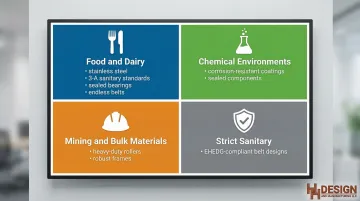
- Stainless steel construction meeting 3-A Sanitary Standards, with sealed bearings and endless belts (no metal stitching) for food and dairy applications
- Corrosion-resistant coatings and sealed components for chemical environments
- Heavy-duty roller systems and robust frames for mining or bulk material handling
- EHEDG-compliant belt conveyor designs for facilities with strict sanitary requirements
Industry Applications in Food, Chemical, and Bulk Material Manufacturing
Food and Dairy Manufacturing
Flexible workstations accommodate frequent changeovers between product SKUs, easy washdown cleaning cycles, and compliance with sanitary design standards. Key features include:
- Adjustable belt widths for different container sizes
- Quick-release components for rapid cleaning
- Stainless steel construction with 3-A Dairy certification
- Sealed bearings positioned to prevent contamination
Downtime costs in food manufacturing make rapid changeover capability essential. With potential losses reaching $300,000 per hour, the ability to switch products in minutes rather than hours delivers immediate ROI.
Chemical and Agricultural Processing
Bulk material handling demands workstations that manage variable fill weights, accommodate different container sizes — bags, drums, and totes — and withstand harsh environments. Purpose-built configurations for chemical and agricultural applications include:
- Chemical-resistant coatings and materials
- Integration with filling and weighing equipment
- Dust control and containment systems
- Heavy-duty construction for demanding environments
Mining and Heavy Material Handling
Mining applications require high load-bearing capacity and abrasion resistance. Flexible workstations in these contexts use:
- Heavy-duty roller systems with reinforced frames
- Abrasion-resistant belt surfaces
- Robust construction for continuous-duty operation
- Modular frames that support reconfiguration as extraction zones or processing stages change
Assembly and Packaging Lines
Where mining prioritizes brute durability, general assembly lines demand adaptability. Flexible workstations let manufacturers reconfigure quickly without rebuilding conveyor infrastructure — a practical advantage for seasonal runs or contract manufacturing. Typical benefits include:
- Fast reconfiguration for seasonal or contract product changes
- No need to rebuild conveyor infrastructure between runs
- Reduced capital expense from reusing modular components
- Lower downtime when switching between product lines
Fixed vs. Flexible Conveyor Systems: Making the Right Call
Most manufacturing operations reach a fork in the road: commit to a fixed conveyor line built for one purpose, or invest in a flexible system that adapts as production shifts. The right answer depends on how stable your throughput actually is — and how confident you are that it stays that way.
When Fixed Systems Make Sense
Fixed conveyor systems are appropriate for:
- High-volume, single-SKU production with stable throughput expectations
- Long-term production runs with no anticipated product changes
- Applications where the line will remain unchanged for 10+ years
- Environments where upfront cost is the primary decision factor
When throughput is predictable and product mix won't shift, a fixed line's lower upfront cost and optimized layout deliver real long-term value.
When Flexible Workstations Are Better
Choose flexible workstations when you have:
- Variable product mixes with frequent changeovers
- Shorter production runs (days or weeks, not months)
- Growing operations that anticipate expansion
- Environments where reconfiguration downtime costs more than higher initial investment
Three Questions to Guide Your Choice:
- Frequency of product changeovers: Daily or weekly changes favor flexible systems
- Variability in throughput volume: Seasonal spikes or contract manufacturing demand adaptability
- Available floor space: Limited space requires systems that reconfigure within existing footprint
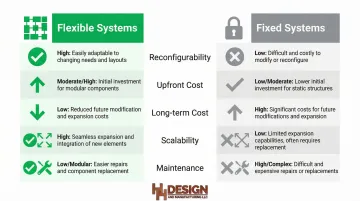
Comparison of Key Attributes:
| Criteria | Flexible Systems | Fixed Systems |
|---|---|---|
| Reconfigurability | Hours to adjust layout | Days/weeks for modifications |
| Upfront Cost | Moderate to high | Lower initial investment |
| Long-term Cost | Lower due to reusability | Higher due to replacement costs |
| Scalability | Easy expansion | Limited; often requires redesign |
| Maintenance | Standardized parts | System-specific components |
Steps to Implement a Flexible Conveyor Workstation Successfully
Start with a Line Audit
Before specifying equipment, map your current material flow:
- Identify bottleneck stations where delays occur
- Measure throughput variability across shifts and seasons
- Document the full range of product types and container sizes
- Note floor space constraints and utility locations
- Review safety requirements and regulatory compliance needs
These findings give your engineering partner the specifics needed to design a workstation that actually fits your operation.
Work with a Custom Engineering Partner
Off-the-shelf conveyor modules rarely match exact plant floor constraints. Custom-designed workstations—engineered to specific dimensions, material requirements, and control specifications—reduce rework during installation and cut long-term maintenance calls.
H&H Design and Manufacturing combines custom design capability with in-house UL-certified control panel fabrication, delivering complete workstation solutions where mechanical and electrical systems are designed as integrated units. This single-source approach ensures compatibility and reduces installation complexity. That same integration mindset should extend to how the workstation fits into your broader line—now and in the future.
Plan for Integration and Future Expansion
Ensure your workstation design accounts for:
- Future sensor additions for quality control or tracking
- Automation upgrades as labor availability changes
- Line extensions to accommodate increased capacity
- Integration with upstream and downstream equipment
Modular designs let you add capacity or automation in phases—without halting production to rebuild from scratch.
Consider Total Cost of Ownership
Evaluate not just purchase price, but:
- Installation time and labor costs
- Training requirements for operators and maintenance staff
- Energy consumption and operating costs
- Maintenance parts availability and costs
- Reconfiguration expenses over the system's lifetime
Flexible systems typically deliver lower total cost over time—reconfiguration savings alone can offset the gap between a modular system and a fixed-line alternative.
Frequently Asked Questions
What is a flexible conveyor workstation?
A flexible conveyor workstation is a modular conveyor station along a manufacturing line that can be reconfigured in layout, speed, and height to accommodate different products, processes, or throughput levels without a full system rebuild.
How does a modular conveyor workstation differ from a fixed conveyor system?
Fixed systems are optimized for a single product or process and are difficult to change once installed. Modular workstations use interchangeable components that can be repositioned or expanded as production needs evolve, typically in hours rather than days or weeks.
Which industries benefit most from flexible conveyor workstations?
Food, dairy, chemical, agricultural, and mining industries benefit most due to frequent product changeovers, variable container sizes, and demanding sanitary or chemical-resistance requirements — all factors that make rapid reconfiguration directly valuable.
Can flexible conveyor workstations handle dry bulk materials like powders or granules?
Yes. With the right belt surface, enclosure, and accumulation design, flexible workstations can handle dry bulk applications — including integration with filling and weighing equipment, dust control, and material-specific handling features.
What should I look for when selecting a conveyor workstation manufacturer?
Prioritize manufacturers with custom engineering capability, in-house UL-certified control panel fabrication, industry-specific experience, and proven post-installation support.
How long does it take to reconfigure a flexible conveyor workstation?
Reconfiguration time varies by system complexity, but well-designed modular workstations can typically be adjusted within hours using standard tools — compared to days or weeks for a fixed conveyor installation.
Ready to explore flexible conveyor solutions for your facility? Contact H&H Design and Manufacturing at (620) 421-9800 to discuss your specific application. Their engineering team designs custom workstations around your product, floor layout, and capacity goals — with UL-certified control panel integration and hands-on experience across food, chemical, agricultural, and bulk material manufacturing.