Introduction
Logistics coordinators, operations managers, and supply chain teams in agriculture, chemicals, mining, and food industries face a persistent challenge: improper jumbo bag loading in shipping containers. When FIBCs (Flexible Intermediate Bulk Containers) shift during transit, the consequences are severe—cargo damage, bag failure, regulatory violations, and costly product loss. Between 2023 and 2025, the London P&I Club documented multiple incidents where improperly stowed FIBCs caused fires and structural damage, with claims reaching into the millions.
Jumbo bag loading is the process of placing, arranging, and securing FIBCs inside shipping containers to safely transport dry bulk materials. Done correctly, it protects your cargo, maintains regulatory compliance, and prevents 1,000-kilogram bags from becoming unstable projectiles in heavy weather.
This guide covers:
- How the loading process works, step by step
- Which method to choose based on your cargo and destination
- What factors determine a successful load
- Where teams most commonly go wrong
Key Takeaways
- Jumbo bags hold 500–2,000 kg and must fit within a container's rated payload—never exceed gross weight limits stamped on the container door
- Choose between direct stacking (maximizes space) and palletized loading (improves handling) based on cargo type and destination equipment
- Prevent shifting using centered or side-by-side arrangements, dunnage bags, wooden bracing, and cargo straps on heavy-weather routes
- Consistent fill levels and even weight distribution from purpose-built filling equipment directly affect stacking stability in transit
- SOLAS Chapter VI and the IMO CSS Code Annex 10 govern FIBC stowage and securing requirements
What Is Jumbo Bag Loading in Shipping Containers?
Jumbo bag loading is the structured placement of filled FIBCs—typically weighing 500 to 2,000 kg each—into 20-foot or 40-foot shipping containers, following specific weight, arrangement, and securing protocols to ensure safe transit. The process maximizes payload utilization within container weight limits while preventing cargo movement, bag deformation, or structural failure during handling and ocean or rail voyages.
This method sits between two distinct approaches. With bulk loading, loose material is poured directly into a lined container — no discrete units at all. With rigid palletized goods, the cargo holds its shape throughout transit. FIBCs combine elements of both: they're individual units, but flexible ones that can deform under pressure and require their own handling logic. The bags compress, settle, and bulge during transit, altering the stowage footprint in ways that rigid cargo does not.
Standard containers accommodate these flexible units, but the loading approach must account for how FIBCs respond to dynamic forces: rolling motion at sea, acceleration and braking during rail transport, and compressive loads from stacking.
Why Jumbo Bag Loading Practices Matter in Container Shipping
Consequences of Poor Loading
Bags that are improperly arranged or unsecured shift during heavy weather, creating dangerous imbalances. Gard's documentation on cargo shifting shows that FIBCs deform and compress during voyages—without proper shoring, bags shift into void spaces, potentially causing vessels to list. Excessive top weight has been a direct cause of bag rupture, with failures cascading through entire stows.
The London P&I Club has warned of multimillion-dollar claims arising from hold fires caused by improper stowage of bagged chemicals. Incompatible chemicals stowed together, or bags stowed with breakbulk steel, have resulted in bag failures, spills, and subsequent fires.
Compliance Requirements
SOLAS Chapter VI requires bulk cargo in containers to follow the Code of Safe Practice for Cargo Stowage and Securing. The IMO CSS Code Annex 10 specifically addresses FIBC stowage, requiring void spaces to be chocked to prevent shifting. In practice, this means:
- Shippers must ensure bags are stowed "as close as possible" with gaps filled by dunnage or bracing
- Hazardous materials in FIBCs must comply with IMDG Code packing instructions, not IMSBC Code protocols
- Failure to comply with the Cargo Securing Manual can void P&I insurance cover
Common Misconceptions
These compliance requirements exist precisely because jumbo bag loading behaves differently from standard palletized cargo — and many shipping teams don't account for that difference. The most common gaps:
- FIBCs compress and bulge under ship motion in ways rigid boxes don't, making initial stow tightness deceptive
- Multi-layer stacks generate compressive loads that can exceed individual bag ratings
- Materials settle over long voyages, loosening stows that appeared secure at loading
How Jumbo Bag Loading Works: Step-by-Step
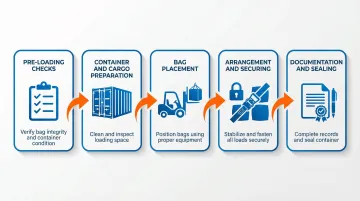
The end-to-end process follows five stages: pre-loading checks → container and cargo preparation → bag placement → arrangement and securing → documentation and sealing. Success depends on work done before the container loading stage even begins.
Bags that are unevenly filled or overfilled lose their uniform shape, making stable stacking difficult. Purpose-built dry bulk filling equipment solves this — H&H Design and Manufacturing's Series 330E and Series 110DS systems, for example, deliver ±1 lb. per 1,000 lbs. accuracy using direct mount load cell designs that eliminate flex points.
Consistent fill weight and bag shape are the foundation for everything that follows. With that foundation in place, the remaining steps become considerably more predictable.
Preparation and Pre-Loading Checks
Container verification:
- Check the container door placard for tare weight, maximum payload, and gross weight rating
- Inspect the container floor for damage, particularly wooden floors rated for 5,460 kg forklift axle loads
- Confirm interior dimensions match your bag size and stacking plan
Bag inspection:
- Verify each bag for tears, punctures, or UV degradation
- Check that discharge spouts are intact and properly sealed
- Inspect lifting loops for fraying or damage—all loops must be intact per ISO 21898 standards
Equipment readiness:
- Confirm forklifts or cranes are rated for filled bag weight (typically 500–2,000 kg)
- Use rounded-edge forks or hooks per FIBCA guidelines to prevent loop damage
- Ensure adequate clearance for overhead lifting in the loading area
Placement and Arrangement
Bags are lifted using 1, 2, or 4 lifting loops depending on design. The placement sequence starts from the container's front wall and proceeds rearward, row by row.
Centered loading: Both bags in a pair are aligned along the container's longitudinal centerline with no gap between them. Padding is placed against sidewalls to prevent lateral movement. Best used when bag dimensions closely match half the container interior width (approximately 1.17 meters for standard containers).
Side-by-side loading: Bags are placed tightly against both sidewalls with a center gap that must be reinforced. Wider bags typically call for this approach, but it requires sturdy bracing — wooden frames or inflatable dunnage bags — to prevent inward collapse during transit.
Each row must be placed tightly against the previous row with no unsupported gaps. As bags are placed, monitor for deformation or bulging that indicates overfilling or uneven weight distribution.
Securing and Final Checks
Gap reinforcement:
- Fill lateral gaps between bags and container walls with inflatable dunnage bags (AAR-verified Level 1-5 depending on load)
- Install wooden bracing for structural gaps that dunnage cannot fill
- Apply cargo straps or nets for heavy-weather routes or long ocean voyages
Load distribution verification:
- Check that container floor load does not exceed rated capacity (typically 4.8 tons per running meter for 20-foot wooden-floor containers)
- Verify that total cargo weight plus tare weight does not exceed gross weight rating
- Confirm cargo height does not exceed door height or block container closure
Documentation:
- Record actual cargo weight, bag count, and securing materials used
- Photograph the final stow for insurance and compliance records
- Seal the container and apply hazardous materials placards where required
Loading Methods, Arrangement, and Securing Techniques
Direct Stacking vs. Palletized Loading
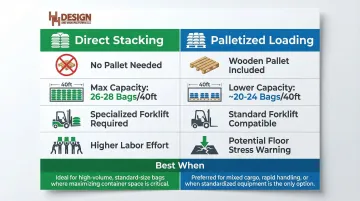
Direct stacking places bags directly on the container floor without pallets:
- Maximizes space utilization — a 40-foot container holds 26–28 bags at 1,000 kg each
- Requires smooth-bore containers and destination ports with bulk-handling equipment (forklifts with push-pull attachments or slip sheets)
- More labor-intensive to unload; higher risk of bag damage from floor friction
Palletized loading places bags on wooden or plastic pallets before container entry:
- Improves handling stability and allows standard forklift unloading; often required by destination customs
- Requires standard pallets (1,200 mm × 1,000 mm) or Euro pallets (1,200 mm × 800 mm) with adequate vertical clearance
- Reduces total bag count per container and introduces point-loading risks on the container floor
Decision criteria: Choose direct stacking when maximizing payload is critical and destination infrastructure supports bulk handling. Choose palletized loading when destination handling equipment is limited or customer specifications require it.
Arrangement Patterns
Centered loading aligns bags along the container's longitudinal centerline:
- Place the first bag pair with inner edges touching at the centerline
- Fill sidewall gaps with padding or dunnage bags
- Best suited for bag widths of 1.0–1.2 meters (roughly half the 2.35-meter interior width)
- Provides natural lateral stability with minimal bracing
Side-by-side loading places bags against both sidewalls:
- Position bags tightly against each wall with a center gap
- Reinforce the center gap with wooden frames or inflatable dunnage bags rated for the load
- Suited for wider bags (1.3–1.5 meters) that cannot be centered
- Requires more aggressive securing to prevent inward collapse
Reinforcement Materials and Securing
The arrangement pattern you choose determines which reinforcement materials are needed — and how aggressively you'll need to apply them.
Wooden Blocking
- Provides structural support for gaps exceeding 15–20 cm
- Must be cut to fit tightly with no movement
- Typical dimensions: 100 mm × 100 mm or 150 mm × 150 mm lumber
Inflatable Dunnage Bags
- Fill voids between bag rows and container walls
- AAR-rated by level: Level 1 for light loads through Level 5 for heavy applications
- Inflate to manufacturer's specified pressure (typically 4–6 PSI)
- Load rating must match or exceed the cargo weight at that position
Cargo Straps and Nets
- Required for high-motion routes (heavy weather, rail transport)
- Straps must meet CSS Code Annex 13 requirements for Minimum Breaking Load (MBL)
- Attach only to fixed container securing points — never to bag loops
- Web lashing is typically rated at 50% of breaking strength as Maximum Securing Load (MSL)
Stacking Rules for Multi-Layer Loads
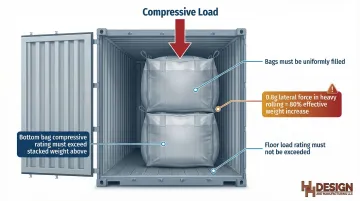
Once securing hardware is in place, stacking decisions become the final load integrity check. ISO 21898 specifies maximum compressive load and safe stacking height for FIBCs. Double stacking is possible only when:
- Bottom bag's rated compressive load exceeds the combined weight of bags stacked above it
- Container floor load rating is not exceeded (critical for palletized loads)
- Bags are uniformly filled and maintain rigid shape
- Route conditions permit (avoid double stacking for heavy-weather routes with low-rated bags)
In a 40-foot container, a second-layer bag can experience lateral forces of 0.8g during heavy rolling — effectively increasing its calculated weight by 80% for securing purposes. Always verify bottom bag compressive strength before stacking, and never exceed the manufacturer's stated stacking load.
Key Factors That Affect Jumbo Bag Loading
Bag Fill Level and Uniformity
Underfilled bags lose rigidity and collapse under top loads, creating voids that allow shifting. Overfilled bags become convex and unstable when stacked, with bulging sides that cannot nest properly. Both are upstream filling problems.
Purpose-built bag filling equipment with direct mount load cell designs and programmable controls ensures consistent fill weights and uniform bag shape. Systems like H&H Design and Manufacturing's Series 330E deliver ±1 lb. per 1,000 lbs. accuracy, creating bags that stack predictably and maintain their geometry throughout transit.
Cargo Density and Material Behavior
High-density cargoes (minerals, chemicals) consolidate and shift during transit differently than low-density materials (grains, plastic granules). Dense materials create higher compressive loads on lower layers and are more likely to cause floor damage when concentrated on small pallet footprints.
Material behavior also affects securing requirements:
- Powders and fine granules settle more than pellets, requiring tighter initial stows
- Hygroscopic materials may absorb moisture and increase weight during voyage
- Compressible materials (plastic pellets, grains) consolidate under top loads, loosening the stow
Container Floor Load Rating
Standard wooden container floors have a forklift axle load limit of 5,460 kg. Exceeding this with heavy palletized FIBCs risks floor damage. For a 20-foot container, the maximum spread load is approximately 4.8 tons per running meter.
Point loading compounds this risk. A 2,000 kg FIBC on a standard pallet (1.2 m²) creates a concentrated load of 1,667 kg/m² — multiple bags on small pallets can exceed floor ratings, causing cracking or collapse. Steel-floor containers handle up to 9,200 kg axle load but are less commonly available.
Cargo Hazard Classification
Floor load limits are only part of the compliance picture. Certain materials require special handling even when bagged:
- Ferrosilicon (UN 1408) can emit toxic gases (arsine, phosphine) and is prone to self-heating; crews must have gas detection equipment per IMDG requirements
- Copper concentrates may exhibit self-heating properties when bagged, with heat trapped inside the bag increasing fire risk
- Environmentally hazardous substances (UN 3077) must be declared under IMDG Code and may require segregation from other cargo
Bagged hazardous materials fall under IMDG Code packing instructions, not IMSBC Code protocols. Shippers must verify cargo classification before booking and provide appropriate documentation — typically a Material Safety Data Sheet and a completed DG declaration.
Transit Conditions
Long ocean voyages with rolling motion create dynamic lateral forces on stowed bags. Routes through heavy-weather areas (North Atlantic, Southern Ocean) demand more aggressive securing compared to short coastal moves or inland rail transport.
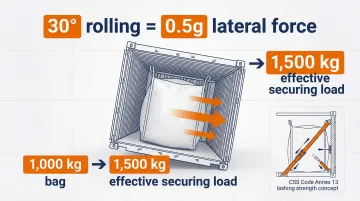
A bag in a container experiencing 30-degree rolling can experience lateral forces of 0.5g — 50% of its weight. In practical terms, a 1,000 kg bag effectively becomes 1,500 kg for securing purposes. CSS Code Annex 13 provides methods to assess securing efficiency and calculate required lashing strength.
Common Mistakes and When to Reconsider This Approach
Frequent Operational Errors
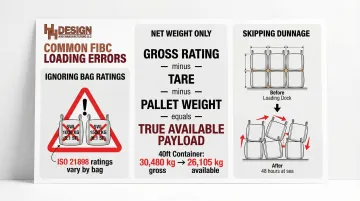
Three errors show up repeatedly in FIBC container loading:
- FIBC interchangeability: Bags carry different safe working loads (SWL) and stacking ratings per ISO 21898. A bag rated for 1,000 kg SWL may only support 3,000 kg of stacking load — exceeding that causes failure.
- Net weight only: Teams often ignore container tare weight and pallet weight. A 40-foot container with a 30,480 kg gross rating, 3,750 kg tare, and 26 pallets at 25 kg each leaves only 26,105 kg of available payload — not 26,730 kg.
- Skipping dunnage: Bags settle as cargo consolidates during transit. What appears tight at loading becomes loose after 48 hours at sea, allowing shifting that can cascade into complete stow failure.
Misconceptions About Bag Strength
Teams often assume a structurally intact bag will hold its shape under multi-layer stacking pressure or ship motions. Gard's documentation shows that bag rupture cascades into destabilized stows, with failures in one bag causing adjacent bags to shift and fail.
Tensile strength is a contingency, not a stowage strategy. Proper arrangement and securing must prevent bags from ever reaching their structural limits — if your plan depends on the fabric holding, the stow is already wrong. That same logic applies when deciding whether FIBCs are the right packaging format at all.
When Jumbo Bags Are Not the Right Fit
Reconsider FIBC container loading when:
- Group A liquefaction-prone cargo: Materials like certain mineral concentrates must travel under strict IMSBC bulk protocols. Bagging alone does not eliminate liquefaction risk.
- Floor load limits cannot accommodate bag weight: When bag weight exceeds container floor ratings even with pallet distribution, smaller bags, rigid IBCs, or bulk container liners are more appropriate.
- Receiving facility lacks FIBC-rated lift equipment: If the destination site has no forklifts rated for 1,000+ kg loads or overhead cranes, palletized smaller packages may be necessary despite lower space efficiency.
Conclusion
Effective jumbo bag loading converts a flexible, high-capacity packaging format into a safe, space-efficient, regulation-compliant unit load that performs reliably from origin to destination. The process demands informed decision-making at every stage: choosing the correct bag, filling it uniformly with calibrated equipment, selecting the right loading method, securing against transit forces, and meeting SOLAS and IMO CSS Code requirements.
Teams who treat jumbo bag loading as a generic task expose themselves to avoidable losses and liability. The documented incidents of cargo fires, vessel listing, and multimillion-dollar claims demonstrate the consequences of shortcuts. Getting it right comes down to a few non-negotiables:
- Understanding how FIBCs behave under dynamic transit forces
- Respecting container floor load limits and gross weight caps
- Applying proper dunnage, bracing, and securing techniques
- Documenting compliance with SOLAS VGM and CSS Code requirements
Logistics professionals who build these steps into standard procedure protect cargo, reduce liability exposure, and keep shipments moving without costly delays or claims.
Frequently Asked Questions
What is the maximum load for a 20ft and 40ft container?
A standard 20-foot container typically allows 28,180–30,200 kg payload; a 40-foot container generally allows 26,700–28,750 kg. Always verify the rated limit stamped on the container door before loading, and account for tare weight plus any pallet or securing material weight.
How many jumbo bags fit in a standard shipping container?
The number depends on bag dimensions and fill weight—a standard 40-foot container can typically hold 20–26 bags of approximately 1,000 kg each, while a 20-foot container holds roughly 10–14 bags. Both volume and weight limits must be checked, as whichever is reached first determines the maximum load.
Can jumbo bags be double-stacked inside a shipping container?
Double stacking is safe only when the bottom bag's rated compressive load per ISO 21898 exceeds the weight above it and the container floor rating is not exceeded. Heavy-weather routes, low-rated bags, and partially filled bags should remain single-stacked.
What is the difference between palletized and direct loading of jumbo bags?
Palletized loading places bags on wooden or plastic pallets, improving stability and enabling forklift handling at the destination. Direct stacking skips pallets to maximize usable space but requires ground-level handling equipment on the receiving end.
What regulations apply to shipping jumbo bags in containers?
SOLAS Chapter VI and the Code of Safe Practice for Cargo Stowage and Securing apply to all container cargo; hazardous materials in FIBCs must comply with the IMDG Code, and certain bulk mineral cargoes may fall under the IMSBC Code. Shippers should verify cargo classification before booking to ensure proper documentation and compliance.
How do you prevent jumbo bags from shifting during ocean transport?
Under-filled bags are the primary cause of in-transit shifting. Prevent movement by:
- Filling bags uniformly to maintain a rigid shape
- Using inflatable dunnage bags or wooden bracing to eliminate lateral voids
- Packing bags tightly together with no unsupported gaps
- Applying cargo straps or nets on high-motion routes