Introduction
Selecting a powder filling machine ranks among the most consequential equipment decisions a manufacturing operation can make. The wrong choice triggers a cascade of operational failures: inaccurate fills, material waste, costly downtime, and compliance violations across industries from food and dairy to chemicals and agriculture. According to industry research, overfilling by just 2% on a 500g package can cost manufacturers $10 per 1,000 units, directly eroding profit margins in high-volume operations.
No single machine fits every operation. Powder flowability, target throughput, bag format, and regulatory requirements vary significantly between applications — and a filling system optimized for free-flowing granules will fail when tasked with cohesive, fine powders that bridge and clump.
This guide walks through what powder filling machines are, how different types work, and the six most important factors to evaluate before investing.
Key Takeaways
- Choosing the right powder filling machine starts with understanding your powder's flow characteristics, bulk density, and particle size
- Auger fillers work best for fine, free-flowing powders; net weight fillers offer the highest accuracy; gross weight fillers are built for bulk bags
- Your throughput targets and container formats must match the machine's rated speed and changeover design
- Total cost of ownership goes beyond purchase price — factor in maintenance, spare parts, and vendor support
- Getting these decisions right upfront prevents costly retrofits and production downtime later
What Is a Powder Filling Machine?
A powder filling machine is industrial equipment designed to measure and dispense controlled quantities of dry bulk powder into bags, containers, or other packaging formats with repeatable accuracy. These systems range from simple volumetric dispensers to gravimetric platforms that weigh each fill to within 0.25% of target weight.
Machines vary fundamentally by dosing method. Weight-based systems use load cells to measure product mass, while volume-based systems control the amount dispensed by auger rotations or cup size.
This distinction matters because powder behavior varies dramatically. Free-flowing granules like sugar perform predictably in volumetric systems, while fine, cohesive, or hygroscopic powders like flour or milk powder require specialized designs to prevent bridging and maintain accuracy.
Types of Powder Filling Machines
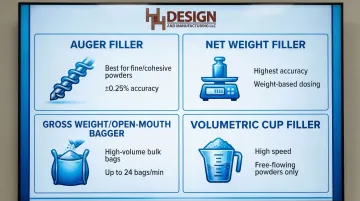
Auger fillers use a rotating screw inside a tube to dispense powder by controlling rotation speed and duration. The auger mechanism works well for fine, cohesive, or non-free-flowing powders including flour, protein powder, and chemical powders where volume consistency is needed. Modern servo-driven auger systems can achieve ±0.25% accuracy when integrated with weigh scales.
Net weight fillers dispense product until a target weight is reached using a live scale beneath the container. Powder feeds into a weigh bucket on load cells; once the target weight is reached, the measured dose dumps into the package. This approach delivers the highest accuracy, making it the right choice when fill-weight compliance or expensive materials make giveaway a real cost concern.
Gross weight fillers and open-mouth baggers are common in high-volume dry bulk operations serving mining, grain, and fertilizer industries. Large-format bags (25–50 kg) sit on a scale during filling, and the system stops automatically at a preset gross weight. In automated configurations, these systems can process up to 24 bags per minute for 50 lb bags.
Volumetric cup fillers suit free-flowing, uniform-particle powders at high speeds. Cups of fixed volume pass under a hopper, fill, then dump product into containers. While fast, accuracy can drift when bulk density fluctuates throughout a production run—a limitation that makes them unsuitable for applications requiring tight weight control.
Benefits of Powder Filling Machines in Industrial Operations
Automated powder filling delivers measurable operational benefits:
- Reduced product giveaway from overfilling protects margins on every package
- Improved throughput versus manual filling, with automated lines reaching 60-90 containers per minute
- Consistent fill weights that support regulatory compliance and customer trust
- Reduced dust and spillage with enclosed filling systems that protect workers and product
Industries like dairy, food manufacturing, specialty chemicals, and agriculture depend on reliable powder filling to meet NIST Handbook 133 weight regulations, prevent contamination, and protect margins at scale. For operations producing over 500,000 packages annually, the payback period for automated equipment typically runs 12 to 24 months — which makes selecting the right machine type the first decision worth getting right.
What to Consider When Choosing the Right Powder Filling Machine
The "best" powder filling machine is not the fastest or most automated—it is the one that matches your specific powder behavior, production volume, bag format, and operational constraints. The following six factors translate those variables into a clear selection framework.
Powder Characteristics and Flowability
Powder flowability is the single most important physical variable in machine selection. Free-flowing powders like granulated sugar, salt, and dried grain move predictably through most systems. Cohesive, fine, or hygroscopic powders—flour, milk powder, fine chemicals—tend to clump, bridge, or stick, requiring specialized auger designs, vibration assist, or enclosed systems.
Flowability is measured using standardized metrics including the Carr Index and Hausner Ratio. According to USP <1174> standards, powders with a Carr Index below 15% exhibit good to excellent flow, while values above 25% indicate poor flow requiring mechanical assistance.
Additional properties to assess:
- Bulk density affects volumetric accuracy—if density increases 10%, a volumetric filler dispenses 10% more weight
- Particle size distribution determines dust generation; fine powders need sealed filling paths
- Moisture sensitivity may require nitrogen purging or humidity-controlled environments to prevent clumping
Required Filling Accuracy and Throughput
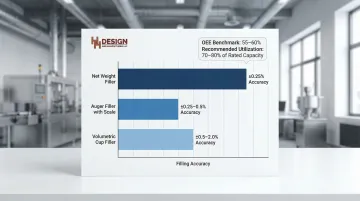
Filling accuracy determines which dosing technology to use. Weight-based systems (net weight or gross weight fillers) offer the highest accuracy and are preferred for regulated products or expensive materials where giveaway is costly. Net weight auger fillers typically achieve ±0.25% accuracy, while volumetric systems range from ±0.5% to ±2.0% depending on product consistency.
Throughput must match upstream and downstream equipment. Undersizing a filler creates a bottleneck; oversizing inflates capital cost. Calculate required bags per shift based on current targets, then add buffer for planned growth.
Account for downtime, changeover, and cleaning time—specify a machine that runs at 70–80% of rated capacity under real conditions. Global packaging lines average 55–60% OEE, so a machine that must run at peak speed just to meet targets leaves no room for variability.
Container and Bag Format Compatibility
The packaging format—open-mouth bags, valve bags, FIBCs (bulk bags), cans, jars, or bottles—directly determines the type of filling head, spout design, and container handling system required. A machine optimized for 25 kg valve bags cannot be easily adapted to filling 500 g retail jars without significant modification.
Container size range and changeover flexibility matter for operations running multiple SKUs. Look for machines with adjustable filling heads, quick-change tooling, and programmable fill targets to reduce changeover time. Best-practice changeovers using SMED principles take less than 10 minutes, enabling efficient multi-product runs. Tool-less auger removal and HMI recipe storage eliminate operator error and reduce downtime between products.
Automation Level and Integration with Production Lines
Manual and semi-automatic systems require more operator involvement and suit lower-volume, multi-product, or pilot operations. Fully automatic systems integrate container feeding, filling, closing, and conveyance into a synchronized line that maximizes throughput and minimizes labor cost—replacing a two-operator semi-auto process with a fully automatic line can save approximately $52,500 annually.
Integration compatibility matters. The filler must communicate with upstream feeders, downstream conveyors, and quality control checkweighers. Machines with PLCs and standard communication protocols like OPC-UA integrate more smoothly into existing lines and support real-time production monitoring. Verify that the control system can exchange data with your MES/ERP systems before committing to a purchase.
Material Compatibility and Regulatory Requirements
Food, dairy, and pharmaceutical applications require machines built with food-grade stainless steel contact surfaces, sanitary weld finishes, and easy-to-clean designs that meet FDA 21 CFR 117.40 standards. Improper materials risk contamination, failed audits, and product recalls. For dairy applications, 3-A Sanitary Standards specify smooth surfaces, accessible cleaning points, and appropriate drainage.
Chemical and mining applications have different demands: corrosion resistance, explosion-proof electrical components where combustible dusts are present, and robust sealing to prevent fugitive dust emissions. NFPA 652/654 standards and NEC Class II electrical classifications apply to environments where combustible dust creates explosion hazards. Buyers should verify that machine construction matches both product chemistry and facility safety classifications.
Total Cost of Ownership and Vendor Support
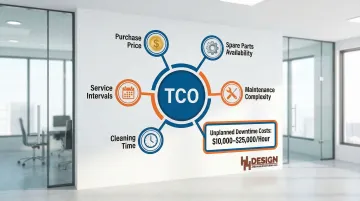
Purchase price is only one component of total cost. A machine that looks affordable at purchase can become expensive quickly if parts are hard to source or maintenance requires outside technicians. Unplanned downtime can cost $10,000 to $25,000 per hour in lost production.
Evaluate TCO across these dimensions before committing:
- Spare parts availability — are common wear items stocked domestically or shipped internationally?
- Maintenance complexity — can operators handle routine tasks without specialized tools?
- Cleaning time per shift — sanitary designs pay back quickly in labor hours
- Service intervals — how frequently does the machine require scheduled downtime?
Vendor capability is equally important. Look for manufacturers with proven installation experience in your industry, the ability to customize equipment to your specific powder and packaging format, and a track record of commissioning equipment that meets specified fill accuracy and throughput targets. H&H Design Manufacturing, for example, controls quality through every stage of design, manufacturing, and commissioning—which matters when your powder or packaging format doesn't fit a standard catalog machine.
How H&H Design Manufacturing Can Help
Once you've identified what your powder filling process requires, the next step is finding a manufacturer that can actually build it to spec. H&H Design Manufacturing has been building dry bulk weighing and packaging equipment since 2008, serving food, dairy, chemical, mining, and agricultural customers across the US, Canada, Mexico, South America, and the Middle East. The company focuses on custom-designed equipment matched to the specific powder characteristics and packaging formats each customer requires.
As a family-owned business, H&H offers the responsiveness to meet tight deadlines and handle custom requests that larger manufacturers often cannot.
The company is also a Certified UL Industrial Control Panel Shop for the US and Canada — meaning electrical systems meet rigorous safety standards, which matters in regulated industries and facilities with strict safety protocols.
Key capabilities include:
- Custom design and manufacturing for dry bulk applications, from small modifications to complete ground-up builds
- Quality control at every stage from design through commissioning
- Service and support for legacy Tech Pack equipment following the 2011 acquisition of Tech Packaging Group
- Design team experienced across powder, granule, and bulk bag filling systems
- Equipment ranging from 2 oz to 3,000 lb fill capacities with auger, vibratory, gravity, and pneumatic filling methods
If you're working through the selection process, H&H's engineering team can review your powder's flowability, packaging format, and output targets — then recommend the filling technology and system configuration that fits. Reach them at sales@hhdesignmfg.com or (620) 421-9800.
Conclusion
Choosing the right powder filling machine means matching equipment specifications to the physical reality of your operation. That includes your powder's behavior, your packaging format, your throughput targets, and your regulatory environment—not simply picking the most popular or least expensive option available.
The six factors covered—powder characteristics, accuracy and throughput, container compatibility, automation level, material compliance, and total cost of ownership—provide a structured framework for reducing risk and supporting long-term production performance. A few patterns stand out consistently:
- Powders with poor flowability demand different technology than free-flowing granules
- High-value materials justify gravimetric systems that eliminate costly giveaway
- Multi-SKU operations need quick-changeover tooling to minimize downtime between products
Filling machine selection is not a one-time decision. As product lines evolve, production volumes change, or regulatory requirements shift, equipment performance should be reviewed periodically to ensure the machine continues to meet operational needs. Working with a manufacturer that offers custom engineering, direct technical support, and experience across food, chemical, agricultural, and industrial applications—like H&H Design Manufacturing has delivered since 2008—makes that ongoing optimization practical rather than disruptive.
Frequently Asked Questions
What is the difference between an auger filler and a net weight filler for dry powder?
Auger fillers dispense powder by controlling the rotation of a screw (volume-based) and suit cohesive or fine powders. Net weight fillers stop filling when a target weight is reached on a live scale, offering higher accuracy for applications where fill weight compliance or material cost makes giveaway a significant concern.
How does powder flowability affect which filling machine I should choose?
Free-flowing powders work with a wider range of machine types, while cohesive, fine, or hygroscopic powders require designs that prevent bridging and clumping—such as auger fillers with agitation or enclosed vacuum-assisted systems. Skipping this step is one of the most common causes of inconsistent fills and unplanned downtime.
What fill weight accuracy should I expect from an industrial powder filling machine?
Weight-based systems typically achieve ±0.25% to ±0.5%; volumetric systems range from ±0.5% to ±2.0%. Request specs under conditions that match your actual powder and speed, and verify them during factory acceptance testing.
Can one powder filling machine handle multiple powder types or container sizes?
Many industrial fillers support changeovers through adjustable tooling and programmable parameters, but compatible powder types and container formats vary by machine design. If you run significantly different products or sizes, confirm multi-product capability and changeover time with the manufacturer before committing.
What certifications or standards should a powder filling machine meet for food or chemical applications?
Food and dairy applications typically require FDA 21 CFR compliance, sanitary construction (stainless steel, smooth welds, cleanable surfaces), and potentially 3-A Dairy standards. Chemical applications in combustible dust environments need ATEX or NEC explosion-proof ratings and corrosion-resistant materials suited to the specific chemical.
How do I calculate the right production capacity for a powder filling machine?
Calculate required bags or containers per shift based on current production targets, then add a buffer for planned growth and account for downtime, changeover, and cleaning time. Specify a machine that runs at 70–80% of its rated capacity under real conditions rather than one that must run at maximum speed to meet targets.