Introduction
Budgeting for packaging automation equipment is harder than it looks — and getting it wrong is expensive. The global packaging automation market is projected to reach $86.64 billion by 2026, growing at a CAGR of over 7% through 2031, driven by acute labor shortages and rising demand for operational efficiency across food, dairy, chemicals, agriculture, and mining.
Costs vary widely depending on system type, automation level, production capacity, and customization requirements. Misunderstanding these variables leads to poor decisions: underbudgeting creates production bottlenecks, while over-specifying means paying for capacity you'll never use.
Many buyers focus solely on the sticker price, overlooking installation, integration, and ongoing operational costs that can quietly reshape the economics of the entire project.
This article breaks down pricing tiers, the full spectrum of cost components, the factors that drive price up or down, and how to budget accurately for a packaging automation investment.
Key Takeaways
- Packaging automation equipment ranges from under $20,000 for basic semi-automatic setups to $500,000+ for fully integrated industrial systems
- The biggest price drivers are automation level, production throughput, material type, and degree of customization
- Small and mid-size operations typically fall in the $30,000–$150,000 range; high-volume industrial lines cost significantly more
- Higher upfront investment in a well-spec'd system delivers lower total cost of ownership over time
- Installation and integration add 15–30% to equipment cost — budget for both, not just the machine
How Much Does Packaging Automation Equipment Cost?
There is no single price for packaging automation equipment. Costs vary based on application, industry, scale, and configuration — and buying the wrong tier creates real operational problems.
The risks of cost misunderstanding are substantial:
- Underbudgeting leads to purchasing underpowered equipment that bottlenecks production
- Over-specifying results in paying for capacity or features that go unused
- Ignoring installation costs causes budget overruns post-purchase
Understanding those risks makes the tier breakdown below more useful — each level represents a distinct operational fit, not just a price point.
Typical Pricing Tiers
Entry-Level / Semi-Automatic Systems — $10,000–$40,000
These systems are the starting point for operations automating a single process step: think foot-pedal baggers, manual-assist weigh-fill stations, and basic bag sealers. They keep one operator productive without requiring full line integration.
What's typically included:
- Manual or foot-pedal operation
- Basic digital controls and simple weighing systems
- Minimal automation features
What's not included at this price:
- PLC controls or automated bag handling
- Integration with upstream/downstream equipment
- Advanced HMI interfaces
Best For: Low-volume runs (10–15 bags/hour) and businesses taking their first step toward automation.
Mid-Range / Standard Automated Systems — $20,000–$150,000
Mid-tier systems are where most industrial buyers land. They auto-cycle through filling operations with PLC controls, programmable recipes, and digital weighing — reducing labor while delivering consistent, repeatable output.
Standard inclusions:
- PLC controls (typically Allen-Bradley) with HMI touchscreens
- Automated filling sequences and digital weighing systems
- VFD-controlled drives
- Basic integration capability with existing equipment
Common add-on costs:
- Custom bag sizes or non-standard fill weights
- Stainless steel construction for food or chemical applications
- Advanced ERP/SCADA integration
- Specialized material handling features
Best For: Growing operations needing repeatable throughput with reduced labor (20–30 containers/hour, depending on product and configuration).
High-End / Fully Integrated Custom Systems — $150,000–$1,200,000+
At this tier, you're buying a complete engineered system — not a standalone machine. Servo-driven components, robotic palletizing, washdown-ready frames, and IIoT-connected controls come standard. Every element is built around your specific product, bag type, and line layout.
Key capabilities:
- Servo-driven actuation with ±0.5–1% fill accuracy
- Robotic bag placement and auto-palletizing
- Advanced HMI with IIoT/OEE data integration
- Complete line integration from filling to palletizing
- Washdown-ready construction for regulated environments
Best For: High-volume operations in chemicals, mining, or large-scale food production where precision, speed, and minimal operator intervention are non-negotiable.
Key Factors That Affect the Cost of Packaging Automation Equipment
Packaging automation pricing is shaped by a combination of technical specifications, operational requirements, and application-specific demands. Understanding these levers helps buyers get accurate quotes rather than ballpark figures.
Automation Level and System Complexity
The degree of automation—from manual-assist to semi-automatic to fully automated—is the single biggest cost variable.
Cost progression:
- Manual-assist systems: Basic controls, operator-dependent pacing
- Semi-automatic systems: PLC controls, some automated functions, operator oversight required
- Fully automatic systems: Servo motors, HMI touchscreens, feedback sensors, minimal operator intervention
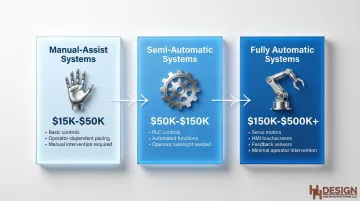
Each feature adds cost incrementally. Servo-driven systems carry higher upfront costs but offer high precision, energy efficiency (drawing power only when moving), and lower total cost of ownership compared to pneumatic systems, which require continuous compressed air and more frequent seal/valve maintenance.
Production Capacity and Throughput Requirements
Required output—bags per minute, pounds per hour, cycles per shift—drives both machine sizing and price. Over-sizing for theoretical peak demand versus actual average demand is a common and costly mistake.
Throughput benchmarks:
- Manual/Semi-Auto: 10-15 bags/hour for bulk applications
- Mid-Range Automatic: 20-30 bags/hour with consistent pacing
- High-Speed Automation: 30-35+ bags/hour for bulk; up to 24 bags/minute for small bag systems with high-speed net weighers
Higher throughput requires more robust engineering, faster actuation, and often automated conveyor systems to maintain pace. Material properties compound these requirements — what you're filling determines machine design just as much as how fast you need to fill it.
Material Type and Product Characteristics
The product being packaged — dry bulk powders, granules, chemicals, dairy, minerals — affects equipment design, material selection, and price.
Material considerations:
- Free-flowing granules work with gravity or vibratory fillers (lower cost)
- Fine powders require dust control and specialized sealing (moderate cost increase)
- Abrasive materials need hardened contact surfaces and reinforced construction (significant cost increase)
- Corrosive chemicals require 304 or 316 stainless steel rather than painted steel (substantial premium)
- Hygroscopic materials need specialized seals and environmental controls
Food-grade stainless steel construction with sanitary design features (smooth welds, no crevices, CIP capability) adds significant manufacturing hours and material costs compared to standard industrial builds.
Customization vs. Off-the-Shelf Configuration
Standard catalog equipment is lower cost but may not fit specific bag sizes, fill weights, or facility layouts. Custom-engineered systems are designed to spec for specific applications — built around your bag sizes, fill weights, and facility layout rather than forcing your process to fit a catalog design.
Custom builds incur non-recurring engineering (NRE) costs and extend delivery timelines, but they eliminate operational compromises and typically deliver better long-term ROI for non-standard applications. The upfront premium often reduces downstream costs.
Compliance, Safety, and Certification Requirements
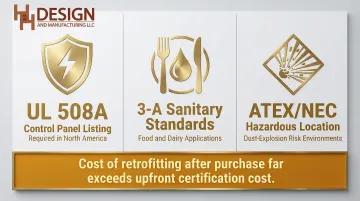
Certifications add to equipment cost but are non-negotiable for regulated industries:
- UL 508A listing for control panels (essential in North America)
- 3-A Sanitary Standards for food/dairy applications
- ATEX/NEC hazardous location ratings for dust-explosion risk environments
Equipment lacking proper certifications creates liability exposure and potential compliance failures. Retrofitting for compliance after purchase is far more expensive than specifying it upfront.
Complete Cost Breakdown: Beyond the Purchase Price
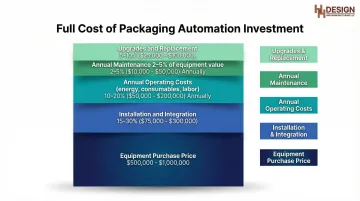
The sticker price represents only one layer of the total investment. Buyers who plan only around equipment cost routinely face budget surprises after purchase.
Initial Equipment Purchase
This is a one-time cost covering the machine or system itself.
Example ranges:
- Entry-level semi-automatic: $10,000–$40,000
- Mid-range automatic: $50,000–$150,000
- High-end integrated system: $200,000–$800,000
Getting itemized quotes—not ballpark figures—is essential for accurate budgeting. Quotes from manufacturers vary widely based on specifications.
Installation, Integration, and Commissioning
This one-time cost covers site preparation, mechanical installation, electrical work, control panel integration, line integration with existing equipment, and factory/field commissioning.
Typical cost: 15–30% of equipment purchase price. Complex integrations can push that higher.
For a $100,000 system, budget $15,000–$30,000 for professional installation and integration. Skipping this or attempting in-house installation without expertise often leads to performance issues and warranty complications.
Operating Costs
Ongoing operating costs cover three main categories:
- Energy consumption — Servo-driven systems can reduce energy use by up to 80% for specific functions compared to pneumatic systems, which lose efficiency through air leaks
- Consumables — Bags, liners, and seals are recurring line items that vary by throughput volume
- Operator labor — Well-automated systems reduce labor cost per unit over time; calculate this ROI before purchase, not after
Maintenance, Repairs, and Parts
Annual maintenance runs 2–5% of equipment value and covers scheduled preventive maintenance, wear part replacement (seals, belts, sensors), and unplanned repairs.
Two factors keep long-term maintenance costs down:
- Parts availability — Domestically manufactured equipment with local inventory avoids the delays and premiums that come with imported parts on long lead times
- Drive technology — Servo systems carry fewer wear parts than pneumatics, extending service intervals and reducing overall maintenance burden
Upgrades and End-of-Life Replacement
Periodic costs include software and firmware updates, capacity upgrades, control system modernization, and eventual machine replacement.
Modular systems built by manufacturers with long product support windows reduce these costs over the equipment's life. H&H Design Manufacturing, for instance, builds equipment that can be expanded with multi-unit integration and automation enhancements after initial installation — so the initial purchase doesn't become a ceiling on future capacity.
Low-Cost vs. High-Cost Packaging Automation: What's the Difference?
Price tier determines what you actually get in performance, durability, and long-term operating efficiency — not just the upfront cost.
| Feature | Budget / Entry-Level | Premium / High-End |
|---|---|---|
| Fill Accuracy | ±1-2% | ±0.5-1% |
| Throughput | Inconsistent, operator-dependent | Consistent, high-speed (30-35+ bags/hour) |
| Durability | Painted steel, pneumatic | Stainless steel, servo |
| Maintenance | Frequent seal/valve replacement | Minimal wear parts, longer MTBF |
| Changeover | Manual, tool-heavy | Tool-less, HMI-driven |
| Data Access | Basic counters | IIoT/OEE integration with ERP/SCADA |
| Service Life | 5-7 years typical | 10-15+ years with proper maintenance |
| Energy Costs | Higher (compressed air consumption) | Lower (servo efficiency) |
The lowest-cost option frequently results in the highest total cost of ownership due to more frequent downtime, shorter service life, higher maintenance needs, and lower throughput efficiency. Premium systems also protect against revenue loss from overfilling — tighter fill accuracy means less product giveaway (excess material dispensed beyond the target weight) on every bag.
The decision should be based on lifecycle cost, not purchase price alone. A budget machine may save $20,000 upfront, but higher energy costs, increased maintenance, and accumulated product giveaway can make it more expensive over a 5-year period.
How to Estimate the Right Budget for Packaging Automation Equipment
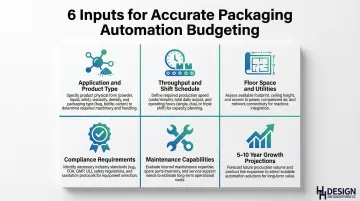
The right budget is one built around operational fit—not the cheapest option available or the most feature-rich system on the market. Six inputs should anchor every budget conversation:
- Application and product type — material characteristics (powder, granule, abrasive, corrosive), flow properties, bulk density, and dust control requirements
- Throughput and shift schedule — average bags/hour at realistic operating conditions, number of shifts per day, seasonal demand swings
- Floor space and utilities — ceiling height, electrical capacity (voltage/amperage), compressed air availability, and facility layout constraints
- Compliance requirements — food-grade or sanitary standards, hazardous location classifications, industry-specific regulations
- Maintenance capabilities — in-house technical expertise, spare parts strategy, and whether your team runs planned or reactive maintenance
- 5–10 year growth projections — expected volume increases, product line expansions, and your planned automation upgrade path
Working directly with an experienced equipment manufacturer during the scoping phase—rather than buying off a catalog—allows buyers to size the system accurately and avoid costly over- or under-specification. H&H Design Manufacturing offers collaborative scoping for custom applications, helping customers define the right system configuration before quoting.
What Most Buyers Miss When Budgeting for Packaging Automation
Focusing Only on the Purchase Price
The most common mistake is comparing equipment solely on sticker price without calculating total cost of ownership. This leads buyers toward cheaper systems that cost more to operate, maintain, and eventually replace.
Calculate TCO over 5 years: Purchase price + installation + (annual operating costs × 5) + (annual maintenance × 5) + expected downtime costs.
Underestimating Installation and Integration Costs
Site preparation, electrical work, and integration with upstream/downstream equipment can add 15–30% to the equipment cost, yet many buyers budget only for the machine itself.
Complex integrations involving existing ERP systems, multiple conveyor lines, or custom facility layouts can push installation costs even higher. Professional installation by the OEM ensures optimal setup and preserves warranty coverage.
Ignoring Compliance and Certification Costs
Equipment without proper certifications (UL control panel listing, food-grade standards, ATEX ratings) may require expensive retrofits or fail regulatory inspection, wiping out any apparent cost savings.
Retrofitting for Class II Division 1 compliance or food safety after purchase is far more expensive than specifying the right certifications upfront — so build that into your budget from the start.
Choosing Equipment That Doesn't Match the Application
Off-the-shelf systems designed for generic applications often underperform in specialized environments like dry bulk chemicals, abrasive minerals, or high-humidity dairy settings. The result: accelerated wear, frequent breakdowns, and costly workarounds that erode any upfront savings.
Custom-engineered equipment costs more upfront, but eliminates those compromises. For non-standard applications — dry bulk chemicals, abrasive minerals, high-humidity dairy — the premium typically pays for itself within 18–24 months through reduced downtime and higher throughput.
Frequently Asked Questions
How much does packaging automation equipment cost?
Costs range from roughly $10,000–$20,000 for basic semi-automatic equipment to $500,000+ for fully automated, custom-integrated industrial systems. The final cost depends heavily on automation level, throughput requirements, product characteristics, and customization needs.
What is the typical ROI timeline for packaging automation equipment?
Typical payback periods fall between 6 to 24 months for well-scoped systems. High-volume operations can see payback in under 18 months, driven primarily by labor cost reduction (40–80%), higher throughput, and reduced product loss from improved fill accuracy.
What's the cost difference between semi-automatic and fully automatic packaging equipment?
Semi-automatic systems generally cost $10,000–$40,000 but require more operator labor. Fully automatic systems carry higher initial costs ($50,000–$150,000+) but lower per-unit operating costs — the right fit for high-volume operations where labor savings quickly offset the capital investment.
Does custom-built packaging equipment cost more than off-the-shelf?
Custom-built equipment typically costs more upfront but delivers better long-term ROI for non-standard applications. It's engineered around your specific product, throughput, and facility — not the other way around.
What ongoing maintenance costs should I budget for packaging automation equipment?
Budget 2–5% of equipment value annually for maintenance. Domestically manufactured equipment with readily available parts tends to have lower and more predictable maintenance costs. Servo-driven systems require less maintenance than pneumatic systems, which need frequent seal and valve replacement.
What certifications should I look for when buying packaging automation equipment?
Key certifications to verify with any vendor:
- UL 508A — required for control panels in North America; confirms electrical safety and insurability
- 3-A Sanitary or FDA/USDA compliance — essential for food and dairy applications
- ATEX or NEC hazardous location ratings — required in chemical or mining environments with combustible dust risk
Ask vendors to confirm their shop holds the relevant certifications, not just that the equipment meets the standard.