Introduction
The wrong sugar packaging machine doesn't just underperform — it compounds costs. Inaccurate fills create product waste. Mismatched throughput forces line stoppages. Undersized systems require expensive retrofits the moment demand grows or your product mix changes.
Sugar packaging spans a wider range than most industries expect. Formats alone run from 1g single-serve sachets to 50kg wholesale bags to 1,500kg bulk containers. Product behavior varies just as much:
- Free-flowing granulated sugar moves easily through volumetric fillers
- Cohesive powdered sugar clumps and bridges without proper agitation
- Sticky brown sugar demands specialized handling to prevent buildup
Production volumes add another layer — small-batch artisan runs have almost nothing in common with high-speed industrial lines turning out thousands of bags per hour.
No single machine fits all these scenarios. Long-term ROI depends on matching equipment specifications to your product characteristics, production volume, and line integration requirements — not chasing the highest-speed or most feature-rich option available. The five tips below cut through the complexity.
Key Takeaways
- Sugar packaging machines automate filling, sealing, and labeling—ranging from sachet systems to bulk bag fillers
- Five factors drive the right choice: throughput, sugar type, format options (sachets to bulk bags), automation fit, and hygiene compliance
- Right-sized equipment for your operation consistently outperforms the fastest machine on paper
- When standard equipment falls short, custom-engineered systems from manufacturers like H&H Design Manufacturing are built to your exact process requirements
What Are Sugar Packaging Machines?
Sugar packaging machines are automated or semi-automated systems designed to measure, fill, seal, and output consumer- or industrial-ready sugar packages. These systems handle everything from retail sachets for coffee service to multi-ton bulk bags for industrial food processors.
The right machine type is determined by three factors: output bag size, packaging material, and production throughput.
Types of Sugar Packaging Machines
Vertical Form-Fill-Seal (VFFS) Machines
VFFS systems form bags from flat film rolls, fill them with product, and seal them in continuous vertical motion. They're the standard for small-to-medium retail formats, producing pillow bags, gusseted bags, and stand-up pouches. High-speed continuous motion models can reach up to 4,800 bags per hour, making them ideal for retail sugar packaging from 50g to 5kg.
Open-Mouth Bagging Machines
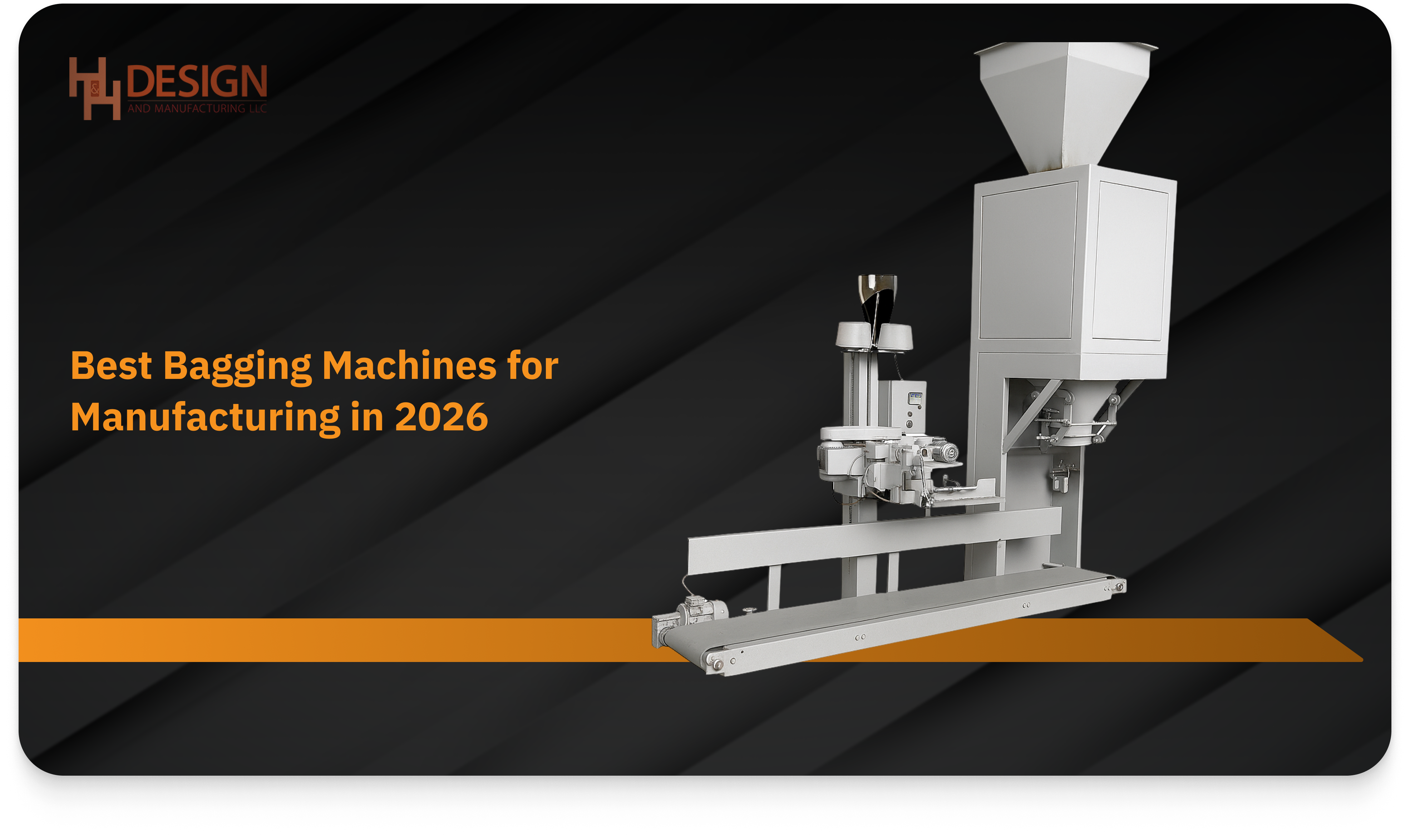
These systems fill pre-formed bags—the industry standard for medium-to-large wholesale formats. They position a pre-made bag under a filling spout, discharge the sugar, and seal the bag. Capacity ranges from 5kg to 50kg in multi-wall paper or woven polypropylene bags. Throughput spans from 150 bags per hour for semi-automatic systems to over 1,800 bags per hour for fully automatic lines.
Stick Pack Machines
Specialized multi-lane VFFS systems create narrow, tubular single-serve packets (1g to 10g) for hospitality, airlines, and coffee service. Multi-lane configurations can produce hundreds to thousands of sticks per minute, delivering extremely high throughput for convenience formats.
Big-Bag / FIBC Filling Systems
Flexible Intermediate Bulk Container (FIBC) fillers are purpose-built for industrial bulk transport, filling large woven sacks from 500kg to 1,500kg. These systems serve B2B supply chains moving sugar to food processors, bakeries, and beverage manufacturers.
Key Benefits of Sugar Packaging Automation
Switching from manual to automated packaging delivers measurable gains across four areas:
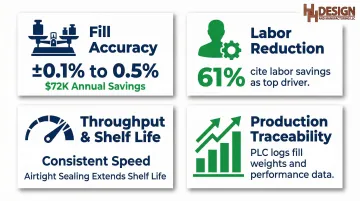
- Fill accuracy: Modern industrial weighers hit +/- 0.1% to 0.5% of target weight. A single gram of overfill per bag on a 60-bags-per-minute line costs over $72,000 annually for high-value specialty sugars — precision pays for itself.
- Labor reduction: 61% of packaging operations cite labor cost reduction as the top driver for automation. Bulk bag fillers can drop staffing from multiple operators to a single supervisor.
- Throughput and shelf life: Automated lines run at consistent speed without fatigue. Airtight sealing blocks moisture ingress in hygroscopic products (those that readily absorb moisture) like sugar, extending shelf life meaningfully.
- Production traceability: PLC-controlled systems log fill weights, throughput rates, and equipment performance in real time — giving quality teams the data needed for compliance and process improvement.
5 Expert Tips for Choosing the Right Sugar Packaging Machine
No two sugar packaging operations are identical. Product form, output volume, facility layout, and downstream logistics all shape which machine will actually perform — and which will create problems within a year. These five tips give you a systematic framework for evaluating your options against real business outcomes.
Tip 1: Match Machine Throughput to Your Production Volume
Throughput mismatch is the most common and costly error in equipment selection. An undersized machine creates bottlenecks that limit your ability to fulfill orders, forcing overtime and missed delivery windows. An oversized machine ties up capital unnecessarily and drives up energy costs while running at partial capacity.
Calculate your bags-per-hour or kg-per-hour requirements based on current production demand plus a realistic 3–5 year growth projection. Industry best practices suggest sizing equipment against this planning horizon to avoid premature replacement.
Throughput Benchmarks by Machine Category:
- Semi-automatic open-mouth baggers: 150–400 bags/hour
- Fully automatic open-mouth systems: 600–1,800+ bags/hour
- VFFS retail formats: 60–100+ bags/minute
- Stick pack multi-lane systems: 200–1,000+ sticks/minute
- FIBC/bulk bag fillers: 10–150 bags/hour
Semi-automatic systems require manual bag hanging and operator intervention, making them suitable for lower volumes or operations with readily available labor. Fully automatic systems — covering bag placing, filling, sealing, and discharge — require minimal supervision and deliver consistent throughput regardless of operator skill level.
Unplanned downtime on packaging lines can cost $15,000 to $20,000 per hour in lost production value. That makes right-sizing your machine one of the highest-ROI decisions in equipment planning.
Tip 2: Understand Your Sugar's Physical Characteristics
Granulated sugar, powdered sugar, raw sugar, and brown sugar behave completely differently in filling systems. Differences in particle size, moisture content, bulk density, and flowability directly affect the type of filling mechanism required.
Physical Properties by Sugar Type:
- Granulated sugar: Free-flowing with mean particle size around 286 µm; flows easily but can be abrasive
- Powdered/icing sugar: Highly cohesive with fine particles (~77 µm); poor flowability, prone to bridging in hoppers
- Raw/turbinado sugar: Coarser particles (~696 µm); generally free-flowing but with varying bulk densities
- Brown sugar: High moisture content makes it sticky and non-free-flowing
Filling Mechanism Compatibility:
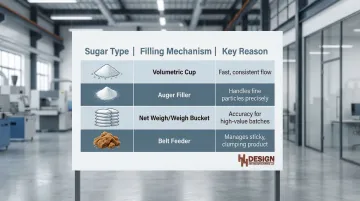
| Mechanism | Best For | Why |
|---|---|---|
| Volumetric cup | Granulated sugar | High speed and low cost for free-flowing, consistent-density products |
| Auger filler | Powdered/icing sugar | Positive displacement screw forces non-free-flowing powders through funnel, preventing bridging |
| Net weigh/weigh bucket | Bulk/high-value sugar | Weighs product before filling for high accuracy and speed |
| Belt feeder | Brown sugar | Handles sticky materials that would clog augers or gravity gates |
Risks of Incompatible Mechanisms
Using the wrong filling technology creates expensive downstream problems:
- Auger bridging with coarse granules causes flow interruptions and inconsistent fills
- Electrostatic clumping with fine powders makes product cling to tubes and seals
- Inaccurate fills when bulk density fluctuates cause giveaway or underfill violations
- Rework costs from rejected bags erode automation gains
Verify that your equipment supplier has experience with your specific sugar type and can demonstrate fill accuracy with your actual product during testing.
Tip 3: Evaluate Packaging Format and Bag Size Flexibility
Format flexibility is a strategic asset, especially for producers serving multiple retail channels — single-serve sachets, 1kg retail bags, and 25kg wholesale sacks. Machines locked into one format limit market responsiveness and force you to maintain multiple lines for different SKUs.
Key Flexibility Features:
Adjustable Jaw Widths and Quick-Change Tooling
Modern VFFS machines with quick-change modules can perform 3D format changes (pillow bag to block bottom, for example) in as little as 5 to 45 minutes. Open-mouth baggers with adjustable bag carriages accommodate different heights and widths without major mechanical changes.
Film and Material Compatibility
- Woven polypropylene: Standard for 5kg–50kg bulk bags due to durability and moisture resistance
- Multilayer laminates: Essential for retail pouches requiring moisture and oxygen barriers
- Paper: Multi-wall paper bags common for 1kg–5kg retail formats
Verify that your machine can handle the specific film types and thicknesses required for your product's shelf-life requirements.
Reducing changeover time often unlocks more capacity than minor speed increases. Track actual switchover time between formats and factor this into your overall equipment effectiveness (OEE) calculations. Systems requiring more than 30 minutes for format changes create significant production losses in operations running multiple SKUs.
Tip 4: Assess Automation Level and Integration with Your Packaging Line
Format flexibility only delivers value when your machine fits cleanly into the broader line. A sugar packaging machine must integrate with upstream feeders, conveyors, and hoppers, as well as downstream equipment like shrink wrappers, case packers, and palletizers. Poor integration creates manual intervention points that erode the gains automation was supposed to deliver.
Critical Integration Questions:
Control System Compatibility
- Does the machine use a PLC with open communication protocols (EtherNet/IP, Modbus, Profibus)?
- Can the control system interface with your existing plant SCADA or ERP for production tracking?
- Are recipe management and changeover instructions stored in the PLC for quick product switches?
Standardized interfaces like PackML simplify integration of machines from different OEMs, reducing commissioning time and ongoing maintenance complexity.
The Cost of Manual Intervention
Human data entry error rates sit between 1% and 4%, and on high-speed lines that margin compounds quickly. Automated data capture — tied directly to your PLC or SCADA — eliminates transcription errors and gives you accurate production records without adding headcount.